
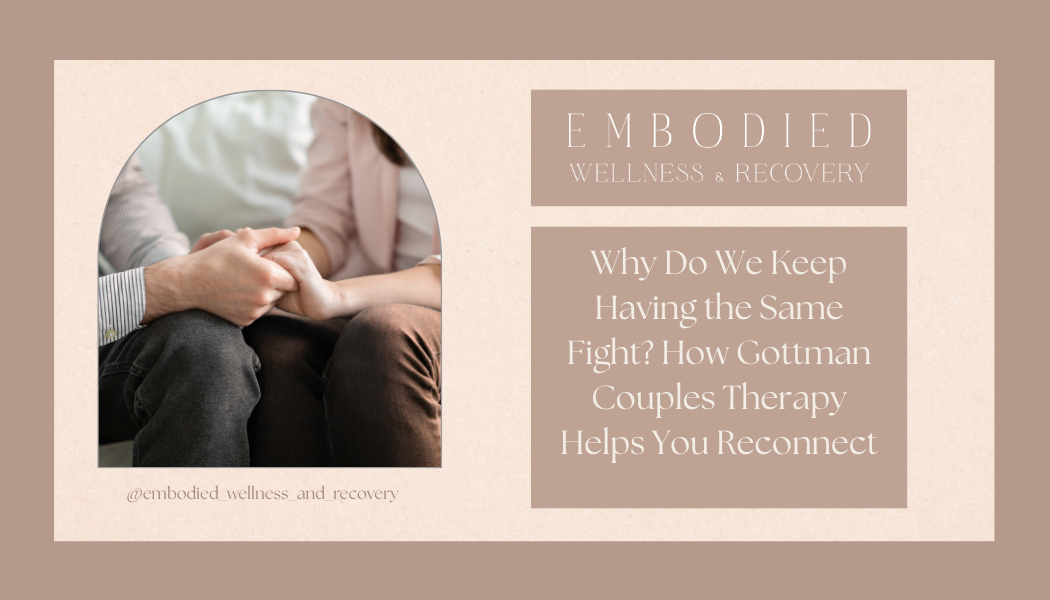
Why Do We Keep Having the Same Fight? How Gottman Couples Therapy Helps You Reconnect
Why Do We Keep Having the Same Fight? How Gottman Couples Therapy Helps You Reconnect
Stuck in the same arguments? Learn how Gottman couples therapy helps improve communication, manage conflict, and rebuild trust and emotional intimacy.
The argument starts with dishes, spending, or another evening spent looking at separate screens. Within minutes, you are defending yourself against accusations you have heard before. You explain harder. Your partner withdraws further. Eventually, someone apologizes or changes the subject. But nothing feels resolved.
Why do we keep having the same fight? Why does my partner shut down when I need reassurance? How can we love each other and still feel so misunderstood?
Recurring relationship conflict can leave couples exhausted and uncertain about their future. Gottman couples therapy offers practical ways to understand the pattern, communicate differently, and rebuild connection.
Why Couples Keep Having the Same Arguments
Repeated arguments often involve an unresolved emotional meaning beneath the immediate problem. A disagreement about household responsibilities may carry the question, “Can I depend on you?” Conflict about sex may involve fears of rejection, pressure, or inadequacy. An argument about money may reflect different needs for security and independence.
Consider this cycle: One partner feels overlooked and protests. The other hears criticism and becomes defensive. The first escalates to get a response. The second withdraws to escape the tension. Each person’s attempt to protect themselves intensifies the other’s distress.
Gottman and Levenson’s (1992) longitudinal research linked patterns of marital interaction and physiology with later relationship outcomes. Their findings helped establish that understanding conflict requires attention to both behavior and bodily responses. These associations do not determine any individual couple’s future. PubMed
What Is Gottman Couples Therapy?
Developed by John and Julie Gottman, the Gottman Method combines relationship assessment with structured interventions addressing friendship, conflict management, and shared meaning. Couples learn to recognize destructive interactions, express needs more clearly, and respond to everyday opportunities for connection. Treatment aims to increase respect, affection, and intimacy while helping partners navigate differences (The Gottman Institute, n.d.-b).
Does Gottman therapy work? Research offers encouraging findings, with limitations. In a small study involving 16 Iranian couples, participants receiving Gottman couple therapy showed improvements in marital adjustment and intimacy compared with a control group. The small sample and specific cultural setting limit generalization (Davoodvandi et al., 2018).
Five Ways Gottman Therapy Helps You Reconnect
1. Recognize the Four Horsemen
The Gottman framework identifies four damaging communication patterns: criticism, contempt, defensiveness, and stonewalling. Its corresponding skills include gentle complaints, appreciation, taking responsibility, and physiological self-soothing (The Gottman Institute, n.d.-a).
What happens when “You never help” becomes “I’m overwhelmed and need help cleaning up tonight”?
The concern remains clear, but the request gives your partner something specific to respond to. Therapy helps couples practice these changes without requiring either person to suppress legitimate frustration.
2. Notice Emotional Flooding Before Escalation
Does your heart race during conflict? Do you lose your words, feel trapped, or feel an urgent need to leave?
Gottman describes overwhelming physiological arousal during conflict as flooding. Learning to recognize it helps couples decide when to pause instead of continuing an increasingly unproductive conversation.
The Gottman approach recommends a self-soothing break of at least 20 minutes. Agreeing on a return time helps distinguish a constructive pause from indefinite withdrawal. Individual settling times vary. A useful starting point: “I want to understand you, and I’m too overwhelmed right now. Let’s take a break and return at 7:30.”
3. Understand the Need Beneath the Complaint
Before responding to an accusation, ask: What matters so much about this issue?
Try asking yourself:
— What am I afraid my partner’s behavior means?
— What do I need them to understand?
— What specific change would help?
“I need more notice when plans change” is easier to address than “You don’t care about me.”
Understanding a partner’s experience does not require agreeing with every interpretation. It creates room for a more useful conversation.
4. Practice Repair After Disconnection
Couples need ways to recover when conversations go poorly. A repair might sound like, “That came out harshly. Let me try again,” or “I understand why that hurt. I want to take responsibility for my part.”
The Gottman Method includes interventions that help couples repair conflict and strengthen their friendship (The Gottman Institute, n.d.-b). A meaningful apology becomes more credible when followed by observable change. Repeated reassurance without follow-through can deepen disappointment.
5. Rebuild Connection Outside Arguments
When did you last feel curious about your partner rather than frustrated with them? The Gottman approach encourages partners to strengthen friendship and respond to bids for connection, such as a question, shared observation, or request for attention.
Connection also has a neurobiological dimension. In an fMRI study of 16 married women anticipating electric shock, holding a spouse’s hand reduced activity in neural systems associated with threat responding (Coan et al., 2006). This laboratory finding supports the importance of supportive relationships, but does not establish that touch resolves conflict or is welcome in every moment.
A Path Toward Greater Trust and Intimacy
At Embodied Wellness and Recovery, our expertise spans trauma, nervous system regulation and repair, relationships, sexuality, and intimacy, We integrate relationship skills with attention to attachment wounds, bodily responses, and the experiences shaping each partner’s reactions.
For couples experiencing coercive control or fear of retaliation, safety and individual assessment take priority over communication exercises. For many couples, progress begins with a manageable change: noticing escalation earlier, making one clearer request, or returning to a conversation with greater care.
You do not have to resolve every difference to build a more connected relationship. You can learn to approach those differences with curiosity, accountability, and mutual respect.
Explore couples therapy at Embodied Wellness and Recovery.
Contact us today to schedule a free 20-minute consultation with our team of somatic practitioners, trauma specialists, and relationship experts and begin your journey toward embodied connection with yourself and others.
📞 Call us at (310) 651-8458
📱 Text us at (310) 210-7934
📩 Email us at admin@embodiedwellnessandrecovery.com
🔗 Visit us at www.embodiedwellnessandrecovery.com
👉 Check us out on Instagram @embodied_wellness_and_recovery
🌍 Explore our offerings at Linktr. ee: https://linktr.ee/laurendummit
References
Coan, J. A., Schaefer, H. S., & Davidson, R. J. (2006). Lending a hand: Social regulation of the neural response to threat. Psychological Science, 17(12), 1032–1039.
Davoodvandi, M., Navabi Nejad, S., & Farzad, V. (2018). Examining the effectiveness of Gottman couple therapy on improving marital adjustment and couples’ intimacy. Iranian Journal of Psychiatry, 13(2), 135–141.
Gottman, J. M., & Levenson, R. W. (1992). Marital processes predictive of later dissolution: Behavior, physiology, and health. Journal of Personality and Social Psychology, 63(2), 221–233.
The Gottman Institute. (n.d.-a). The four horsemen: The antidotes.
The Gottman Institute. (n.d.-b). The Gottman method.
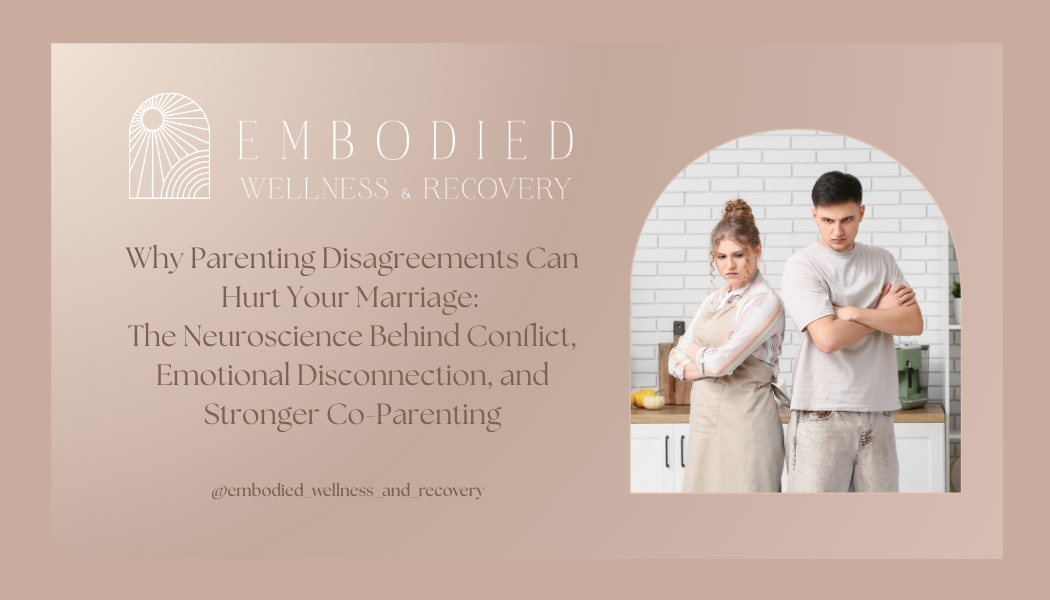
Why Parenting Disagreements Can Hurt Your Marriage: The Neuroscience Behind Conflict, Emotional Disconnection, and Stronger Co-Parenting
Why Parenting Disagreements Can Hurt Your Marriage: The Neuroscience Behind Conflict, Emotional Disconnection, and Stronger Co-Parenting
Parenting disagreements can quietly erode trust, intimacy, and marital satisfaction. Learn how different parenting styles affect your relationship, what neuroscience reveals about conflict, and how couples can reconnect through emotional safety and teamwork.
Few experiences transform a relationship as profoundly as becoming parents. Children bring joy, purpose, laughter, and a love unlike anything many couples have ever experienced. They also introduce one of the most common sources of marital conflict: disagreements about parenting.
Should you be stricter?
Should you be more flexible?
Is your child too young for a smartphone?
Should consequences be immediate or natural?
How much independence is appropriate?
How should bedtime, screen time, homework, discipline, or emotional expression be handled?
While these conversations may appear to be about parenting, they often become something much deeper. They become conversations about values, trust, respect, safety, identity, and partnership.
Perhaps you've found yourself wondering:
Why do we argue so much about parenting?
Why does it feel like we're on opposite teams?
Why do I feel criticized every time I parent our child?
Why does my partner undermine me in front of the kids?
Why do I feel more like a co-manager than a spouse?
If these questions feel familiar, you're far from alone. Parenting disagreements are among the most common concerns addressed in couples counseling, particularly during the early years of raising children. Research consistently shows that conflict surrounding parenting can reduce relationship satisfaction and increase stress for both partners and children (Kopystynska et al., 2022).
The encouraging news is that disagreement does not mean your relationship is failing. More often, it reflects two people trying to protect what matters most through different lenses.
Parenting Styles Are Shaped Long Before Parenthood
Many couples assume parenting disagreements begin after children arrive. In reality, they often begin decades earlier. Each partner enters parenthood carrying an invisible blueprint shaped by childhood experiences, attachment relationships, cultural values, family traditions, and previous life experiences.
Perhaps one partner grew up in a home with firm rules and clear expectations. The other may have experienced highly permissive parenting. One may have been criticized frequently. The other may have wished for more structure. Without realizing it, each person often believes their parenting approach feels "normal." When these different blueprints collide, conflict naturally follows.
Why Parenting Conflict Feels So Personal
From a neuroscience perspective, parenting activates some of our deepest emotional and biological systems. Protecting children is closely tied to survival. When a partner questions our parenting decisions, the brain may interpret the disagreement as more than simple feedback.
It may perceive criticism, rejection, failure, or threat. The amygdala, the brain's threat detection center, becomes increasingly active. Stress hormones rise. The nervous system shifts toward protection rather than collaboration. Instead of listening with curiosity, partners often become defensive, critical, or emotionally withdrawn.
The conversation quickly changes from:
"How should we handle this?"
To:
"Why don't you trust me?"
The Hidden Cost of Parenting Disagreements
When unresolved parenting conflict continues over months or years, many couples notice subtle changes in their relationship. They communicate less. Affection decreases. Conversations revolve entirely around logistics. Date nights disappear. Resentment quietly accumulates. Partners begin feeling less like romantic companions and more like coworkers managing a demanding project.
Some describe becoming roommates who happen to share children. These patterns rarely develop because couples stop loving one another. They develop because chronic stress consumes the emotional energy that once nourished the relationship.
Children Benefit When Parents Feel Emotionally Safe
Many parents focus understandably on creating emotional safety for their children. Less attention is often given to emotional safety between the adults. Yet children are remarkably sensitive to the emotional climate of the home. When parents consistently criticize, dismiss, or undermine one another, children often experience increased stress, even if the arguments are never directed at them.
Conversely, when children observe respectful disagreement, collaborative problem-solving, and healthy repair, they learn valuable relationship skills. One of the greatest gifts parents can offer their children is not perfect agreement. It is demonstrating how loving adults navigate differences with respect and compassion.
Trauma Can Shape Parenting Without You Realizing It
Trauma does not simply influence how we respond to danger. It can also shape how we respond to everyday parenting situations. A parent who experienced harsh punishment may avoid discipline altogether. Someone who grew up in an unpredictable home may become highly controlling in an effort to create stability.
A parent who rarely felt emotionally seen may become deeply distressed when their child experiences disappointment. These reactions are understandable. The nervous system often attempts to protect children from experiences we ourselves found painful. Sometimes those protective instincts are incredibly helpful. Other times, they create conflict between partners whose nervous systems respond to different histories. Understanding these patterns often replaces blame with empathy.
Your Child Is Not the Problem
Couples frequently enter therapy believing their child's behavior is the primary issue. Sometimes the greater challenge lies in how stress affects the relationship between the parents. Children naturally test limits, express emotions, seek independence, and make mistakes.
What predicts long-term family resilience is not the absence of parenting challenges. It is the parents' ability to remain emotionally connected as they face those challenges together. When couples shift from "my parenting versus your parenting" to "our shared parenting," conflict often becomes less adversarial and far more collaborative.
From Opponents to Partners
Healthy parenting does not require identical parenting styles. It requires shared values, respect, curiosity, flexibility, and a willingness to understand why your partner responds the way they do.
Instead of asking:
"Why are you parenting like that?"
Consider asking:
"What experience taught you this was the safest way to respond?"
That single question often transforms criticism into understanding.
How Couples Counseling Helps
At Embodied Wellness and Recovery, we understand that parenting disagreements are rarely about discipline alone. They often reflect attachment histories, trauma responses, nervous system activation, communication patterns, and unmet emotional needs.
Using neuroscience-informed, trauma-informed, and attachment-based approaches, we help couples strengthen emotional safety while learning practical strategies for collaborative parenting. Rather than determining which parent is "right," therapy helps partners understand each other's perspectives, regulate conflict more effectively, communicate with greater empathy, and rebuild the sense of teamwork that children thrive upon.
Navigating Differences While Maintaining Connection
Every couple will disagree about parenting at times. The goal is not eliminating differences. The goal is learning how to navigate those differences without sacrificing trust, intimacy, or emotional connection. When partners begin understanding the neuroscience behind parenting conflict, they often discover that they are not standing on opposite sides after all.
They are two loving parents whose brains, histories, and nervous systems are trying to protect the same precious people in different ways. The strongest families are not those without disagreement. They are those in which parents repeatedly choose curiosity over criticism, collaboration over competition, and connection over the need to be right. Those choices strengthen not only the parenting partnership but also the marriage at the heart of the family.
Reach out to schedule a complimentary 20-minute consultation with our team of therapists, trauma specialists, somatic practitioners, or relationship experts and start working towards integrative, embodied healing today.
📞 Call us at (310) 651-8458
📱 Text us at (310) 210-7934
📩 Email us at admin@embodiedwellnessandrecovery.com
🔗 Visit us at www.embodiedwellnessandrecovery.com
👉 Check us out on Instagram @embodied_wellness_and_recovery
🌍 Explore our offerings at Linktr.ee: https://linktr.ee/laurendummit
References
Belsky, J. (1984). The determinants of parenting: A process model. Child Development, 55(1), 83-96.
Cowan, P. A., & Cowan, C. P. (2019). Becoming parents: Supporting couples through the transition to parenthood (2nd ed.). Routledge.
Feinberg, M. E. (2003). The internal structure and ecological context of coparenting: A framework for research and intervention. Parenting: Science and Practice, 3(2), 95-131.
Gottman, J. M., & Silver, N. (2015). The seven principles for making marriage work (Revised ed.). Harmony Books.
Gottman, J. S., & Gottman, J. (2024). Fight right: How successful couples turn conflict into connection. Harmony.
Kopystynska, O., Mueller, J., Bradford, K., Chandler, A. B., Foran, H. M., & Higginbotham, B. J. (2022). The influence of interparental conflict and violence on parenting and parent–child relationships. Personal Relationships, 29(3), 488-523.
Porges, S. W. (2022). Polyvagal theory: A science of safety. Frontiers in Integrative Neuroscience, 16, 871227.
Schore, A. N. (2019). Right brain psychotherapy. W. W. Norton & Company.
Siegel, D. J. (2020). The developing mind: How relationships and the brain interact to shape who we are (3rd ed.). Guilford Press.
van der Kolk, B. A. (2014). The body keeps the score: Brain, mind, and body in the healing of trauma. Viking.
Walsh, F. (2016). Strengthening family resilience (3rd ed.). Guilford Press.

Financial Infidelity: Why Couples Hide Money From Each Other and How Betrayal Changes the Brain
Financial Infidelity: Why Couples Hide Money From Each Other and How Betrayal Changes the Brain
Discover why financial infidelity can feel as devastating as other forms of betrayal. Learn the neuroscience behind financial betrayal, hidden spending, secret debt, and broken trust, and how couples counseling can help partners rebuild emotional safety and connection.
For many couples, the most painful betrayal isn't an affair. It's discovering that the person they trusted most has been hiding money.
A secret credit card.
Hidden debt.
Undisclosed gambling.
Large purchases that were never mentioned.
A separate bank account.
A concealed investment.
A financial decision that affects both partners but was made in secret.
In an instant, the conversation shifts from finances to something much deeper.
Perhaps you've found yourself asking:
Why would they hide this from me?
If they lied about money, what else have they lied about?
Can I ever trust them again?
Was our entire financial future built on deception?
How could someone who says they love me keep such a significant secret?
These questions are deeply understandable. Financial infidelity often creates emotional wounds that extend far beyond dollars and cents. Many people describe the experience as profoundly disorienting because it challenges not only their financial security but also their sense of emotional safety within the relationship. Understanding why financial infidelity happens and how it affects the brain can help couples move beyond blame toward deeper understanding and meaningful repair.
What Is Financial Infidelity?
Financial infidelity occurs when one partner intentionally conceals financial information, behaviors, or decisions that would likely affect the other partner or the relationship.
Examples may include:
— Secret credit cards
— Hidden bank accounts
— Concealed debt
— Undisclosed loans
— Gambling losses
— Hidden investments
— Secret purchases
— Lying about income
— Withholding financial information
— Providing inaccurate information about spending
Not every private purchase constitutes financial infidelity. The defining characteristic is deception. When one partner knowingly withholds important financial information that would reasonably influence shared decisions, trust begins to erode.
Why Financial Betrayal Hurts So Much
Many people feel surprised by the intensity of their emotional response.
They may think:
"Why does this feel almost like an affair?"
From a neuroscience perspective, the answer is understandable. Trust forms one of the brain's primary foundations for safety. Healthy relationships allow the nervous system to predict that a partner is dependable, honest, and emotionally available.
When that expectation is suddenly violated, the brain experiences a profound mismatch between expectation and reality. The person who once represented safety now feels unpredictable. That shift can activate many of the same survival systems involved in other forms of interpersonal betrayal.
Betrayal Changes the Way the Brain Processes Information
When financial deception is discovered, many individuals experience intense emotional and physiological reactions.
They may notice:
— Difficulty sleeping
— Obsessively reviewing financial records
— Constantly replaying conversations
— Increased anxiety
— Emotional numbness
— Difficulty trusting their own judgment
These reactions are not signs of weakness. They are common responses to betrayal. The brain begins searching for additional information to restore a sense of certainty and safety.
Many people repeatedly ask themselves:
"How did I miss this?"
"Were there signs I ignored?"
"What else don't I know?"
The nervous system is attempting to answer one essential question:
"Am I actually safe?"
Why People Hide Money
While every situation is unique, financial infidelity is rarely motivated by a single factor. Sometimes people hide money because they fear conflict. Others fear judgment. Some experience deep shame about debt or financial mistakes.
Others struggle with compulsive spending or gambling. Still others learned early in life that discussing money leads to criticism, punishment, or emotional pain. For some individuals, secrecy became a survival strategy long before the current relationship began. Understanding these underlying dynamics does not excuse deception. However, it often helps explain why otherwise caring people make choices that ultimately damage trust.
Childhood Experiences Shape Adult Financial Behavior
Our relationship with money often begins long before we earn our first paycheck. Some individuals grew up watching their parents argue constantly about finances. Others experienced chronic financial instability.
Some were taught that money determined personal worth. Others learned that discussing finances was dangerous or shameful. Still others experienced caregivers who hid financial information from one another.
These early experiences become part of the brain's internal blueprint for managing money, conflict, and security. As adults, those patterns may quietly reappear in intimate relationships. Someone who experienced financial instability may secretly save money because uncertainty feels intolerable. Someone raised in a highly critical environment may hide purchases out of fear of disapproval. Someone whose family avoided discussing finances may continue avoiding difficult conversations with their partner.
These behaviors often represent attempts to regulate anxiety rather than intentional efforts to harm a relationship. Unfortunately, secrecy almost always creates greater pain over time.
Financial Infidelity Is Often About Emotional Safety
Couples frequently believe financial deception stems from greed or irresponsibility. Sometimes it does. More often, however, it reflects a nervous system attempting to avoid emotional discomfort.
Avoiding shame.
Avoiding conflict.
Avoiding rejection.
Avoiding disappointment.
Avoiding vulnerability.
Ironically, the very strategy intended to preserve the relationship often becomes the source of its greatest injury. Short-term emotional relief creates long-term relational damage.
When Financial Betrayal Activates Old Trauma
For individuals with histories of trauma, financial infidelity may feel especially overwhelming. Previous experiences involving abandonment, betrayal, emotional neglect, childhood instability, or broken trust can become reactivated. The present moment begins to merge with earlier experiences.
Someone may think:
"This always happens to me."
"I can't trust anyone."
"I'm never safe."
These beliefs often emerge because the brain stores emotionally significant experiences in ways that influence future expectations. Current betrayal may awaken emotional memories that have remained dormant for years. Understanding this process can help individuals respond with greater self-compassion while seeking the support needed to heal.
Financial Infidelity Often Impacts Emotional and Physical Intimacy
Trust is one of the strongest predictors of emotional closeness. When trust is damaged, intimacy often changes as well.
Many couples notice:
— Less affection
— Reduced emotional openness
— Increased conflict
— Less laughter
— More emotional distance
— Decreased sexual desire
— Difficulty feeling emotionally safe together
From a neuroscience perspective, this makes sense. The nervous system prioritizes protection before connection. When betrayal activates the brain's threat response, it becomes much more difficult to experience curiosity, vulnerability, and sexual intimacy. The relationship begins operating from self-protection rather than emotional closeness.
The encouraging news is that trust can often be rebuilt when both partners are willing to understand the deeper patterns that contributed to the deception and commit to a process of honest repair.
Can Trust Be Rebuilt After Financial Infidelity?
One of the first questions many couples ask after discovering financial deception is:
"Can we recover from this?"
The answer depends less on the size of the financial loss and more on what happens after the truth is revealed. Trust is not rebuilt through promises alone. The brain requires consistent evidence that the relationship has become emotionally and physically safe again.
Just as trust develops through repeated experiences of honesty and reliability, it is restored through repeated experiences of transparency, accountability, and emotional responsiveness. Repair is a process. Not a single conversation.
Why Transparency Matters
After financial betrayal, the injured partner's brain often becomes hypervigilant.
Many people feel compelled to:
— Review bank statements repeatedly.
— Monitor spending.
— Verify financial information.
While these behaviors may seem excessive, they often reflect the nervous system's attempt to restore predictability after trust has been disrupted. Transparency helps calm this uncertainty.
For the partner who engaged in financial deception, transparency may include:
— Full disclosure of all financial accounts.
— Honestconversations about debt, spending, or investments.
— Sharing passwords when mutually agreed upon.
— Developing joint financial plans.
— Communicating before making significant financial decisions.
— Answering questions with patience rather than defensiveness.
Transparency is not about punishment. It is about providing the brain with new experiences that gradually restore a sense of safety.
Accountability Is Different From Shame
Many individuals who commit financial infidelity experience profound shame.
Shame often sounds like:
"I'm a terrible person."
"I've ruined everything."
"There's no point in trying."
While understandable, shame rarely promotes lasting change. It often encourages withdrawal, secrecy, and avoidance. Accountability sounds different.
It says:
"I understand how my actions affected you."
"I'm willing to answer difficult questions."
"I want to understand why I made these choices."
"I'm committed to rebuilding trust through consistent actions."
Accountability creates opportunities for repair. Shame often keeps couples stuck.
Understanding the Nervous System of the Injured Partner
For the partner who experienced financial betrayal, healing rarely follows a straight line. One day, they may feel hopeful. The next day, they may feel overwhelmed by fear or anger. This fluctuation is common. The brain continues evaluating whether the relationship is safe enough to trust again.
Questions frequently arise:
"Is this really over?"
"Could it happen again?"
"Can I believe what I'm hearing?"
Rather than viewing these reactions as irrational, it can be helpful to understand them as the nervous system gathering new evidence before relaxing its protective responses. Healing often occurs gradually through repeated experiences of honesty, consistency, and emotional presence.
The Role of Compassion
Compassion does not require minimizing harmful behavior. Nor does it require immediate forgiveness. Instead, compassion allows couples to remain curious about the deeper factors that contributed to the deception while still holding one another accountable. Often, financial infidelity reflects unresolved fears, attachment wounds, compulsive behaviors, perfectionism, or deeply ingrained beliefs about money. Addressing these underlying issues reduces the likelihood that similar patterns will reappear.
Rebuilding Emotional Safety
Financial recovery and relational recovery are not always the same process. A couple may successfully eliminate debt while still feeling emotionally distant. Conversely, couples may still face financial challenges as they develop a stronger, more secure relationship.
Emotional safety grows when partners consistently demonstrate:
— Honesty.
— Reliability.
— Curiosity.
— Empathy.
— Respect.
— Accountability.
— Emotional responsiveness.
These experiences gradually teach the nervous system that vulnerability can once again exist alongside connection.
Practical Strategies for Couples
Although every relationship is different, several practices can support recovery after financial betrayal.
Schedule Regular Financial Conversations
Rather than discussing money only during moments of crisis, establish predictable check-ins where both partners can openly discuss goals, concerns, and progress. Predictability reduces anxiety.
Practice Emotional Regulation Before Financial Discussions
If either partner becomes emotionally overwhelmed, pause the conversation. A regulated nervous system is better equipped for thoughtful communication than one operating from survival mode.
Explore the Meaning Behind Financial Behaviors
Instead of asking only:
"What did you do?"
Also ask:
"What were you feeling?"
"What were you afraid might happen?"
Understanding motivation helps create insight without excusing harmful behavior.
Create Shared Financial Goals
Working toward common goals shifts the focus from past mistakes to future collaboration.
Couples begin seeing themselves as teammates rather than adversaries.
How Couples Counseling Helps
Financial infidelity rarely improves through budgeting alone. Because trust, attachment, trauma, and nervous system regulation are deeply involved, many couples benefit from professional guidance.
At Embodied Wellness and Recovery, we understand that financial betrayal affects far more than finances. It impacts emotional safety, identity, attachment, sexuality, and the nervous system. Using trauma-informed, neuroscience-based, and attachment-focused approaches, we help couples:
— Understand the emotional meaning beneath financial conflict.
— Address betrayal trauma.
— Reduce chronic hypervigilance.
— Improve emotional regulation.
— Strengthen communication.
— Restore emotional and physical intimacy.
— Develop healthier financial transparency.
— Rebuild trustthrough consistent, meaningful repair.
Rather than focusing solely on the financial behavior itself,therapy explores the underlying patterns that contributed to the deception and helps both partners develop new ways to create safety together.
Finding Relational Security Again
Financial infidelity is rarely about money alone. It is about trust.
Safety.
Vulnerability.
Partnership.
When deception enters a relationship, the brain naturally becomes more vigilant, searching for certainty and protection. Although that process can feel overwhelming, it also reminds us how deeply human our need for trust truly is.
Relationships are strengthened not because mistakes never occur, but because partners become willing to respond to those mistakes with honesty, accountability, curiosity, and compassion. Trust is rebuilt one conversation, one transparent decision, one consistent action at a time.
Over time, those moments become new evidence for the brain that connection can once again feel secure. Financial honesty is ultimately about much more than balancing accounts. It is about creating a relationship where both partners feel safe enough to build a future together.
Reach out to schedule a complimentary 20-minute consultation with our team of therapists, trauma specialists, somatic practitioners, or relationship experts and start working towards integrative, embodied healing today.
📞 Call us at (310) 651-8458
📱 Text us at (310) 210-7934
📩 Email us at admin@embodiedwellnessandrecovery.com
🔗 Visit us at www.embodiedwellnessandrecovery.com
👉 Check us out on Instagram @embodied_wellness_and_recovery
🌍 Explore our offerings at Linktr.ee: https://linktr.ee/laurendummit
References
American Psychological Association. (2023). Stress in America™ 2023: A nation recovering from collective trauma.
Archuleta, K. L., Grable, J. E., & Britt, S. L. (2013). Financial and relationship satisfaction as a function of harsh start-up and shared goals. Journal of Financial Therapy, 4(1), 1-19.
Conger, R. D., Conger, K. J., & Martin, M. J. (2010). Socioeconomic status, family processes, and individual development. Journal of Marriage and Family, 72(3), 685-704.
Falconier, M. K., Jackson, J. B., Hilpert, P., & Bodenmann, G. (2015). Dyadic coping and relationship satisfaction: A meta-analysis. Clinical Psychology Review, 42, 28-46.
Gottman, J. M., & Silver, N. (2015). The seven principles for making marriage work (Revised ed.). Harmony Books.
Gottman, J. S., & Gottman, J. (2024). Fight right: How successful couples turn conflict into connection. Harmony.
Knapp, P., & Lott, B. (2010). Money and relationships: Seven essential tools for healthy finances and better communication. New Harbinger Publications.
Porges, S. W. (2022). Polyvagal theory: A science of safety. Frontiers in Integrative Neuroscience, 16, 871227.
Slepian, M. L., Moulton-Tetlock, E., Greenaway, K. H., & Bastian, B. (2023). Keeping secrets and the burden of concealment. Current Directions in Psychological Science, 32(1), 18-24.
Siegel, D. J. (2020). The developing mind: How relationships and the brain interact to shape who we are (3rd ed.). Guilford Press.
van der Kolk, B. A. (2014). The body keeps the score: Brain, mind, and body in the healing of trauma. Viking.