
Why Do I Never Feel Good Enough? How Childhood Trauma Creates Low Self-Esteem, Chronic Self-Doubt, and Conditional Self-Worth
Why Do I Never Feel Good Enough? How Childhood Trauma Creates Low Self-Esteem, Chronic Self-Doubt, and Conditional Self-Worth
Why do you never feel good enough? Learn how childhood trauma, emotional neglect, criticism, and conditional love can create low self-esteem, chronic self-doubt, perfectionism, and difficulty recognizing your own worth.
You can be successful and still feel inadequate. You can receive a compliment and immediately dismiss it. You can accomplish something remarkable and, within minutes, begin thinking about what you should have done better. You can be loved and still quietly wonder when someone will discover that you are not quite as worthy as they think.
If this sounds familiar, you may have spent years trying to build self-esteem by becoming more accomplished, attractive, helpful, productive, successful, or desirable. But what if the problem isn't that you haven't done enough to feel good about yourself? What if you learned very early that being “good enough” was something you had to earn?
For many adults struggling with low self-esteem, chronic self-doubt, perfectionism, and feelings of inadequacy, the roots extend far beyond confidence. Childhood trauma, emotional neglect, criticism, comparison, conditional love, and unpredictable caregiving can profoundly influence how we learn to understand our own worth.
Where Does the Feeling of “Not Good Enough” Come From?
Children do not develop their sense of self in isolation. We initially learn who we are through relationships. When caregivers consistently communicate warmth, interest, emotional attunement, protection, and acceptance, children gradually internalize an important message:
“I matter because I exist.”
But what happens when love or attention feels conditional?
Maybe you received affection when you performed well but criticism when you struggled. Perhaps another sibling was constantly held up as the standard. Maybe your caregiver was emotionally unavailable, unpredictable, highly critical, overwhelmed, or difficult to please. Or perhaps nothing obviously terrible happened. Your physical needs may have been met while your emotional world was largely unnoticed.
Research has consistently linked childhood maltreatment and emotional neglect with poorer self-esteem later in life. Studies also suggest that emotional abuse and neglect can influence the development of negative beliefs about oneself and contribute to vulnerability for later psychological difficulties (McCrory & Viding, 2015; van Harmelen et al., 2010).
A child rarely concludes:
My caregiver has limited emotional capacity.
Instead, the developing mind may decide:
“There must be something wrong with me.”
When Self-Worth Becomes Conditional
This is where conditional self-worth can develop.
Instead of:
“I am worthy.”
The belief becomes:
I am worthy when I succeed.
I am lovable when I am easy.
I am valuable when I am useful.
I am attractive when someone desires me.
I am good when nobody is disappointed in me.
I matter when I achieve.
This can create adults who appear highly competent while privately struggling with low self-esteem and self-doubt. You might earn another degree, get promoted, change your body, receive praise, become indispensable to everyone around you, or find a partner who loves you deeply. And still, somehow, it is never enough.
Why?
Because achievement can temporarily reassure conditional self-worth, but it cannot permanently resolve it. The finish line keeps moving.
The Neuroscience of Childhood Trauma and Self-Esteem
Childhood adversity does not simply influence what we remember. It can affect developing neural systems involved in threat detection, emotion regulation, social evaluation, and self-referential processing. Research suggests that childhood maltreatment may sensitize neural systems to social threat, creating what researchers have described as a form of latent vulnerability to later mental health difficulties (McCrory & Viding, 2015).
In practical terms, the brain may become exceptionally attentive to cues of rejection, criticism, anger, or disapproval. A neutral comment feels critical. Constructive feedback feels humiliating. Someone else's success feels like evidence of your inadequacy. A partner needing space feels like rejection. A mistake feels like exposure. The nervous system is not simply processing what is happening now. It may also be that the present is being interpreted through expectations formed in earlier relationships.
Why Criticism Can Become an Inner Critic
Children repeatedly exposed to criticism do not simply remember critical words. They may internalize the critic. Eventually, nobody has to tell you that you should have done better. You tell yourself. You notice the flaw before anyone else can. You criticize yourself before someone else gets the opportunity. You anticipate rejection before it arrives.
This can create a painful paradox: self-criticism may begin as an attempt at self-protection. If I identify every weakness first, maybe nobody can surprise me with it. If I become perfect, maybe I cannot be rejected. If I never become complacent, maybe I will finally be enough.
Research has found important relationships among childhood maltreatment, self-criticism, shame, and psychological distress, suggesting that negative self-relating can become one pathway through which adverse childhood experiences continue affecting adults (Irons et al., 2006).
Emotional Neglect: When What Didn't Happen Matters
Some childhood wounds are defined not by what happened, but by what was missing.
Were your feelings noticed?
Were you comforted when you were frightened?
Could you make mistakes without fearing humiliation?
Did someone delight in who you were rather than primarily what you accomplished?
Could you disagree and remain connected?
Were your boundaries respected?
Did anyone teach you that your needs mattered too?
Emotional neglect can be particularly difficult to recognize because there may be no dramatic event to point toward. Yet repeatedly experiencing your emotions, needs, preferences, or vulnerabilities as irrelevant can quietly shape self-worth. You may become remarkably good at functioning while remaining disconnected from yourself.
How Low Self-Esteem Shows Up in Adulthood
Low self-worth does not always look like insecurity. Sometimes it looks like perfectionism, overworking, people-pleasing, difficulty receiving compliments, staying in relationships where you are undervalued, comparing yourself constantly to other people, needing reassurance, struggling to set boundaries, feeling uncomfortable being seen sexually or emotionally, choosing unavailable partners, believing you have to earn love, or feeling deeply unsettled whenever someone is disappointed in you.
You may even wonder:
Why does everyone else seem more confident than I am?
Why can't I believe compliments?
Why do I constantly compare myself to other people?
Why does one criticism outweigh ten compliments?
Why do I feel worthless when I'm not productive?
Why do I keep choosing relationships where I have to prove my value?
These questions are not superficial concerns about confidence. They often point toward the deeper architecture of self-worth, attachment, trauma, and nervous system safety.
You Cannot Perform Your Way Into Unconditional Worth
One of the most important shifts in rebuilding self-esteem is recognizing that self-worth and achievement are not the same thing. Healthy self-esteem does not mean believing you are exceptional at everything. It means being able to experience failure, rejection, imperfection, disappointment, and uncertainty without turning those experiences into a verdict about your worth.
Instead of:
“I failed, therefore I am a failure.”
The nervous system gradually learns:
“Something went badly, and I am still me.”
That distinction is profound.
Rebuilding Self-Esteem After Childhood Trauma
At Embodied Wellness and Recovery, we understand that low self-esteem often cannot be resolved through affirmations or positive thinking alone. When feelings of inadequacy developed through relationships, trauma, emotional neglect, criticism, or conditional love, meaningful change often requires working with both the mind and nervous system.
Our approach integrates trauma-informed psychotherapy, somatic awareness, attachment work, nervous system regulation, relationships, sexuality, and intimacy to help clients recognize the old adaptations that continue shaping how they experience themselves.
Trauma-focused approaches such as EMDR, somatic therapies, attachment-focused psychotherapy, mindfulness, and self-compassion practices may help people develop a more integrated and less punitive relationship with themselves. The goal is not to convince yourself that you are perfect.
It is something far more sustainable:
Learning that you do not have to be perfect to remain worthy.
Perhaps the question is no longer:
“What do I need to accomplish, change, fix, or prove before I finally feel good enough?”
Perhaps it becomes:
“Who might I become if I stopped treating my worth as something I have to earn?”
Reach out to schedule a complimentary 20-minute consultation with our team of therapists, trauma specialists, somatic practitioners, or relationship experts, and start working towards integrative, embodied healing today.
📞 Call us at (310) 651-8458
📱 Text us at (310) 210-7934
📩 Email us at admin@embodiedwellnessandrecovery.com
🔗 Visit us at www.embodiedwellnessandrecovery.com
👉 Check us out on Instagram @embodied_wellness_and_recovery
🌍 Explore our offerings at Linktr.ee: https://linktr.ee/laurendummit
References
Irons, C., Gilbert, P., Baldwin, M. W., Baccus, J. R., & Palmer, M. (2006). Parental recall, attachment relating and self-attacking/self-reassurance: Their relationship with depression. British Journal of Clinical Psychology, 45(3), 297-308.
McCrory, E. J., & Viding, E. (2015). The theory of latent vulnerability: Reconceptualizing the link between childhood maltreatment and psychiatric disorder. Development and Psychopathology, 27(2), 493-505.
van Harmelen, A. L., de Jong, P. J., Glashouwer, K. A., Spinhoven, P., Penninx, B. W. J. H., & Elzinga, B. M. (2010). Child abuse and negative explicit and automatic self-associations: The cognitive scars of emotional maltreatment. Behavior Research and Therapy, 48(6), 486-494.
Young, J. E., Klosko, J. S., & Weishaar, M. E. (2003). Schema therapy: A practitioner's guide. Guilford Press.
Why Do I Feel Responsible for Everyone’s Feelings? How Trauma, Hypervigilance, and People-Pleasing Create Emotional Over-Responsibility
Why Do I Feel Responsible for Everyone’s Feelings? How Trauma, Hypervigilance, and People-Pleasing Create Emotional Over-Responsibility
Do you feel responsible for everyone’s feelings? Learn how trauma, hypervigilance, people-pleasing, and the fawn response create emotional over-responsibility, and how to rebuild boundaries, self-trust, and nervous system safety.
Someone you love is upset. Maybe their voice changes. They become quiet. Their text seems shorter than usual. They sigh, look disappointed, or seem irritated. Before they have even told you what is wrong, something happens inside you.
Did I do something? Are they mad at me? How can I fix this? Should I apologize? Maybe I should explain myself. What can I do to make them feel better?
If this feels familiar, you may think you are simply highly empathetic, sensitive, or especially attuned to other people. But sometimes what looks like empathy is actually hypervigilance shaped by trauma. When your nervous system has learned that another person's anger, disappointment, withdrawal, or distress could threaten connection or emotional safety, you may begin to experience other people's feelings as something you are responsible for managing.
The underlying belief becomes:
“I can't feel okay until everyone around me is okay.”
Why Do I Feel Responsible for Other People's Emotions?
Emotional over-responsibility often develops in relationships where safety, affection, or connection felt unpredictable. Perhaps you grew up with a parent who was angry, emotionally volatile, depressed, highly critical, or easily overwhelmed. Maybe you learned to monitor a caregiver's mood before asking for something you needed.
Or perhaps love felt conditional. Being agreeable, helpful, successful, quiet, emotionally easy, or useful helped preserve connection. Children are remarkably adaptive. When a child cannot control the environment, they may learn to control themselves in response to it.
Don't make Dad angry.
Keep Mom happy.
Don't create another problem.
Figure out what everyone needs.
Be good.
Over time, paying close attention to other people's emotional states can become a strategy for maintaining safety. Research on childhood maltreatment suggests that adverse early experiences can influence the processing of emotional cues, particularly cues associated with threat, and may contribute to heightened vigilance for anger and other signs of interpersonal danger (McCrory & Viding, 2015). The skill that once helped you anticipate what was coming may later become chronic hypervigilance in relationships.
When Hypervigilance Masquerades as Empathy
There is an important distinction between empathy and emotional over-responsibility.
Empathy says:“I care that you're hurting.”
Emotional over-responsibility says:“I need to make you stop hurting so that I can feel safe.”
The difference is subtle but profound. You may be exceptionally good at reading facial expressions, tone of voice, pauses, body language, or shifts in someone's energy. You might notice tension in a room before anyone says a word. Research suggests that childhood trauma can be associated with alterations in emotional processing and increased sensitivity to potential social threats (McCrory et al., 2017). Your nervous system may therefore be asking a different question than you realize.
Not simply:
“How are they feeling?”
But:
“What does how they're feeling mean for me?”
The Neuroscience of Hypervigilance and the Trauma Response
Trauma affects more than memory. It can shape the brain's systems for detecting and responding to threat. The amygdala helps identify emotionally significant information, particularly potential danger. The prefrontal cortex helps evaluate context, regulate emotional responses, and determine whether a threat requires action.
Research examining posttraumatic stress disorder has found alterations in neural circuits involved in threat detection and emotional regulation, including interactions between the amygdala and prefrontal regions (Rauch et al., 2006). When the nervous system has been repeatedly exposed to interpersonal threat, subtle signs of disapproval may trigger a disproportionately strong response.
A partner's silence can feel like rejection. Someone's disappointment can feel like abandonment.
Conflict can feel dangerous.
A boundary can feel cruel.
Saying no can feel selfish.
The body may react before the thinking brain has had time to determine whether anything is actually wrong.
People-Pleasing and the Fawn Response
This is where people-pleasing as a trauma response can emerge.
You may soothe, accommodate, apologize, over-explain, anticipate needs, avoid disagreement, or abandon your own preferences to restore emotional equilibrium.
The relief that follows can reinforce the pattern.
Someone is upset.
Your nervous system becomes activated.
You fix, appease, apologize, or accommodate.
The tension decreases.
Your body learns:
“Taking care of other people's emotions keeps me safe.”
Research on attachment suggests that early caregiving experiences help shape internal expectations about relationships, emotional regulation, and others' availability during distress (Mikulincer & Shaver, 2016). For some adults, preserving connection can become so important that they repeatedly sacrifice authenticity to avoid rejection.
Signs of Emotional Over-Responsibility
You might recognize emotional over-responsibility if you:
— Feel anxious when someone is disappointed in you
— Immediately assume someone's bad mood is about you
— Apologize even when you have done nothing wrong
— Struggle to say no without guilt
— Change your boundaries when someone reacts negatively
— Over-explain your choices
— Constantly monitor other people's moods
— Feel responsible for resolving conflict
— Prioritize other people's comfort over your own emotional safety
— Feel selfish when choosing yourself
— Become exhausted or resentful from continually caring for everyone else
— Have difficulty knowing what you want because you are constantly tracking what everyone else needs
Perhaps the most painful question underneath all of this is:
“If I stop taking care of everyone's feelings, will they still love me?”
Why Setting Boundaries Can Feel So Uncomfortable
For someone with a history of trauma or people-pleasing, setting healthy boundaries may initially create more anxiety, not less. You say no. The other person is disappointed. Your nervous system interprets their disappointment as evidence that something has gone terribly wrong.
So you retract the boundary, explain excessively, offer an alternative, or begin managing their reaction. But another person's disappointment does not automatically mean your boundary is wrong. Someone can dislike your decision, and your decision can still be appropriate. Someone can feel hurt, and you can still have acted with integrity. Someone can be angry, and you do not necessarily have to fix it.
This is one of the most important distinctions in rebuilding self-trust and personal agency:
You can care about someone's feelings without becoming responsible for changing them.
Rebuilding Nervous System Safety and Emotional Boundaries
Changing emotional over-responsibility requires more than simply telling yourself to “stop people-pleasing.” These patterns often live in the nervous system as much as they live in conscious thought. Trauma-informed therapy can help you become curious about what happens inside your body when someone is unhappy with you.
Does your chest tighten?
Does your stomach drop?
Do you immediately start rehearsing an explanation?
Do you feel an urgent need to text, apologize, rescue, or make things right?
That moment between noticing another person's emotion and taking responsibility for it is where new choices can begin. Somatic therapy, EMDR, attachment-focused therapy, mindfulness, and other trauma-informed approaches can help people develop greater capacity to tolerate relational discomfort while remaining connected to their own needs, values, boundaries, and bodily signals. The goal is not to become less caring. It is to develop empathy without self-abandonment.
You Are Allowed to Let Other People Have Their Feelings
At Embodied Wellness and Recovery, we understand that trauma can profoundly shape the nervous system, relationships, sexuality, intimacy, boundaries, and our sense of responsibility for the people we love.
Our work integrates trauma treatment, neuroscience, somatic awareness, nervous system repair, attachment, and relational therapy to help clients understand why these patterns developed and create new ways of relating without sacrificing themselves to maintain connection.
One of the most meaningful shifts can be moving from:
“How do I make sure everyone is okay with me?”
to:
“Can I remain connected to myself even when someone else is uncomfortable with my choices?”
You can be compassionate without rescuing. You can understand without agreeing. You can love someone without regulating their emotions for them, and perhaps most importantly, someone else's feelings can matter without becoming your responsibility.
Reach out to schedule a complimentary 20-minute consultation withour team of therapists,trauma specialists, somatic practitioners, orrelationship experts, and start working towards integrative, embodied healing today.
📞 Call us at (310) 651-8458
📱 Text us at (310) 210-7934
📩 Email us at admin@embodiedwellnessandrecovery.com
🔗 Visit us at www.embodiedwellnessandrecovery.com
👉 Check us out on Instagram @embodied_wellness_and_recovery
🌍 Explore our offerings at Linktr.ee: https://linktr.ee/laurendummit
References
McCrory, E. J., Gerin, M. I., & Viding, E. (2017). Annual research review: Childhood maltreatment, latent vulnerability and the shift to preventative psychiatry. Journal of Child Psychology and Psychiatry, 58(4), 338-357.
McCrory, E. J., & Viding, E. (2015). The theory of latent vulnerability: Reconceptualizing the link between childhood maltreatment and psychiatric disorder. Development and Psychopathology, 27(2), 493-505.
Mikulincer, M., & Shaver, P. R. (2016). Attachment in adulthood: Structure, dynamics, and change (2nd ed.). Guilford Press.
Rauch, S. L., Shin, L. M., & Phelps, E. A. (2006). Neurocircuitry models of posttraumatic stress disorder and extinction: Human neuroimaging research, past, present, and future. Biological Psychiatry, 60(4), 376-382.
Why Can’t I Trust My Own Decisions? How Trauma and Gaslighting Create Chronic Self-Doubt
Why Can’t I Trust My Own Decisions? How Trauma and Gaslighting Create Chronic Self-Doubt
Why can’t you trust your own decisions? Learn how trauma, gaslighting, PTSD, and nervous system dysregulation create chronic self-doubt and how to rebuild self-trust, confidence, and personal agency.
Have you ever made a decision, felt confident about it for five minutes, and then immediately started questioning yourself?
What if I’m overreacting? What if I misunderstood? What if I make the wrong choice? Maybe I’m being too sensitive. Maybe they’re right, and I’m the problem.
For people with a history of trauma, emotional abuse, gaslighting, or chronically invalidating relationships, decision-making can become surprisingly painful. Even relatively ordinary choices can trigger anxiety, overthinking, reassurance-seeking, or a nearly paralyzing fear of getting it wrong. You may know intellectually that you are capable of making decisions, yet something inside you does not trustyour own perception.
That disconnect is important. Chronic self-doubt is not necessarily a lack of intelligence, insight, or competence. Sometimes, it reflects a nervous system that learned that trusting yourself was unsafe.
How Trauma Can Make You Stop Trusting Yourself
Trauma does more than create painful memories. It can change the way the brain evaluates threat, uncertainty, reward, and risk. Research has found associations between PTSD symptoms and altered decision-making under uncertainty. For example, people with PTSD may show greater aversion to ambiguous situations, particularly when potential loss is involved. More recent research has also found that greater PTSD symptom severity can be associated with giving disproportionate weight to negative experiences when making uncertain decisions (Ruderman et al., 2016; Verfaellie et al., 2025).
In everyday life, that can sound like:
What if I regret this?
What if something goes wrong?
What if I disappoint someone?
What if I missed something important?
When your nervous system has learned to anticipate danger, uncertainty itself can begin to feel threatening. Instead of asking, “What do I want?” you may automatically ask, “Which choice is least likely to cause something bad to happen?” Those are very different ways of moving through the world.
Gaslighting Can Create an Internal Argument With Yourself
Gaslighting adds another layer. Gaslighting is a form of psychological manipulation in which someone repeatedly challenges, dismisses, or distorts another person's perception of reality. You may hear statements such as:
“You’re remembering it wrong.”
“You’re too sensitive.”
“That never happened.”
“You always exaggerate.”
“You’re making something out of nothing.”
Over time, the external gaslighter can become an internalized voice of self-doubt. Recent experimental research examining gaslighting-like interpersonal dynamics found that pressure from close partners increased acceptance of misinformation and decreased confidence in people's recollections (Andrews et al., 2025).
In other words, repeatedly having your reality challenged can affect not only what you believe happened, but also how confidently you trust your own memory. Eventually, you may no longer need someone else to question you. You do it yourself.
The Neuroscience of Chronic Self-Doubt
Decision-making depends on communication among multiple brain systems involved in memory, emotion, threat detection, reward processing, interoception, and executive functioning. The prefrontal cortex helps us evaluate information, inhibit automaticresponses, consider consequences, and make flexible decisions. The amygdala and related threat networks help detect potential danger. The hippocampus contributes contextual memory, while reward-related regions help us estimate whether something is worth pursuing.
Traumatic stress can disrupt the balance among these systems. Research suggests that traumatic stress may increase the influence of automatic threat-based learning on decision-making, making flexible, goal-directed choices more difficult under certain conditions (Ousdal et al., 2018). PTSD has also been associated with differences in neural systems involved in evaluating rewards, losses, and uncertain outcomes.
This helps explain why someone can be exceptionally competent at work yet become overwhelmed when deciding whether to end a relationship, establish a boundary, confront someone, move, date again, or say no.
The issue may not be “I don’t know what to do.”
It may be “My nervous system does not feel safe trusting what I know.”
Trauma Can Disconnect You From Your “Gut”
There is another fascinating piece of the self-trust puzzle: interoception. Interoception is your brain's ability to perceive and interpret signals coming from inside your body, including heartbeat, breathing, muscle tension, hunger, discomfort, arousal, and other internal sensations. These signals contribute to emotional awareness and intuitive decision-making.
Research suggests that childhood trauma can interfere with the ability to process, integrate, and trust bodily signals associated with emotions and needs. Research on PTSD and interoception similarly suggests that disrupted interpretation of internal signals may contribute to difficulty trusting one's instincts and making decisions.
If you spent years learning to override your discomfort because someone told you that you were “dramatic,” ignore your boundaries to keep another person happy, or distrust your instincts because they were repeatedly questioned, you may eventually lose access to an important internal compass.
You stop asking, “What am I noticing?”
And start asking, “What am I supposed to think?”
Signs You May Have Lost Trust in Your Own Judgment
Chronic self-doubt can show up in subtle ways. You may:
— Ask multiple people what they think before making decisions
— Replay conversations looking for evidence that you did something wrong
— Over-explain your choices
— Apologize excessively
— Change your mind when someone becomes disappointed or angry
— Struggle to identify what you actually want
— Assume other people's perceptions are more accurate than yours
— Stay in relationships long after your body is telling you something feels wrong
— Feel intense anxiety after setting a boundary
— Research choices endlessly because you are terrified of making a mistake
Ironically, the harder you try to achieve absolute certainty, the less confident you may feel. Self-trust does not come from never making the wrong decision. It comes from knowing that you can remain connected to yourself even when a decision does not turn out exactly as you hoped.
Rebuilding Self-Trust and Personal Agency
Rebuilding agency after trauma or gaslighting is often less about becoming more certain and more about becoming more connected to yourself. Start with smaller decisions. Ask yourself what you prefer before asking anyone else.
Notice your first response before analyzing it. Pay attention to sensations of expansion, tension, relief, hesitation, or discomfort without automatically treating them as instructions. Then practice tolerating the uncertainty that follows a decision.
You might tell yourself:
I made the best decision I could with the information available to me.
This is very different from demanding that you prove your decision was objectively correct. Trauma therapy can also help people differentiate between present-day intuition and old threat responses. Somatic therapy, EMDR, mindfulness-based approaches, attachment-focused therapy, and other trauma-informed modalities can support nervous system regulation while helping clients reconnect with emotions, bodily cues, boundaries, preferences, and values.
Self-Trust Is Built Through Relationship With Yourself
At Embodied Wellness and Recovery, we understand that chronic self-doubt often cannot be resolved through positive thinking alone.
Our work integrates trauma treatment, neuroscience, nervous system repair, somatic awareness, attachment, relationships, sexuality, and intimacy to help people understand not only what they think, but what their bodies have learned to expect. For someone who has survived gaslighting, relational trauma, betrayal, or chronic invalidation, rebuilding self-trust can be profound.
The goal is not to become a person who never questions yourself. Healthy self-reflection matters. The goal is to stop automatically assuming that everyone else's interpretation deserves more authority than your own.
With practice, the question can gradually shift from:
“How do I know I’m making the right decision?”
to:
“Can I listen to myself, make a thoughtful choice, and trust myself to respond to whatever happens next?”
That is personal agency. And that is where self-trust begins.
Reach out to schedule a complimentary 20-minute consultation with our team of therapists, trauma specialists, somatic practitioners, or relationship experts, and start working towards integrative, embodied healing today.
📞 Call us at (310) 651-8458
📱 Text us at (310) 210-7934
📩 Email us at admin@embodiedwellnessandrecovery.com
🔗 Visit us at www.embodiedwellnessandrecovery.com
👉 Check us out on Instagram @embodied_wellness_and_recovery
🌍 Explore our offerings at Linktr.ee: https://linktr.ee/laurendummit
References
1) Andrews, S. J., Ellison, S., Shaw, H., & Gabbert, F. (2025). Gaslighting and memory: The effects of partner-led challenges on recall and self-perception. Memory.
2) Ousdal, O. T., Huys, Q. J. M., Milde, A. M., Craven, A. R., Ersland, L., Endestad, T., Melinder, A., Hugdahl, K., & Dolan, R. J. (2018). The impact of traumatic stress on Pavlovian biases. Psychological Medicine, 48(2), 327–336.
3) Ruderman, L., Ehrlich, D. B., Roy, A., Pietrzak, R. H., Harpaz-Rotem, I., & Levy, I. (2016). Posttraumatic stress symptoms and aversion to ambiguous losses in combat veterans. Depression and Anxiety, 33(7), 606–613.
4) Verfaellie, M., Patt, V., Lafleche, G., Jones, D., & Vasterling, J. J. (2025). Choosing certainty over risk: Associations of PTSD symptom severity with memory sampling during experiential decision making. Journal of Anxiety Disorders, 110, 102979.
Why Does Kindness Make Me Uncomfortable? How Trauma Can Make Love, Compliments, and Care Feel Unsafe
Why Does Kindness Make Me Uncomfortable? How Trauma Can Make Love, Compliments, and Care Feel Unsafe
Why does kindness make you uncomfortable? Learn how trauma, attachment wounds, and nervous system dysregulation can make compliments, love, care, and healthy relationships feel unsafe.
What if you are wonderful at caring for everyone else, but the moment someone tries to care for you, something inside you tightens? Someone compliments you, and you immediately dismiss it. Someone offers to help, and your automatic response is, “I’ve got it.” Someone treats you with tenderness, and instead of relaxing, you become suspicious. Someone loves you consistently, and part of you wants to pull away.
You may desperately want love, care, tenderness, and emotional connection. Yet when kindness actually arrives, your nervous system does not seem to know what to do with it.
This confusing response can leave you wondering:
Why does kindness make me uncomfortable? Why can't I accept compliments? Why do I distrust people who are nice to me? Why is it easier to give love than receive it?
For some people with unresolved trauma or attachment wounds, the answer may have less to do with rejecting love and more to do with what the brain and nervous system learned about safety, trust, vulnerability, and relationships.
Why Can Trauma Make Kindness Feel Uncomfortable?
We tend to imagine that kindness should automatically feel good, but the brain does not evaluate relationships based solely on what is objectively healthy. It also relies on previous experience to predict what will happen next.
If affection, attention, or care was historically followed by criticism, manipulation, abandonment, intrusion, punishment, or disappointment, receiving kindness may carry an unconscious question:
“What is this going to cost me?”
Perhaps someone was generous and later reminded you of everything they had done for you. Maybe affection disappeared when you disappointed a caregiver. Perhaps praise was rare, unpredictable, or conditional on achievement. Maybe you learned that seeking comfort led to rejection. Or perhaps the people who were supposed to make you feel safe were also the people you had to protect yourself from.
Research on childhood maltreatment supports this connection between adverse relational experiences and later interpersonal distrust. One study found that greater childhood maltreatment was associated with perceiving interaction partners as less trustworthy and with negatively biased emotion processing (Hepp et al., 2021).
Your adult mind may recognize kindness. Your nervous system may still be waiting for what historically came afterward.
Trauma Changes the Brain's Predictions About Relationships
The brain is constantly making predictions.
Is this safe?
Can I trust this person?
What does this expression mean?
What happens if I let my guard down?
Attachment experiences help shape these predictions.
A neuroscience review of adult attachment found that attachment patterns can influence how the brain processes social safety, threat, reward, and emotional information. These processes involve interconnected regions including the amygdala, hippocampus, striatum, insula, cingulate cortex, and prefrontal regions (Vrticka & Vuilleumier, 2012).
More recent research continues to demonstrate that childhood trauma can have lasting effects on neural systems involved in emotion, social information, reward, and threat detection. This helps explain why a trauma response does not always look like obvious fear.
Sometimes it looks like:
“I don't need anything.”
“I'd rather do it myself.”
“They're probably just being polite.”
“I don't trust people who are too nice.”
“I feel weird when someone compliments me.”
“I owe them now.”
“This relationship feels boring.”
“Something must be wrong because they're treating me so well.”
These responses may represent attempts to preserve predictability and control.
Why Compliments Can Feel So Uncomfortable After Trauma
Consider what happens when someone says:
“You look beautiful.”
Do you allow yourself to receive it?
Or do you immediately respond:
“No, I look exhausted.”
Do you joke?
Change the subject?
Compliment them back?
Explain why they are wrong?
A compliment creates a surprisingly intimate psychological moment. Someone is directing positive attention toward you, and for a few seconds, you are being seen. For someone carrying shame, chronic criticism, or a belief that worth must be earned, that visibility can feel uncomfortable.
Neuroscience research shows that compliments between romantic partners engage brain regions involved in reward and social processing (Flores et al., 2023). Positive social experiences are not trivial. The brain is designed to respond to them. But trauma may alter how easily positive experiences are integrated.
Research examining PTSD and reward processing suggests that trauma-related disorders can affect the way people interact with and respond to positive stimuli, although researchers emphasize that this area still requires further investigation (Seidemann et al., 2021). In other words, receiving something good may itself require practice.
When Hyper-Independence Is a Trauma Response
Hyper-independence is often celebrated. You handle things. You don't ask for help. You solve problems. You take care of everyone else. You rarely need anything.
From the outside, this can look like strength, and sometimes it is. But there is an important question worth asking:
Do I choose independence, or do I feel unsafe depending on anyone?
There is a profound difference. If relying on others once led to disappointment, neglect, humiliation, or loss of control, the nervous system may conclude: Depending on myself is safer than needing someone else.
That strategy can be extraordinarily adaptive until intimacy requires something different. Healthy relationships involve interdependence. We need the capacity both to give and receive, support and be supported, care and be cared for. When receiving feels dangerous, relationships can quietly become one-sided. You become indispensable to everyone while allowing almost no one to become indispensable to you.
Why Healthy Love Can Feel Uncomfortable After Trauma
This is one of the most confusing consequences of relational trauma. Someone is emotionally available, consistent, respectful, kind, and interested. They honor your boundaries. They communicate.
And instead of feeling relieved, you think:
“Where's the chemistry?”
Sometimes there genuinely isn't chemistry, but sometimes something more complicated is happening. The nervous system can become accustomed to particular relationship patterns. Uncertainty, pursuit, withdrawal, criticism, emotional unpredictability, or intermittent affection may become deeply familiar.
Then a consistently available person feels different, and we can mistakenly interpret unfamiliarity as incompatibility. This does not mean people should force themselves to remain in relationships that do not feel right. It means that when healthy intimacy repeatedly creates discomfort, curiosity can be more informative than immediate judgment.
Ask:
Am I uninterested, or am I unactivated?
Does this person feel wrong, or simply unfamiliar?
Have I historically mistaken anxiety for chemistry?
What happens in my body when someone is consistently available to me?
These questions can reveal relationship patterns that intellectual insight alone may miss.
The Body May Say “No” Before the Mind Understands Why
Trauma is not merely a memory of something that happened. It can influence patterns of attention, emotion, expectation, physiological activation, and behavior.
This is why someone may intellectually know:
“This person is safe.”
while their body responds:
“Don't get too close.”
You may notice tension in your chest when someone expresses affection, an urge to pull away during tenderness, restlessness when someone takes care of you, numbness during emotional intimacy, embarrassment when receiving praise, or suspicion when someone offers something without asking for anything in return. The body is not necessarily reporting present-day danger accurately. It may be responding according to an older template.
Learning to Receive Kindness Without Feeling Unsafe
The goal is not to force yourself to trust everyone or eliminate healthy discernment. It is to develop greater flexibility so that your nervous system can distinguish present safety from past danger.
Start small.
When someone compliments you, experiment with simply saying:
“Thank you.”
Then notice what happens in your body.
Do you tense?
Want to explain?
Feel embarrassed?
Experience an urge to return the compliment immediately?
Try allowing the positive experience to remain for a few seconds longer than usual. When someone offers help, consider accepting something small. When someone is kind, notice whether you immediately search for hidden motives. When your partner offers affection, observe whether you soften toward it or unconsciously brace against it. The goal is curiosity, not self-criticism. You are gathering information about what your nervous system has learned.
Safe Relationships Can Create New Experiences
The encouraging part of understanding the brain is recognizing that it is not static. Research on social connection demonstrates that positive interpersonal experiences engage systems involved in reward, emotional closeness, and affiliation. Research also suggests that positive interactions between attachment partners can influence neural synchrony, highlighting the brain's responsiveness to relational experience (Djalovski et al., 2021).
Repeated experiences matter. Being cared for without owing anything. Setting a boundary and discovering the relationship survives. Expressing a need and being met with compassion. Receiving affection without manipulation. Being vulnerable without being humiliated. Allowing yourself to be supported without surrendering your autonomy. Over time, experiences like these can provide the nervous system with new information: Kindness does not always have a hidden cost.
Trauma Therapy Can Help When Receiving Love Feels Unsafe
At Embodied Wellness and Recovery, we understand that trauma treatment involves more than intellectually understanding the past. Our work addresses trauma, attachment, nervous system repair, relationships, sexuality, and intimacy through an integrative, neuroscience-informed, and somatically oriented approach.
Sometimes the challenge is not understanding that you deserve healthy relationships. It is developing the embodied capacity to experience care without bracing against it. Therapy can help identify the relationship templates that developed through earlier experiences while supporting greater awareness of present-day sensations, emotions, boundaries, and attachment responses.
The goal is not indiscriminate trust. It is discernment. It is learning the difference between vulnerability and danger. Between dependence and healthy interdependence. Between intensity and intimacy. Between someone wanting something from you and someone simply wanting to give something to you.
Perhaps most importantly, it is learning that you do not always have to earn care by being useful, easy, accomplished, attractive, accommodating, or endlessly strong. Sometimes someone is kind because they care about you. And slowly, the nervous system can learn to let that experience in.
Reach out to schedule a complimentary 20-minute consultation with our team of therapists, trauma specialists, somatic practitioners, or relationship experts, and start working towards integrative, embodied healing today.
📞 Call us at (310) 651-8458
📱 Text us at (310) 210-7934
📩 Email us at admin@embodiedwellnessandrecovery.com
🔗 Visit us at www.embodiedwellnessandrecovery.com
👉 Check us out on Instagram @embodied_wellness_and_recovery
🌍 Explore our offerings at Linktr.ee: https://linktr.ee/laurendummit
References
Chambers, J., & Sullivan, R. (2026). Trauma in attachment: Understanding the first relationship through neurobiology and psychodynamics. Psychodynamic Psychiatry, 54(2), 249-282.
Djalovski, A., Dumas, G., Kinreich, S., & Feldman, R. (2021). Human attachments shape interbrain synchrony to efficiently achieve social goals. NeuroImage, 226, 117600.
Flores, L. E., Eckstrand, K. L., Silk, J. S., Allen, N. B., Ambrosia, M., Healey, K. L., & Forbes, E. E. (2018). Adolescents' neural responses to social reward, real-world emotional closeness, and positive affect. Cognitive, Affective, & Behavioral Neuroscience, 18(4), 705-717.
Hepp, J., Schmitz, S. E., Urbild, J., Zauner, K., Niedtfeld, I., & Bertsch, K. (2021). Childhood maltreatment is associated with distrust and negatively biased emotion processing. Borderline
Seidemann, R., Duek, O., Jia, R., Levy, I., & Harpaz-Rotem, I. (2021). The reward system and post-traumatic stress disorder: Does trauma affect the way we interact with positive stimuli? Chronic Stress, 5, 2470547021996006.
Vrticka, P., & Vuilleumier, P. (2012). Neuroscience of human social interactions and adult
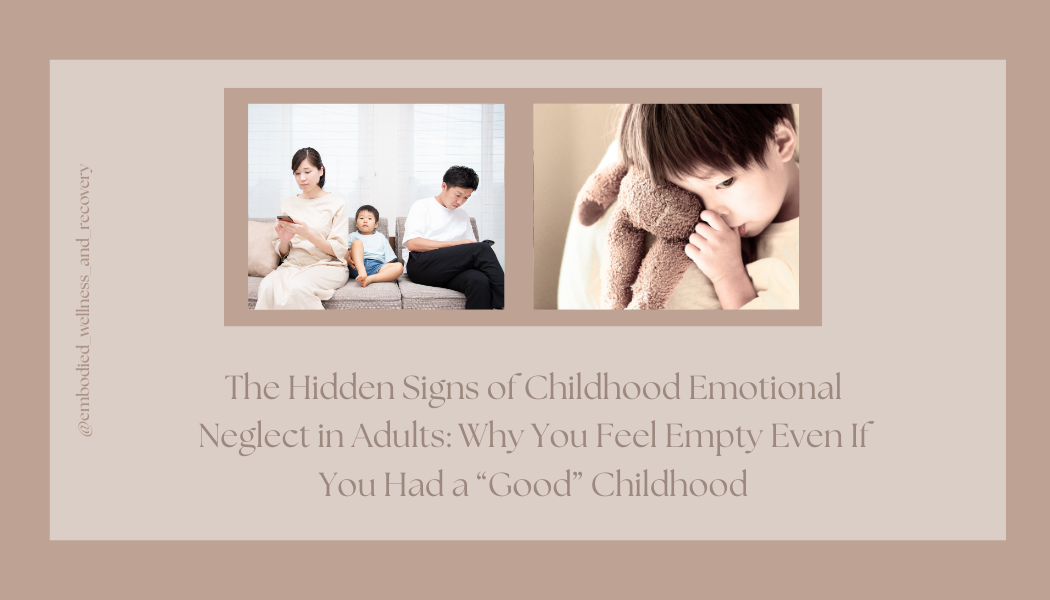
The Hidden Signs of Childhood Emotional Neglect in Adults: Why You Feel Empty Even If You Had a “Good” Childhood
The Hidden Signs of Childhood Emotional Neglect in Adults: Why You Feel Empty Even If You Had a “Good” Childhood
Discover the hidden signs of childhood emotional neglect in adults, including emotional numbness, hyper-independence, people-pleasing, low self-worth, relationship difficulties, and feeling empty despite having a loving childhood.
“My parents loved me.”
“I had everything I needed.”
“Nothing terrible happened to me.”
“So why do I feel like something is missing?”
For many adults struggling with childhood emotional neglect, this contradiction can be profoundly confusing. Perhaps your childhood really was good in many ways. You had food, clothing, birthday parties, vacations, extracurricular activities, and parents who worked hard to provide for you. You may love your parents deeply and know they loved you.
Yet something inside you feels difficult to explain. Maybe you feel emotionally disconnected from yourself. Perhaps you struggle to identify what you need, feel uncomfortable depending on others, or experience a persistent sense of inadequacy despite being accomplished.
Maybe relationships leave you feeling strangely lonely. Or perhaps someone simply asks, “How are you feeling?” and you genuinely don't know. These experiences can sometimes be connected to childhood emotional neglect, a form of relational adversity defined less by what happened to a child than by what was repeatedly missing.
What Is Childhood Emotional Neglect?
Childhood emotional neglect occurs when a child's emotional needs are consistently overlooked, minimized, misunderstood, or insufficiently responded to. This does not necessarily mean a parent was abusive, uncaring, or intentionally neglectful. A parent may have loved their child tremendously while struggling with emotional attunement because of their own upbringing, depression, chronic stress, financial pressure, marital conflict, trauma, cultural expectations, or limited understanding of children's emotional development.
The distinction matters. Emotional neglect is often not about the absence of love. It is about the absence of sufficient emotional responsiveness.
A child needs more than physical safety. Children also develop through experiences such as:
“I can tell someone when I'm scared.”
“My sadness doesn't overwhelm people.”
“My anger doesn't make me unlovable.”
“Someone notices when something is wrong.”
“My feelings contain useful information.”
“I can need someone and still be safe.”
These repeated experiences help shape emotional development, attachment, and nervous system regulation.
Why Childhood Emotional Neglect Can Be So Difficult to Recognize
Physical abuse creates events. Emotional neglect often creates absences. You may not remember the conversation nobody had with you after you were bullied. You may not remember the comforting hug you didn't receive when you were frightened. You may not remember all the times nobody noticed that you were overwhelmed. There is no obvious memory because the wound developed partly through what was missing.
This is why adults sometimes dismiss their own experiences:
“Other people had it much worse.”
“My parents did their best.”
“I wasn't abused.”
“I should be grateful.”
All of these things can be true while another truth also exists:
Some of your emotional needs may not have been adequately met. Research on childhood maltreatment has consistently found that emotional neglect is associated with increased risk for later difficulties, including depression, anxiety, emotional dysregulation, interpersonal problems, and lower psychological well-being (Norman et al., 2012).
Hidden Signs of Childhood Emotional Neglect in Adults
Childhood emotional neglect does not look the same in everyone. In fact, some of its signs are socially rewarded.
1. You Are Extremely Independent
You rarely ask for help. You handle everything yourself. People describe you as capable, strong, responsible, and self-sufficient.
But underneath that independence may be an implicit belief:
“I shouldn't need anyone.”
When emotional support was inconsistent or unavailable during childhood, self-reliance can become a brilliant adaptation. The problem arises when independence becomes the only safe option. Healthy adulthood includes autonomy and the capacity for healthy dependence.
2. You Struggle to Know What You Feel
Someone asks:
“What do you need?”
And your mind goes blank. Perhaps you can analyze everyone else's feelings while struggling to identify your own. This may reflect difficulties with emotional awareness or alexithymia, which involves trouble identifying and describing emotional states.
Children develop emotional literacy partly through caregivers who help name and contextualize their experiences:
“You seem disappointed.”
“That scared you.”
“You really wanted that.”
“You're angry because that felt unfair.”
Without enough of this emotional mirroring, recognizing internal states can remain surprisingly difficult in adulthood.
3. You Feel Guilty for Having Needs
Maybe asking your partner for reassurance feels “needy.” Rest feels lazy. Receiving help makes you uncomfortable. Crying in front of someone feels embarrassing.
You may automatically minimize yourself:
“It's fine.”
“Don't worry about me.”
“I can handle it.”
But having needs is not a character flaw. Needs are part of being human.
4. You Are a People Pleaser
Adults with histories of emotional neglect may become exceptionally attuned to everyone except themselves.
What does my partner need?
Is my friend upset?
Is everyone comfortable?
Did I disappoint someone?
People-pleasing can develop when maintaining connection feels dependent on being easy, helpful, successful, pleasant, or undemanding. Eventually, the nervous system becomes highly skilled at monitoring other people while losing contact with the self.
5. You Feel Lonely Even in Relationships
This can be one of the most painful signs. You may have friends, a spouse, children, coworkers, or a full calendar.
Yet you still feel emotionally alone.
Why?
Because proximity is not the same as emotional intimacy. True intimacy requires allowing another person to know what you feel, want, fear, desire, and need. If emotional vulnerability was never modeled as safe, relationships may remain connected on the surface while feeling strangely distant underneath.
The Neuroscience of Emotional Neglect
Children do not learn emotional regulation entirely on their own. They initially regulate through relationships. A frightened infant is held. A distressed toddler is soothed. An embarrassed child receives reassurance. An overwhelmed teenager has someone who remains present without immediately fixing, criticizing, or dismissing the experience.
These moments of co-regulation help developing neural systems learn how to move through emotional activation and return toward equilibrium. Research on attachment and developmental neuroscience suggests that responsive caregiving plays an important role in developing systems involved in stress regulation, emotional processing, and interpersonal functioning (Schore, 2001).
When co-regulation is insufficient, children adapt. Some suppress emotion. Some become hypervigilant. Some become perfectionistic. Some become caregivers themselves. Some disconnect from bodily sensations. Some learn to need very little. These adaptations may have been highly intelligent responses to the environment in which they developed.
But what protects a child can eventually constrain an adult.
“But My Parents Loved Me”
This may be the most important part. Recognizing childhood emotional neglect does not require deciding your parents were bad people.
Two things can be true simultaneously:
Your parents loved you, and they may not have known how to meet some of your emotional needs. Research on attachment demonstrates that children's emotional development is influenced not simply by whether caregivers love them, but by patterns of responsiveness, availability, sensitivity, and emotional attunement (Mikulincer & Shaver, 2016).
Understanding this distinction allows us to move beyond blame. The goal is not to put your childhood on trial. It is to understand yourself more accurately.
How Childhood Emotional Neglect Affects Adult Relationships and Intimacy
The effects often become particularly visible in romantic relationships. You may desperately want closeness while feeling uncomfortable once someone gets too close. You may struggle to ask for reassurance. Conflict may cause you to shut down. Your partner's disappointment may feel intolerable. Receiving affection may feel more vulnerable than giving it.
Sexual intimacy can also become complicated when being present in the body, communicating desire, expressing preferences, or allowing yourself to receive pleasure requires access to needs you learned to suppress.
You might wonder:
“Why can't I tell my partner what I need?”
“Why do I pull away when someone wants to take care of me?”
“Why does conflict make me want to disappear?”
“Why do I feel responsible for everyone else's feelings?”
“Why do I feel lonely even when someone loves me?”
These are not simply relationship problems. They may reflect relational patterns learned much earlier.
Teaching the Nervous System Something New
At Embodied Wellness and Recovery, we work with adults navigating trauma, attachment wounds, childhood emotional neglect, nervous system dysregulation, relationships, sexuality, and intimacy. Treatment is not simply about understanding childhood intellectually. Insight matters, but the nervous system also needs new experiences.
Therapy can help you practice identifying emotions, recognizing bodily signals, tolerating vulnerability, establishing boundaries, receiving support, communicating needs, and developing relationships in which emotional connection does not require abandoning yourself.
Somatic and trauma-informed approaches can be particularly valuable because many adaptations to emotional neglect exist beneath conscious thought.
The body may still respond according to an old rule:
“Handle it yourself.”
The work becomes gradually discovering:
“I can need someone and remain safe.”
“I can have feelings without apologizing for them.”
“I can disappoint someone without losing myself.”
“I can receive care.”
“My experience matters.”
Maybe Nothing Was “Wrong” With You
If you grew up believing you had a good childhood yet have spent adulthood wondering why you feel empty, emotionally disconnected, inadequate, or inexplicably lonely, perhaps the better question isn't:
“What is wrong with me?”
It might be:
“What did I learn about emotions, needs, vulnerability, and connection?”
Sometimes childhood wounds aren't created solely by what happened. They are also shaped by what a developing nervous system repeatedly needed, but did not receive, and adulthood offers something childhood could not:
The opportunity to become curious about those missing experiences and begin building capacities that were never fully developed, not by rejecting your past, but by learning how to remain connected to yourself in the present.
Reach out to schedule a complimentary 20-minute consultation withour team of therapists,trauma specialists, somatic practitioners, orrelationship experts and start working towards integrative, embodied healing today.
📞 Call us at (310) 651-8458
📱 Text us at (310) 210-7934
📩 Email us at admin@embodiedwellnessandrecovery.com
🔗 Visit us at www.embodiedwellnessandrecovery.com
👉 Check us out on Instagram @embodied_wellness_and_recovery
🌍 Explore our offerings at Linktr.ee: https://linktr.ee/laurendummit
References
Mikulincer, M., & Shaver, P. R. (2016). Attachment in adulthood: Structure, dynamics, and change (2nd ed.). Guilford Press.
Norman, R. E., Byambaa, M., De, R., Butchart, A., Scott, J., & Vos, T. (2012). The long-term health consequences of child physical abuse, emotional abuse, and neglect: A systematic review and meta-analysis. PLOS Medicine, 9(11), e1001349.
Schore, A. N. (2001). Effects of a secure attachment relationship on right brain development, affect regulation, and infant mental health. Infant Mental Health Journal, 22(1-2), 7-66.
Teicher, M. H., & Samson, J. A. (2016). Annual research review: Enduring neurobiological effects of childhood abuse and neglect. Journal of Child Psychology and Psychiatry, 57(3), 241-266.

Why Do Compliments Make Me Uncomfortable? The Neuroscience of Praise, Shame, Self-Worth, and the Fear of Being Seen
Why Do Compliments Make Me Uncomfortable? The Neuroscience of Praise, Shame, Self-Worth, and the Fear of Being Seen
Why do compliments make you uncomfortable? Discover how low self-esteem, shame, trauma, people pleasing, attachment, and the nervous system can make praise feel surprisingly difficult to receive.
Someone tells you, “You look beautiful.”
Before you can even absorb the words, you respond:
"Oh God, no. I look terrible today."
Someone says, “You're incredibly talented.”
You immediately explain why what you accomplished really wasn't that impressive. Your boss tells you that you did an exceptional job. You point out everything you could have done better. A friend compliments your outfit, and within seconds you are complimenting hers.
Why can something intended to make us feel good create such profound discomfort? If you've ever wondered, “Why do compliments make me uncomfortable?” the answer may have much less to do with modesty than you think. For some people, positive attention activates embarrassment, anxiety, shame, skepticism, or even an instinctive desire to disappear. Understanding why requires looking beneath the social interaction and into self-esteem, attachment, trauma, people pleasing, and the nervous system'srelationship with being seen.
Why Can't I Just Accept a Compliment?
Compliments provide information about how another person sees us. When that information fits comfortably with our existing self-concept, receiving it tends to feel relatively easy.
But imagine someone saying:
“You're beautiful.”
while an internal voice immediately responds:
"No, I'm not."
Or:
“You're really good at what you do.”
while another part of you thinks:
"If they really knew me, they wouldn't think that."
Now the brain has two conflicting pieces of information. Psychologists call this cognitive dissonance, the discomfort that occurs when we encounter information that conflicts with established beliefs.
Research on self-verification suggests that people are often motivated to maintain familiar beliefs about themselves, even when those beliefs are negative (Swann et al., 1989). Familiarity creates predictability.
This can create a strange psychological paradox:
A negative belief about yourself can sometimes feel more believable than a positive truth about yourself.
When Praise Collides With Low Self-Esteem
Researchers have found that people with lower self-esteem may have difficulty benefiting from positive feedback in the same way people with more secure self-esteem do.
A compliment may not simply land as:
"Someone appreciates me."
Instead, the mind interrogates it.
"Do they really mean that?"
"Are they just being nice?"
"What do they want?"
"If they knew the real me, would they still say that?"
Research by Kwang and Swann (2010) suggests that people with negative self-views can experience tension between wanting positive evaluation and wantingfeedback that confirms their existing self-concept. In other words, part of you may desperately want affirmation while another part distrusts it when it arrives.
Why Compliments Can Trigger Shame
Shame does not simply say:
“I did something wrong.”
It whispers:
“Something is wrong with me.”
For someone carrying deeply internalized shame, praise can shine attention directly onto the self, and attention can feel dangerous.
Instead of experiencing:
“They see something wonderful in me,”
the nervous system may register:
“They are looking at me.”
That subtle distinction matters. Being positively seen still requires being seen. For people with histories of chronic criticism, bullying, emotional neglect, conditional approval, perfectionism, or relational trauma, visibility may historically have been associated with evaluation. The body remembers that pattern.
The Neuroscience of Why Positive Attention Can Feel Unsafe
The nervous system is constantly predicting what happens next. Rather than evaluating every situation from scratch, the brain relies on previous experiences to anticipate whether something is safe, threatening, rewarding, or uncertain. This predictive function helps us navigate the world efficiently, but it also means that familiarity can sometimes feel safer than positivity. If attention historically preceded criticism, demands, embarrassment, manipulation, or disappointment, attention itself may become activating.
Your rational brain may understand:
"This person is complimenting me."
Meanwhile, your body responds:
"Everyone is looking at us. Get out of here."
You laugh. You minimize. You change the subject. You compliment the other person, and within seconds, the spotlight has moved away. Relief. What looks like social awkwardness may actually be a subtle nervous system regulation strategy.
When Compliments Feel Like Expectations
Sometimes praise doesn't feel uncomfortable because you disagree with it. It feels uncomfortable because of what you believe comes next.
“You're so successful.”
becomes:
"Now I have to keep succeeding."
“You're always so put together.”
becomes:
"I can't let anyone see me struggling."
“You're such an amazing mother.”
becomes:
"I can't make mistakes."
This is particularly relevant for people whose childhood environments emphasized achievement, performance, appearance, caretaking, or being "the good one."Praise may have been conditional. You were celebrated when you performed well. You received approval when you were agreeable. You felt valuable when you made other people happy.
Over time, admiration can become psychologically intertwined with expectation. The compliment isn't simply received. It becomes another standard to maintain.
People Pleasing Can Make Receiving Especially Difficult
People pleasers are often exceptionally comfortable directing positive energy outward. They compliment, support, encourage, help, accommodate, and notice what everyone else needs. Receiving reverses that relational direction. Suddenly, someone is appreciatingyou. There is nothing to accomplish, nothing to fix, nothing to reciprocate, and nothing to earn. That can feel surprisingly vulnerable.
So you immediately say:
“Thanks, but YOU look amazing!”
The attention moves away from you, and your nervous system settles.
Trauma Can Make Positive Experiences Difficult to Absorb
Trauma is commonly associated with fear and distress, but it can also interfere with our capacity to tolerate positive emotional experiences. Research has explored the concept of fear of positive emotions, in which experiences such as happiness, pride, intimacy, or positive attention can evoke anxiety or discomfort rather than uncomplicated pleasure (Gilbert et al., 2012). This can be especially relevant when positive experiences historically felt unpredictable or were followed by disappointment.
The nervous system may quietly learn:
Don't get too comfortable.
Don't get too excited.
Don't draw attention to yourself.
Don't believe something good will last.
These protective strategies may persist long after the environment that created them has changed.
Learning to Receive Without Deflecting
If compliments make you uncomfortable, forcing yourself to "be more confident" may miss the deeper issue. Instead, practice something much smaller.
Someone says:
“You look beautiful.”
Notice what happens inside your body before responding.
Does your chest tighten?
Do you feel heat in your face?
Do you immediately want to explain something?
Do you feel an urge to make yourself smaller?
Do you want to compliment them back?
Pause.
Then experiment with two words:
“Thank you.”
Nothing else. You do not have to agree completely. You do not have to suddenly feel confident. You are simply practicing allowing positive information to remain in the room without immediately pushing it away. Over time, this can become a powerful exercise in nervous system flexibility.
What If the Compliment Isn't the Problem?
At Embodied Wellness and Recovery, we work with individuals and couples navigating trauma, attachment wounds, nervous system dysregulation, relationship difficulties, sexuality, intimacy, shame, and patterns of self-worth.
Through neuroscience-informed, somatic, relational, and trauma-focused approaches, therapy can help uncover why visibility, praise, receiving, vulnerability, or positive attention became uncomfortable in the first place.
Because sometimes the deeper question isn't:
“Why am I so bad at taking compliments?”
It is:
“When did being seen start feeling dangerous?”
And perhaps an even more powerful question:
What if the discomfort isn't because the compliment is untrue, but because believing it would require you to update the story you've learned to tell about yourself? Learning to receive a compliment is a small interpersonal moment.
Underneath it may be something much larger:
The gradual discovery that you can be seen, appreciated, valued, and celebrated without having to perform, minimize yourself, or disappear.
Reach out to schedule a complimentary 20-minute consultation with our team of therapists, trauma specialists, somatic practitioners, or relationship experts and start working towards integrative, embodied healing today.
📞 Call us at (310) 651-8458
📱 Text us at (310) 210-7934
📩 Email us at admin@embodiedwellnessandrecovery.com
🔗 Visit us at www.embodiedwellnessandrecovery.com
👉 Check us out on Instagram @embodied_wellness_and_recovery
🌍 Explore our offerings at Linktr.ee: https://linktr.ee/laurendummit
References
Gilbert, P., McEwan, K., Catarino, F., Baião, R., & Palmeira, L. (2012). Fears of happiness and compassion in relationship with depression, alexithymia, and attachment security in a depressed sample. British Journal of Clinical Psychology, 53(2), 228-244.
Kwang, T., & Swann, W. B., Jr. (2010). Do people embrace praise even when they feel unworthy? A review of critical tests of self-enhancement versus self-verification. Personality and Social Psychology Review, 14(3), 263-280.
Swann, W. B., Jr., Pelham, B. W., & Krull, D. S. (1989). Agreeable fancy or disagreeable truth? Reconciling self-enhancement and self-verification. Journal of Personality and Social Psychology, 57(5), 782-791.
Wood, J. V., Perunovic, W. Q. E., & Lee, J. W. (2009). Positive self-statements: Power for some, peril for others. Psychological Science, 20(7), 860-866.