
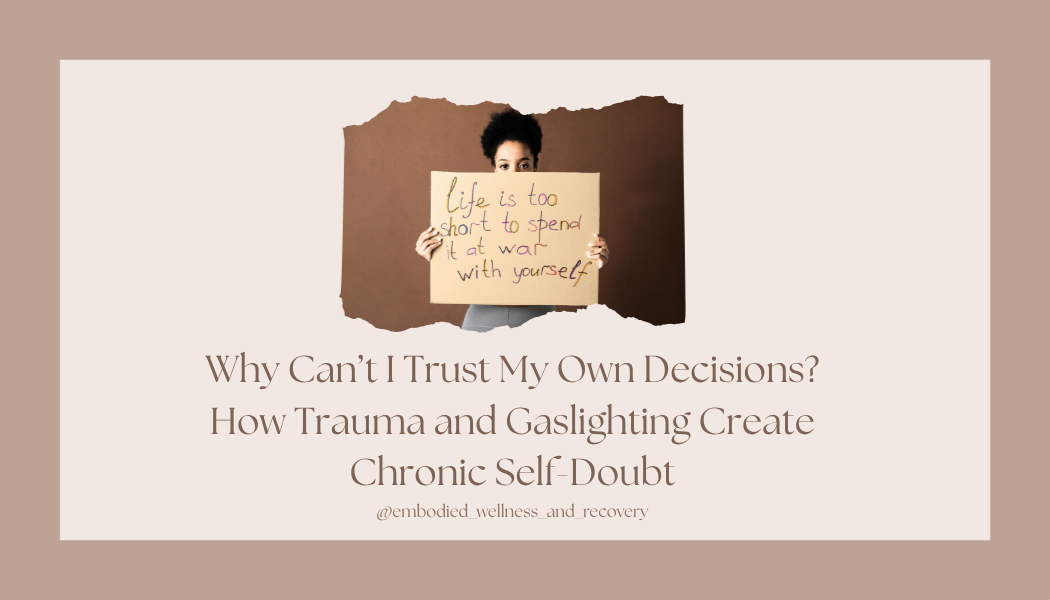
Why Can’t I Trust My Own Decisions? How Trauma and Gaslighting Create Chronic Self-Doubt
Why Can’t I Trust My Own Decisions? How Trauma and Gaslighting Create Chronic Self-Doubt
Why can’t you trust your own decisions? Learn how trauma, gaslighting, PTSD, and nervous system dysregulation create chronic self-doubt and how to rebuild self-trust, confidence, and personal agency.
Have you ever made a decision, felt confident about it for five minutes, and then immediately started questioning yourself?
What if I’m overreacting? What if I misunderstood? What if I make the wrong choice? Maybe I’m being too sensitive. Maybe they’re right, and I’m the problem.
For people with a history of trauma, emotional abuse, gaslighting, or chronically invalidating relationships, decision-making can become surprisingly painful. Even relatively ordinary choices can trigger anxiety, overthinking, reassurance-seeking, or a nearly paralyzing fear of getting it wrong. You may know intellectually that you are capable of making decisions, yet something inside you does not trustyour own perception.
That disconnect is important. Chronic self-doubt is not necessarily a lack of intelligence, insight, or competence. Sometimes, it reflects a nervous system that learned that trusting yourself was unsafe.
How Trauma Can Make You Stop Trusting Yourself
Trauma does more than create painful memories. It can change the way the brain evaluates threat, uncertainty, reward, and risk. Research has found associations between PTSD symptoms and altered decision-making under uncertainty. For example, people with PTSD may show greater aversion to ambiguous situations, particularly when potential loss is involved. More recent research has also found that greater PTSD symptom severity can be associated with giving disproportionate weight to negative experiences when making uncertain decisions (Ruderman et al., 2016; Verfaellie et al., 2025).
In everyday life, that can sound like:
What if I regret this?
What if something goes wrong?
What if I disappoint someone?
What if I missed something important?
When your nervous system has learned to anticipate danger, uncertainty itself can begin to feel threatening. Instead of asking, “What do I want?” you may automatically ask, “Which choice is least likely to cause something bad to happen?” Those are very different ways of moving through the world.
Gaslighting Can Create an Internal Argument With Yourself
Gaslighting adds another layer. Gaslighting is a form of psychological manipulation in which someone repeatedly challenges, dismisses, or distorts another person's perception of reality. You may hear statements such as:
“You’re remembering it wrong.”
“You’re too sensitive.”
“That never happened.”
“You always exaggerate.”
“You’re making something out of nothing.”
Over time, the external gaslighter can become an internalized voice of self-doubt. Recent experimental research examining gaslighting-like interpersonal dynamics found that pressure from close partners increased acceptance of misinformation and decreased confidence in people's recollections (Andrews et al., 2025).
In other words, repeatedly having your reality challenged can affect not only what you believe happened, but also how confidently you trust your own memory. Eventually, you may no longer need someone else to question you. You do it yourself.
The Neuroscience of Chronic Self-Doubt
Decision-making depends on communication among multiple brain systems involved in memory, emotion, threat detection, reward processing, interoception, and executive functioning. The prefrontal cortex helps us evaluate information, inhibit automaticresponses, consider consequences, and make flexible decisions. The amygdala and related threat networks help detect potential danger. The hippocampus contributes contextual memory, while reward-related regions help us estimate whether something is worth pursuing.
Traumatic stress can disrupt the balance among these systems. Research suggests that traumatic stress may increase the influence of automatic threat-based learning on decision-making, making flexible, goal-directed choices more difficult under certain conditions (Ousdal et al., 2018). PTSD has also been associated with differences in neural systems involved in evaluating rewards, losses, and uncertain outcomes.
This helps explain why someone can be exceptionally competent at work yet become overwhelmed when deciding whether to end a relationship, establish a boundary, confront someone, move, date again, or say no.
The issue may not be “I don’t know what to do.”
It may be “My nervous system does not feel safe trusting what I know.”
Trauma Can Disconnect You From Your “Gut”
There is another fascinating piece of the self-trust puzzle: interoception. Interoception is your brain's ability to perceive and interpret signals coming from inside your body, including heartbeat, breathing, muscle tension, hunger, discomfort, arousal, and other internal sensations. These signals contribute to emotional awareness and intuitive decision-making.
Research suggests that childhood trauma can interfere with the ability to process, integrate, and trust bodily signals associated with emotions and needs. Research on PTSD and interoception similarly suggests that disrupted interpretation of internal signals may contribute to difficulty trusting one's instincts and making decisions.
If you spent years learning to override your discomfort because someone told you that you were “dramatic,” ignore your boundaries to keep another person happy, or distrust your instincts because they were repeatedly questioned, you may eventually lose access to an important internal compass.
You stop asking, “What am I noticing?”
And start asking, “What am I supposed to think?”
Signs You May Have Lost Trust in Your Own Judgment
Chronic self-doubt can show up in subtle ways. You may:
— Ask multiple people what they think before making decisions
— Replay conversations looking for evidence that you did something wrong
— Over-explain your choices
— Apologize excessively
— Change your mind when someone becomes disappointed or angry
— Struggle to identify what you actually want
— Assume other people's perceptions are more accurate than yours
— Stay in relationships long after your body is telling you something feels wrong
— Feel intense anxiety after setting a boundary
— Research choices endlessly because you are terrified of making a mistake
Ironically, the harder you try to achieve absolute certainty, the less confident you may feel. Self-trust does not come from never making the wrong decision. It comes from knowing that you can remain connected to yourself even when a decision does not turn out exactly as you hoped.
Rebuilding Self-Trust and Personal Agency
Rebuilding agency after trauma or gaslighting is often less about becoming more certain and more about becoming more connected to yourself. Start with smaller decisions. Ask yourself what you prefer before asking anyone else.
Notice your first response before analyzing it. Pay attention to sensations of expansion, tension, relief, hesitation, or discomfort without automatically treating them as instructions. Then practice tolerating the uncertainty that follows a decision.
You might tell yourself:
I made the best decision I could with the information available to me.
This is very different from demanding that you prove your decision was objectively correct. Trauma therapy can also help people differentiate between present-day intuition and old threat responses. Somatic therapy, EMDR, mindfulness-based approaches, attachment-focused therapy, and other trauma-informed modalities can support nervous system regulation while helping clients reconnect with emotions, bodily cues, boundaries, preferences, and values.
Self-Trust Is Built Through Relationship With Yourself
At Embodied Wellness and Recovery, we understand that chronic self-doubt often cannot be resolved through positive thinking alone.
Our work integrates trauma treatment, neuroscience, nervous system repair, somatic awareness, attachment, relationships, sexuality, and intimacy to help people understand not only what they think, but what their bodies have learned to expect. For someone who has survived gaslighting, relational trauma, betrayal, or chronic invalidation, rebuilding self-trust can be profound.
The goal is not to become a person who never questions yourself. Healthy self-reflection matters. The goal is to stop automatically assuming that everyone else's interpretation deserves more authority than your own.
With practice, the question can gradually shift from:
“How do I know I’m making the right decision?”
to:
“Can I listen to myself, make a thoughtful choice, and trust myself to respond to whatever happens next?”
That is personal agency. And that is where self-trust begins.
Reach out to schedule a complimentary 20-minute consultation with our team of therapists, trauma specialists, somatic practitioners, or relationship experts, and start working towards integrative, embodied healing today.
📞 Call us at (310) 651-8458
📱 Text us at (310) 210-7934
📩 Email us at admin@embodiedwellnessandrecovery.com
🔗 Visit us at www.embodiedwellnessandrecovery.com
👉 Check us out on Instagram @embodied_wellness_and_recovery
🌍 Explore our offerings at Linktr.ee: https://linktr.ee/laurendummit
References
1) Andrews, S. J., Ellison, S., Shaw, H., & Gabbert, F. (2025). Gaslighting and memory: The effects of partner-led challenges on recall and self-perception. Memory.
2) Ousdal, O. T., Huys, Q. J. M., Milde, A. M., Craven, A. R., Ersland, L., Endestad, T., Melinder, A., Hugdahl, K., & Dolan, R. J. (2018). The impact of traumatic stress on Pavlovian biases. Psychological Medicine, 48(2), 327–336.
3) Ruderman, L., Ehrlich, D. B., Roy, A., Pietrzak, R. H., Harpaz-Rotem, I., & Levy, I. (2016). Posttraumatic stress symptoms and aversion to ambiguous losses in combat veterans. Depression and Anxiety, 33(7), 606–613.
4) Verfaellie, M., Patt, V., Lafleche, G., Jones, D., & Vasterling, J. J. (2025). Choosing certainty over risk: Associations of PTSD symptom severity with memory sampling during experiential decision making. Journal of Anxiety Disorders, 110, 102979.
Why Some People Can Lie Without Remorse: Narcissism, Psychopathy, and the Neuroscience of Deception
Why Some People Can Lie Without Remorse: Narcissism, Psychopathy, and the Neuroscience of Deception
Why can some people lie without remorse? Explore the neuroscience of deception, narcissism, psychopathy, gaslighting, chronic infidelity, and how betrayal trauma affects the brain, nervous system, relationships, and ability to trust again.
How could someone who says they love me look me in the eyes, lie convincingly, watch me suffer, and seemingly feel little or no remorse? For people who discover chronic infidelity, financial secrecy, repeated manipulation, gaslighting, or an entire double life, this question can become consuming.
Perhaps you discovered one affair and then learned there were others. Maybe financial records revealed years of hidden behavior. Perhaps your partner repeatedly assured you that your suspicions were irrational, only for you to discover that your intuition had been remarkably accurate.
Suddenly, you are trying to reconcile two apparently incompatible people:
The person I thought I knew.
And:
The person capable of doing this.
The psychological injury of chronic deception goes far beyond discovering that someone lied. It can destabilize your understanding of your relationship, your memories, your judgment, and even your ability to recognize what is real. Understanding the psychology and neuroscience of deception can help explain how some people maintain elaborate lies, but it is equally important to understand what chronic deception does to the person on the receiving end.
Why Do Some People Lie Without Feeling Guilty?
Most people lie occasionally. They may avoid an uncomfortable conversation, conceal something because they feel ashamed, or distort the truth because they fear consequences. That is different from chronic, calculated deception.
Some individuals can maintain multiple realities for months or even years. They may compartmentalize affairs, sexual behavior, financial secrets, substance use, or other relationships while continuing to participate convincingly in family life.
Research suggests that repeated dishonesty may actually change how the brain responds to lying. Garrett and colleagues (2016) found that repeated self-serving dishonesty was associated with decreasing activation in the amygdala, a brain region involved in emotional salience. In other words, the emotional discomfort associated with dishonesty appeared to diminish as dishonest behavior was repeated.
A lie that initially creates anxiety may become easier to tell the tenth, fiftieth, or hundredth time. This does not mean that everyone who lies repeatedly has narcissistic personality disorder or psychopathy. But it helps explain an unsettling possibility: Deception can become psychologically easier with repetition.
Narcissism, Psychopathy, and Deception
The words narcissist, sociopath, and psychopath are frequently used interchangeably online, but clinically they describe different concepts. Narcissistic personality disorder is a recognized diagnosis characterized by patterns that can include grandiosity, entitlement, need for admiration, interpersonal exploitation, and impaired empathy.
“Psychopathy,” by contrast, is not a standalone DSM diagnosis. It is a researched personality construct involving traits that may include superficial charm, manipulativeness, callousness, diminished affective empathy, impulsivity, and limited remorse. Sociopathy is primarily an informal term commonly associated with antisocial personality traits.
Research on psychopathy has identified differences in neural systems involved in emotional processing, moral decision-making, fear learning, and empathy (Blair, 2007). But this distinction matters: A person does not need to be a narcissist or psychopath to lie, cheat, manipulate, or cause profound relational harm. The behavior deserves attention even when the diagnosis is unknown.
How Can Someone Lie to Someone They Love?
One reason chronic deception is so difficult to comprehend is that we naturally assume another person's mind operates similarly to our own.
You may think:
"I couldn't watch someone I love suffer like this."
"I would feel unbearably guilty."
"I could never come home and behave normally after doing that."
And therefore:
"How could they?"
The answer may involve differences in empathy, entitlement, shame, reward processing, attachment, compartmentalization, or capacity for remorse. Someone with pronounced narcissistic traits may lie to protect their self-image, avoid shame, maintain admiration, preserve entitlement, or escape consequences.
Someone with significant psychopathic traits may understand intellectually that another person is hurting while experiencing considerably less emotional resonance with that suffering. This distinction is sometimes described as the difference between cognitive empathy and affective empathy.
A person may understand exactly what you are feeling without emotionally experiencing your pain alongside you. In some individuals, that understanding can even make manipulation more effective.
Why Chronic Deception and Gaslighting Can Make You Question Reality
The deepest injury may begin after the truth comes out. Suddenly, your brain starts reconstructing the past.
Was that business trip really for work?
Was that person actually "just a friend"?
Why did they become defensive when I asked that question?
What else don't I know?
Were the good moments real?
Your brain is essentially discovering that its previous model of reality was unreliable.
The human brain is fundamentally predictive. It continuously uses previous experiences to anticipate what will happen next. Predictability helps the nervous system determine whether the environment is safe.
Chronic deception disrupts that process.
The result can resemble a betrayal trauma response, including:
— checking phones or financial accounts
— replaying conversations
— sleep disruption
— anxiety
— emotional flooding
— difficulty trusting your own perceptions
Research on betrayal trauma suggests that violations committed by someone upon whom we depend can have particularly significant psychological consequences because the source of attachment and the source of threat become intertwined (Freyd, 1996).
Your nervous system is no longer simply asking, "Can I trust this person?"
It may begin asking:
"Can I trust myself to know when something is wrong?"
Why Does Someone Keep Lying Even After Being Caught?
This can be one of the most bewildering aspects of chronic deception. You finally have evidence, yet the person minimizes, denies, changes details, blames you, or admits only what you can prove.
Why?
For some people, telling the truth requires tolerating shame, accountability, loss of control, and consequences. Continued deception can function as an attempt to preserve control over the narrative. Gaslighting can intensify this injury. When someone repeatedly tells you that what you observed did not happen, your feelings are irrational, or your perception cannot be trusted, the conflict is no longer simply about behavior. It becomes a conflict over reality itself.
You Do Not Need a Diagnosis to Trust the Pattern
After discovering chronic deception, it can become tempting to spend hours researching:
Is my partner a narcissist?
Is my spouse a psychopath?
Do narcissists feel remorse?
Can psychopaths love?
Understanding personality patterns can provide valuable context. But eventually, another set of questions becomes more important:
What has repeatedly happened to me?
Does this person take meaningful accountability?
Do their actions consistently match their words?
Do I feel pressured to abandon my own perceptions to maintain this relationship?
What would I need in order to feel emotionally and relationally safe again?
The label matters less than the pattern.
Rebuilding Self-Trust After Betrayal and Chronic Deception
Recovery from betrayal is not simply about deciding whether to stay or leave. It is about restoring the relationship with your own perception.
At Embodied Wellness and Recovery, we specialize in treating trauma, betrayal trauma, relationship difficulties, sexuality, intimacy, and nervous system dysregulation through an integrative, neuroscience-informed approach.
Treatment may involve learning to regulate the nervous system, processing traumatic discoveries, understanding attachment dynamics, establishing boundaries, rebuilding trust in your intuition, and separating what you know from what you have been conditioned to doubt.
Somatic therapies can be particularly valuable because betrayal is not experienced only cognitively. The body may remain vigilant long after the mind understands what happened. The goal is not to become better at detecting every possible lie. It is to become increasingly capable of recognizing your internal signals, evaluating behavior clearly, tolerating difficult truths, and responding in ways that protect your psychological integrity.
Sometimes the most devastating part of discovering a lie is not learning what someone did. It is realizing how long they were able to watch you believe something that wasn't true. Understanding why someone could do that may provide context. But rebuilding your ability to trust what you see, what you feel, and what you know is where recovery begins.
Reach out to schedule a complimentary 20-minute consultation withour team of therapists,trauma specialists, somatic practitioners, orrelationship experts and start working towards integrative, embodied healing today.
📞 Call us at (310) 651-8458
📱 Text us at (310) 210-7934
📩 Email us at admin@embodiedwellnessandrecovery.com
🔗 Visit us at www.embodiedwellnessandrecovery.com
👉 Check us out on Instagram @embodied_wellness_and_recovery
🌍 Explore our offerings at Linktr.ee: https://linktr.ee/laurendummit
References
Blair, R. J. R. (2007). The amygdala and ventromedial prefrontal cortex in morality and psychopathy. Trends in Cognitive Sciences, 11(9), 387–392.
Freyd, J. J. (1996). Betrayal trauma: The logic of forgetting childhood abuse. Harvard University Press.
Garrett, N., Lazzaro, S. C., Ariely, D., & Sharot, T. (2016). The brain adapts to dishonesty. Nature Neuroscience, 19(12), 1727–1732.
Hare, R. D. (2003). Manual for the Revised Psychopathy Checklist (2nd ed.). Multi-Health Systems.