
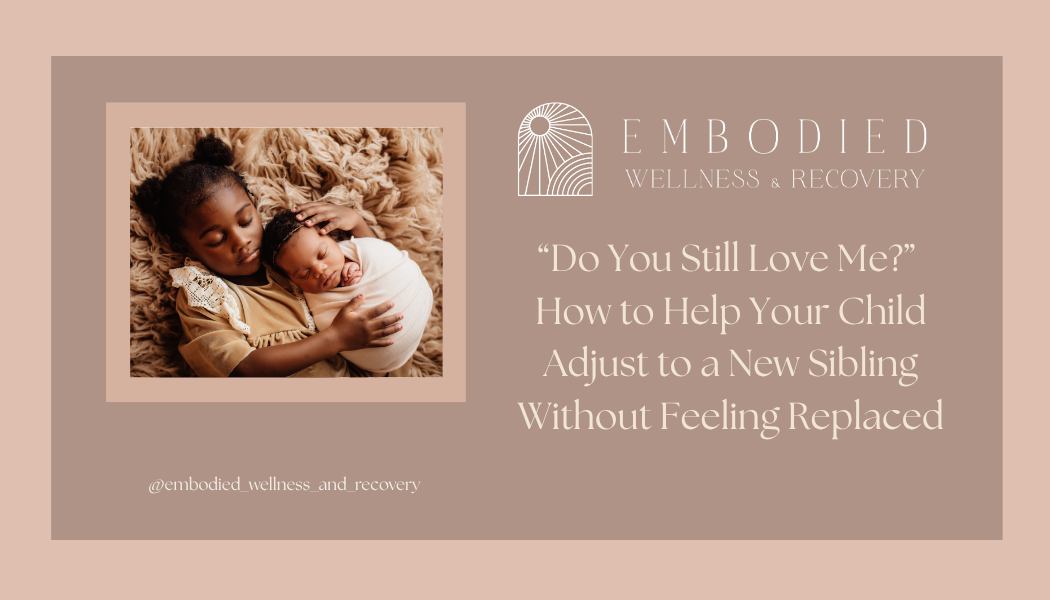
“Do You Still Love Me?” How to Help Your Child Adjust to a New Sibling Without Feeling Replaced
“Do You Still Love Me?” How to Help Your Child Adjust to a New Sibling Without Feeling Replaced
Help your child adjust to a new sibling with practical ways to respond to jealousy, regression, and big feelings while protecting your connection.
Your child kisses the baby’s forehead, then demands that you put the baby down. A previously smooth bedtime becomes a tearful negotiation. Your independent preschooler suddenly wants help getting dressed. You prepared them to become a big brother or sister. Why does your older child seem so unsettled? For some children, welcoming a sibling brings an unspoken question, “Is there still room for me?”
Helping your child adjust to a new sibling involves more than encouraging excitement. It means making space for mixed feelings while showing, through everyday interactions, that their place in your family remains secure.
Why a New Baby Can Bring Big Feelings
A newborn changes familiar routines, parental availability, and the atmosphere at home. Your older child may enjoy the baby while also missing how life felt before. Sibling jealousy, clinginess, or resistance can reflect difficulty navigating those changes. However, distress is not inevitable. Volling’s (2012) review of 30 studies found considerable variation in children’s adjustment, rather than evidence that becoming an older sibling creates a crisis for most children.
In a subsequent longitudinal investigation, many children maintained low levels of behavioral difficulties throughout the transition. The community sample was relatively low risk, so these findings cannot represent every family’s experience (Volling, 2017). Your child can struggle with change and still develop a loving sibling relationship.
The Neuroscience of Feeling Secure
Young children rely on caregivers to help them manage distress. This process, often called co-regulation, involves responsive interactions that support emotional regulation. Gunnar and Donzella’s (2002) review examined how caregiving relationships influence children’s cortisol responses, part of the body’s stress-response system. Their work supports the importance of social support in early stress regulation. It does not suggest that every tantrum signals an abnormal cortisol level. The practical implication is compassionate. When family life changes, familiar connection can help your child find their footing.
Six Ways to Help Your Child Adjust to a New Sibling
1. Prepare Them for Real Life With a Baby
Does your child expect an instant playmate? Have you explained what will happen while you are at the hospital?
Use simple, age-appropriate language: “Babies sleep, cry, and need lots of help. At first, they cannot play the way you do.”
Explain who will care for your child during the birth and which routines will continue. Books and pretend play can make the transition easier to understand. When possible, introduce major changes, such as a new bed, before the baby arrives (American Academy of Pediatrics [AAP], n.d.).
2. Welcome Feelings Without Requiring Excitement
When your child says, “I wish the baby would go away,” you may feel pressure to correct them.
Try: “You miss having more time with me. It is okay to tell me that.”
They can love their sibling and dislike sharing your attention. Invite involvement without making affection or helpfulness an obligation. ZERO TO THREE specifically advises against forcing children to help with the baby. Accepting a feeling gives you information about what your child needs.
3. Protect Predictable Time Together
Does your older child receive most of your attention when something goes wrong?
Create a small, dependable ritual: a morning cuddle, a bedtime story, or a few minutes of child-led play while another adult holds the baby. The AAP recommends dedicated attention for older children during this transition (AAP, n.d.).
Try naming it: “After lunch, we have our special time.”
Consistency matters more than creating an elaborate activity. Choose something realistic enough to repeat.
4. Respond to Regression With Patience
Why is your toddler acting like a baby again? Why have toileting accidents or bedtime difficulties returned?
Some children temporarily seek younger forms of care after a sibling arrives, including wanting to be carried or needing additional help. These changes are described in ZERO TO THREE’s sibling-adjustment guidance.
Offer reassurance without shame: “You want help today. Let’s do this together.”
Maintain supportive routines. Persistent skill loss, painful toileting, or significant sleep disruption deserves a conversation with your pediatrician, not the assumption that sibling jealousy explains everything.
5. Set Calm Limits Around Unsafe Behavior
What if your child hits, squeezes, or pushes the baby?
Move close, protect the baby, and state the limit clearly: “I will not let you hit. You can be angry, and I will help you.”
Stay nearby during interactions and offer alternatives, such as telling you what they want or stepping away with another caregiver. Understanding distress does not require allowing harm. A calm boundary can protect both children while preserving your older child’s dignity.
6. Let Them Be a Child, Too
“You’re the big one now” can unintentionally suggest that comfort belongs primarily to the baby.
Invite small contributions, such as choosing a song, while allowing your child to decline. Continue noticing interests and accomplishments unrelated to siblinghood. They are still learning, still dependent, and still deserving of care.
When Your Family Needs More Support
If distress persists, aggression escalates, or family interactions become increasingly strained, professional support can help you understand the pattern.
At Embodied Wellness and Recovery, our expertise spans trauma, nervous system regulation and repair, relationships, sexuality, and intimacy. Our work with children, parents, and families attends to attachment, emotional regulation, and the pressures shaping connection at home. Becoming an older sibling is a normal developmental transition, and support can be tailored without treating it as trauma.
Your child does not need constant attention or perfect parenting. They benefit from repeated experiences of being noticed, comforted, and included.
“You still matter here” becomes believable through the moments you share.
Explore parenting support and family therapy at Embodied Wellness and Recovery.
Contact us today to schedule a free 20-minute consultation with our team of somatic practitioners, trauma specialists, and relationship experts and begin your journey toward embodied connection with yourself and others.
📞 Call us at (310) 651-8458
📱 Text us at (310) 210-7934
📩 Email us at admin@embodiedwellnessandrecovery.com
🔗 Visit us at www.embodiedwellnessandrecovery.com
👉 Check us out on Instagram @embodied_wellness_and_recovery
🌍 Explore our offerings at Linktr. ee: https://linktr.ee/laurendummit
References
American Academy of Pediatrics. (n.d.). Preparing your older child for a new baby: How to help siblings adjust. HealthyChildren.org.
Gunnar, M. R., & Donzella, B. (2002). Social regulation of the cortisol levels in early human development. Psychoneuroendocrinology, 27(1–2), 199–220.
Volling, B. L. (2012). Family transitions following the birth of a sibling: An empirical review of changes in the firstborn’s adjustment. Psychological Bulletin, 138(3), 497–528.
Volling, B. L. (2017). XI. General discussion: Children’s adjustment and adaptation following the birth of a sibling. Monographs of the Society for Research in Child Development, 82(3), 142–158.
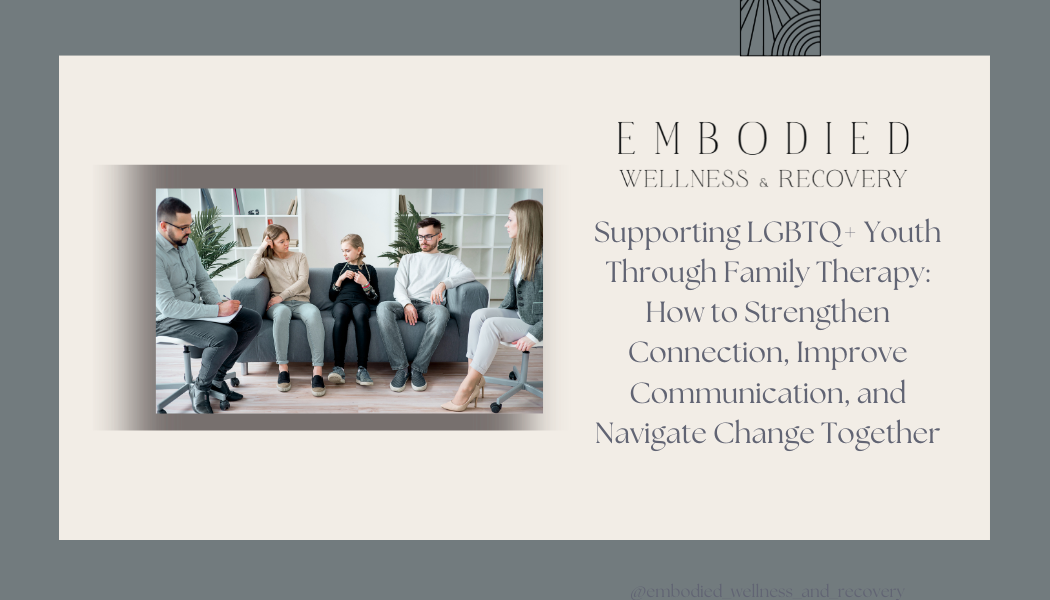
Supporting LGBTQ+ Youth Through Family Therapy: How to Strengthen Connection, Improve Communication, and Navigate Change Together
Supporting LGBTQ+ Youth Through Family Therapy: How to Strengthen Connection, Improve Communication, and Navigate Change Together
Supporting an LGBTQ+ child can bring questions, uncertainty, and emotional challenges for the entire family. Discover how family therapy, attachment science, and neuroscience can strengthen communication, rebuild trust, and preserve connection during times of change.
Learning that your child identifies as LGBTQ+ can bring a wide range of emotions. For many families, the first response is love. Soon after, however, other feelings may begin to surface.
Fear.
Confusion.
Grief over expectations that may be changing.
Worry about your child's future.
Uncertainty about what to say.
Concern that every conversation might make things worse.
Perhaps you have found yourself asking:
— How do I support my child without saying the wrong thing?
— Why do our conversations end in conflict?
— How do I stay connected when we seem to be growing apart?
— What if I accidentally push my child away?
— How can our family move through this together?
These questions are more common than many families realize. While much of the public conversation centers on identity, one of the most significant challenges families face is preserving emotional connection as they navigate change. Family therapy can provide a safe space to strengthen communication, rebuild trust, and help every family member feel heard without losing sight of what matters most: your relationship.
The Challenge Is Often About Connection, Not Love
Many parents deeply love their child while simultaneously feeling overwhelmed by unfamiliar emotions and questions. Likewise, many LGBTQ+ youth long for acceptance while fearing misunderstanding, disappointment, or rejection.
The result can be a painful cycle:
Parents become anxious. Children become guarded. Communication deteriorates. Both sides begin to protect themselves rather than connect with one another. The problem is rarely a lack of love. More often, it is a lack of emotional safety during difficult conversations.
Why Conversations Become So Difficult
From a neuroscience perspective, emotionally charged conversations activate the brain's threat detection system. When people perceive criticism, rejection, shame, or emotional danger, the amygdala becomes more active while the parts of the brain responsible for curiosity, empathy, flexible thinking, and problem-solving become less accessible (Siegel, 2020).
This happens to parents. It happens to children. Suddenly, everyone is reacting rather than listening. One person may withdraw. Another may become defensive. Someone else may attempt to fix, persuade, or avoid the conversation altogether.
Without realizing it, every member of the family is trying to protect themselves. Understanding this changes how we view conflict.
Rather than asking, "Who's right?"
We begin asking:
"What does each person's nervous system need in order to feel safe enough to connect?"
Family Therapy Helps Restore Emotional Safety
Family therapy is not about deciding who is correct. It is about strengthening the relationships that allow difficult conversations to occur with greater understanding and compassion.
Research consistently demonstrates that family acceptance is associated with better mental health outcomes, lower rates of depression, reduced suicide risk, and greater overall well-being among LGBTQ+ youth (Ryan et al., 2010).
Family therapy creates opportunities to:
— Improve communication
— Increase emotional safety
— Repair misunderstandings
— Strengthen attachment
— Reduce conflict
— Foster empathy
— Develop healthier patterns of interaction
The goal is not perfection. The goal is connection.
Understanding Attachment During Times of Change
Attachment theory reminds us that secure relationships are built when people consistently experience safety, responsiveness, and emotional availability. Periods of transition naturally place strain on attachment systems.
Parents may fear:
"Will my child still trust me?"
Children may fear:
"Will my family still accept me?"
These fears often remain unspoken. Instead, they appear as arguments, withdrawal, silence, or emotional distance. Family therapy helps bring these deeper concerns into the open where they can be explored with compassion rather than criticism.
Common Family Experiences
Many families entering therapy describe situations such as:
"We used to talk about everything."
"Now every conversation feels tense."
"I'm afraid of saying the wrong thing."
"My child doesn't tell me anything anymore."
"We're walking on eggshells."
"My spouse and I disagree about how to respond."
These experiences are understandable. They also represent opportunities for growth.
What Neuroscience Teaches About Emotional Safety
The nervous system constantly asks one question:
Am I safe?
When family members experience emotional safety, the brain becomes more capable of:
— Listening
— Reflecting
— Regulating emotions
— Showing empathy
— Solving problems
— Remaining curious
When emotional safety decreases, the nervous system shifts toward self-protection.
People become more likely to:
— Defend
— Criticize
— Withdraw
— Shut down
— Escalate conflict
Family therapy helps slow these interactions long enough for new patterns to develop.
Practical Ways Families Can Strengthen Connection
1. Lead With Curiosity
Replace assumptions with questions.
Instead of:
"Why would you do this?"
Try:
"Help me understand what this experience has been like for you."
Curiosity communicates respect.
2. Listen Before Solving
Many parents immediately search for solutions.
Children often need understanding first.
Feeling heard reduces defensiveness and creates space for meaningful dialogue.
3. Separate Intent From Impact
Families sometimes become stuck because everyone focuses on intentions.
Parents may say:
"I didn't mean to hurt you."
Children may respond:
"But it still hurt."
Both statements can be true. Repair begins when we acknowledge impact without assuming harmful intent.
4. Allow Room for Growth
Parents are learning. Children are learning. Families are learning together. Mistakes will happen. Repair matters more than perfection.
5. Protect the Relationship
Even during disagreement, remind one another:
"We're on the same team."
Shared humanity strengthens attachment.
When Trauma Is Part of the Story
For some families, conversations about identity occur alongside previous experiences of trauma, family conflict, rejection, or emotional wounds. These experiences can heighten sensitivity to misunderstanding and make conversations feel especially intense. Trauma-informed family therapy recognizes that current interactions are often influenced by past experiences. Rather than viewing emotional reactions as character flaws, therapy helps families understand them as nervous system responses that can become more flexible through safety, connection, and repair.
Family Therapy Is About More Than Identity
Although families may initially seek therapy because of LGBTQ+ concerns, many discover that therapy strengthens areas far beyond those conversations.
They develop:
— Better communication
— Greater empathy
— Stronger boundaries
— Healthier conflict resolution
— Increased emotional regulation
— More secure attachment
— Deepertrust
These skills benefit every relationship within the family.
How Embodied Wellness and Recovery Can Help
At Embodied Wellness and Recovery, we believe meaningful healing occurs within the context of safe relationships. Our clinicians specialize in trauma-informed, neuroscience-based care that integrates attachment theory, nervous system regulation, family systems, and evidence-based therapeutic approaches. Whether your family is navigating communication challenges, anxiety, trauma, parenting concerns, or supporting an LGBTQ+ loved one, we create a compassionate environment where every family member has the opportunity to feel seen, heard, and respected.
Our goal is not simply to reduce conflict. It is to help families cultivate deeper trust, stronger emotional bonds, and healthier patterns of connection that endure long after therapy ends.
Creating Safe, Supportive Relationships
Families do not grow stronger because they avoid difficult conversations. They grow stronger because they learn how to have them with honesty, curiosity, compassion, and respect. Supporting an LGBTQ+ child is not about having every answer. It is about creating a relationship where questions can be asked, emotions can be expressed, mistakes can be repaired, and love remains present through every season of change. The most enduring message a family can communicate is this: "Our relationship is strong enough to grow alongside us."
Reach out to schedule a complimentary 20-minute consultation with our team of therapists, trauma specialists, somatic practitioners, or relationship experts and start working towards integrative, embodied healing today.
📞 Call us at (310) 651-8458
📱 Text us at (310) 210-7934
📩 Email us at admin@embodiedwellnessandrecovery.com
🔗 Visit us at www.embodiedwellnessandrecovery.com
👉 Check us out on Instagram @embodied_wellness_and_recovery
🌍 Explore our offerings at Linktr.ee: https://linktr.ee/laurendummit
References
American Psychological Association. (2024). Guidelines for psychological practice with sexual minority persons and gender diverse people.
Diamond, G. M., Diamond, G. S., & Levy, S. (2014). Attachment-based family therapy for depressed adolescents. American Psychological Association.
Porges, S. W. (2021). Polyvagal safety: Attachment, communication, self-regulation. W. W. Norton & Company.
Ryan, C., Russell, S. T., Huebner, D., Diaz, R., & Sanchez, J. (2010). Family acceptance in adolescence and the health of LGBTQ young adults. Journal of Child and Adolescent Psychiatric Nursing, 23(4), 205-213.
Siegel, D. J. (2020). The developing mind: How relationships and the brain interact to shape who we are (3rd ed.). Guilford Press.

How to Talk to Your Teen About Screen Time Without a Fight: What Neuroscience Reveals About Connection, Boundaries, and the Adolescent Brain
How to Talk to Your Teen About Screen Time Without a Fight: What Neuroscience Reveals About Connection, Boundaries, and the Adolescent Brain
Struggling with constant battles over your teen's phone? Discover the neuroscience behind screen time, teen brain development, and practical parenting strategies to reduce conflict, strengthen connection, and set healthy digital boundaries.
Does every conversation about your teen's phone end in an argument?
Do you feel like you're constantly reminding, negotiating, or enforcing limits while your teen becomes increasingly defensive?
Have you found yourself wondering whether you're being too strict or not strict enough?
Perhaps you've noticed your teenspending hours scrolling social media, watching videos, gaming, or texting friends, and you're worried about what it's doing to their mental health, sleep, motivation, or relationships. Many parentsassume the conflict is about screens. Often, it is about something much deeper.
When parents and teens become locked in power struggles over technology, both sides can begin feeling misunderstood, frustrated, and emotionally disconnected. Understanding what is happening inside the adolescent brain can transform these conversations from battles into opportunities for greater trust and connection.
Why Screen Time Conversations Feel So Emotional
If you've ever asked your teen to put down their phone only to receive eye rolls, anger, or silence, you are not imagining the intensity. Adolescence is a period of profound neurological development.
During these years, the brain's reward system develops more rapidly than the areas responsible for planning, impulse control, and long-term decision-making. At the same time, teenagers become increasingly sensitive to peer relationships, social feedback, novelty, and belonging (Blakemore & Mills, 2014).
Social media platforms, gaming apps, and digital notifications are intentionally designed to engage these developing reward systems. To an adult, putting away a phone may feel like a simple request. To an adolescent brain, it can feel like being disconnected from an important social world. Recognizing this difference does not mean abandoning boundaries; it means approaching them with greater understanding.
The Real Problem Is Often Disconnection
Many parents tell us:
"I feel like I'm losing my child."
"They're always on their phone."
"We barely talk anymore."
"Everything turns into a fight."
These concerns reflect something deeper than screen time. They reflect a longing for connection. When conversations revolve only around rules, consequences, and monitoring, parents and teens often become trapped in a cycle of criticism and defensiveness. The goal is not simply to reduce screen time. The goal is to strengthen the relationship that enables healthy limits.
What Neuroscience Tells Us About Conflict
When your teen feels criticized, shamed, or controlled, their nervous system may shift into a defensive state.
Rather than engaging the parts of the brain responsible for reflection, empathy, and problem-solving, they may respond with:
— Arguing
— Shutting down
— Withdrawing
— Becoming sarcastic
— Escalating emotionally
The same is true for parents.
When you become frightened, frustrated, or overwhelmed, your own nervous system can shift into protection mode. Suddenly, the conversation is no longer about screen time. It becomes two nervous systems reacting to one another. This is why regulation matters as much as rules.
Five Ways to Talk About Screen Time Without a Fight
1. Connect Before You Correct
Before discussing limits, strengthen the relationship. Spend time together withouttalking about phones. Go for a walk. Cook dinner together. Ask about their interests. Research consistently shows that warm, supportive parent-child relationships are associated with healthier adolescent adjustment and greater openness to parental guidance(Steinberg, 2014). Children are more likely to accept influence from people with whom they feel emotionally connected.
2. Get Curious Instead of Assuming
Rather than beginning with:
"You're always on your phone."
Try:
"Help me understand what you enjoy most about being online."
You may discover that your teen is:
— Maintaining friendships
— Relieving stress
— Seeking belonging
— Escaping anxiety
— Exploring interests
Curiosity lowers defensiveness and opens the door to collaboration.
3. Explain the "Why"
Teens are far more likely to cooperate when they understand the reasoning behind expectations.
Instead of saying:
"Because I said so."
Try:
"I'm concerned about how late-night scrolling affects your sleep, mood, and concentration."
This communicates care rather than control.
4. Create Boundaries Together
Whenever possible, involve your teen in developing family technology guidelines.
Consider discussing:
— Device-free meals
— Phone-free bedrooms overnight
— Homework before entertainment
— Screen-free family time
— Healthy social media habits
Collaboration increases ownership.
5. Model the Behavior You Want to See
Children notice far more than they hear.
Ask yourself:
— Do I check my phone during conversations?
— Do I bring my phone to the dinner table?
— Am I fully present when my teen wants to talk?
Healthy technology habits begin with the adults in the home.
Address the Need Beneath the Screen
Technology often meets important emotional needs.
For some teens, screens provide:
— Connection
— Entertainment
— Escape
— Predictability
Simply removing the device without addressing those underlying needs often creates more conflict.
Instead, ask:
— What relationships help my teen feel connected?
— What activities help them feel confident?
— Where do they experience belonging offline?
When meaningful alternatives increase, excessive screen dependence often decreases.
What Parents Can Say Instead
Instead of:
"You're addicted to your phone."
Try:
"I've noticed you've seemed more stressed lately. How are you feeling?"
Instead of:
"Put your phone away right now."
Try:
"Let's take a break from screens and spend a little time together."
Instead of:
"You're wasting your life."
Try:
"I miss spending time with you."
These small shifts communicate connection rather than criticism.
When Screen Time Is a Symptom
Sometimes excessive screen use reflects more than habit.
It may be connected to:
— Anxiety
— Depression
— Loneliness
— Social difficulties
— Trauma
In these situations, focusing only on screen limits may overlook the deeper struggle. Understanding what your teen is seeking online can provide valuable insight into what they may need offline.
Supporting Families Through Connection
At Embodied Wellness and Recovery, we understand that parenting in the digital age can feel overwhelming. Our clinicians work with parents, teens, couples, and families using neuroscience-informed, trauma-sensitive approaches that strengthen communication, improve emotional regulation, and foster healthier relationships.
Whether your family is navigating anxiety, attachment challenges, conflict, or the growing influence of technology, our goal is to help parents move from power struggles toward meaningful connection.
Shifting Conversations with Your Teen from Winning to Guiding
The conversation about screen time is rarely just about screens. It is about trust, influence, belonging, and the relationship you are building with your teen. When parents approach these discussions with curiosity, empathy, clear boundaries, and an understanding of the adolescent brain, conversations become less about winning an argument and more about guiding a young person toward lifelong digital balance. Your influence grows not because you control every screen, but because your teen experiences you as a safe, steady, and trusted guide.
Reach out to schedule a complimentary 20-minute consultation with our team of therapists, trauma specialists, somatic practitioners, or relationship experts and start working towards integrative, embodied healing today.
📞 Call us at (310) 651-8458
📱 Text us at (310) 210-7934
📩 Email us at admin@embodiedwellnessandrecovery.com
🔗 Visit us at www.embodiedwellnessandrecovery.com
👉 Check us out on Instagram @embodied_wellness_and_recovery
🌍 Explore our offerings at Linktr.ee: https://linktr.ee/laurendummit
References
Blakemore, S. J., & Mills, K. L. (2014). Is adolescence a sensitive period for sociocultural processing? Annual Review of Psychology, 65, 187-207.
Odgers, C. L., & Jensen, M. R. (2020). Annual Research Review: Adolescent mental health in the digital age. Journal of Child Psychology and Psychiatry, 61(3), 336-348.
Porges, S. W. (2021). Polyvagal safety: Attachment, communication, self-regulation. W. W. Norton & Company.
Steinberg, L. (2014). Age of opportunity: Lessons from the new science of adolescence. Houghton Mifflin Harcourt.
Siegel, D. J. (2020). The developing mind: How relationships and the brain interact to shape who we are (3rd ed.). Guilford Press.