
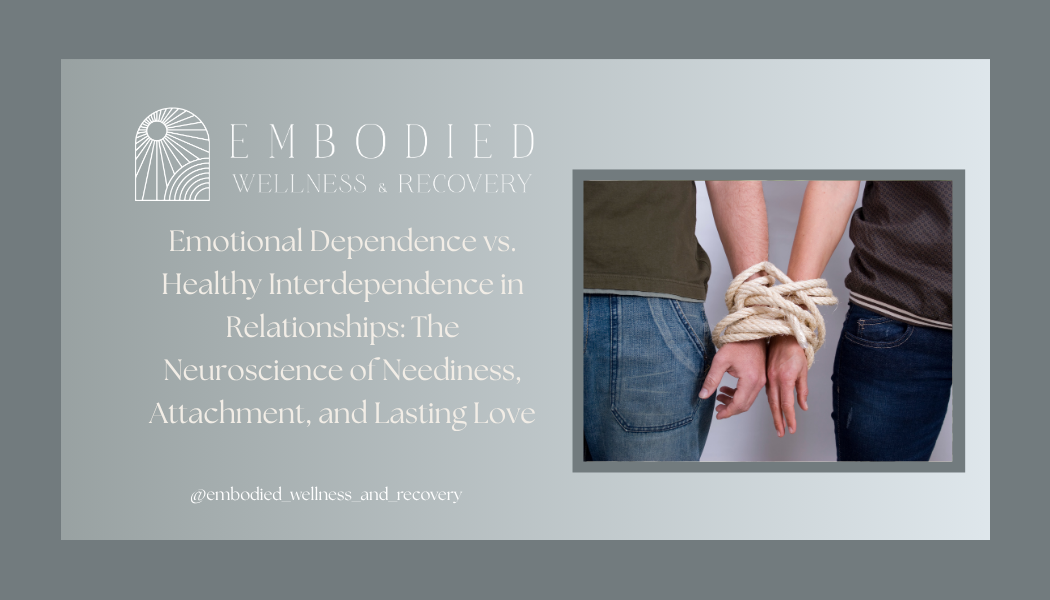
Emotional Dependence vs. Healthy Interdependence in Relationships: The Neuroscience of Neediness, Attachment, and Lasting Love
Emotional Dependence vs. Healthy Interdependence in Relationships: The Neuroscience of Neediness, Attachment, and Lasting Love
Do you feel too needy in relationships, or worry that your partner is overly dependent on you? Learn the difference between emotional dependence and healthy interdependence, how attachment styles and trauma influence relationship dynamics, and what neuroscience reveals about building secure, lasting intimacy.
Have you ever worried that you’re “too needy” in a relationship? Do you find yourself constantly seeking reassurance, feeling anxious when your partner doesn’t respond quickly, or struggling to feel secure when you’re apart? Or perhaps you’re on the other side of the equation. Do you feel overwhelmed by a partner who seems excessively dependent on you for validation, emotional regulation, or a sense of self-worth?
Questions about emotional dependence are among the most common concerns people bring into therapy and relationship counseling, yet many people misunderstand what healthy relationships actually require. Contrary to popular belief, healthy relationships are not built on complete independence. Nor are they built on emotional fusion.
The strongest relationships are built on something in between: healthy interdependence. Understanding the difference between emotional dependence and healthy interdependence can transform not only your relationships, but also your relationship with yourself.
Why the Fear of Being “Too Needy” Is So Common
Modern culture often glorifies independence.
Many people receive messages such as:
— Don’t need anyone.
— Be self-sufficient.
— Never rely on another person for happiness.
— Strong people handle everything themselves.
While self-reliance is valuable, humans are fundamentally relational beings. Research in attachment science consistently demonstrates that emotional connection and secure relationships are essential for psychological well-being (Mikulincer & Shaver, 2016). The desire for closeness, comfort, reassurance, and connection is not a weakness. It is part of being human. The problem arises when emotional needs become the primary source of stability, identity, or self-worth.
What Is Emotional Dependence?
Emotional dependence occurs when a person’s sense of security, value, or emotional stability becomes overly reliant on another person.
Common signs include:
— Constant reassurance seeking
— Fear of abandonment
— Difficulty making decisions independently
— Feeling emotionally devastated when a partner is unavailable
— Losing touch with personal interests, friendships, or goals
— Feeling incomplete without a relationship
For someone experiencing emotional dependence, the relationship can begin to feel less like a partnership and more like a lifeline. The nervous system begins to treat connection as a necessity for survival rather than a source of support.
What Is Healthy Interdependence?
Healthy interdependence looks very different.
Interdependent partners:
— Maintain a strong sense of self
— Support one another emotionally
— Value connection without losing individuality
— Communicate needs directly
— Respect boundaries
— Have lives both together and apart
— Can self-regulate while also seeking support
In healthy interdependence, both partners contribute to the relationship without expecting the other person to manage all emotional needs. The relationship becomes a source of strength rather than a substitute for internal stability.
The Neuroscience of Attachment and Neediness
To understand emotional dependence, it helps to understand attachment. Attachment is the biological system that drives humans to seek safety and connection with trusted others.
From infancy onward, our brains are shaped through relationships. When caregivers are consistently available, responsive, and attuned, children tend to develop secure attachment. When caregivers are inconsistent, unpredictable, emotionally unavailable, or frightening, attachment insecurity may develop.
Research has identified several attachment styles:
Secure Attachment
Individuals generally feel comfortable with intimacy and independence.
Anxious Attachment
Individuals often fear rejection, abandonment, or emotional distance.
Avoidant Attachment
Individuals tend to minimize emotional needs and prioritize self-reliance.
Disorganized Attachment
Individuals experience both a desire for closeness and a fear of it. Many people who describe themselves as “needy” are actually experiencing anxious attachment patterns rather than excessive need.
Why Trauma Can Intensify Emotional Dependence
Relationship anxiety often has deeper roots than the current relationship. Trauma, attachment injuries, childhood emotional neglect, betrayal,and inconsistent caregiving can shape how the nervous system experiences connection. If love once felt unpredictable, the brain may become hypervigilant for signs of rejection.
You may find yourself asking:
— Why do I panic when my partner pulls away?
— Why do I need constant reassurance?
— Why does a delayed text message feel so upsetting?
— Why do I feel insecure even in a loving relationship?
The answer is often found in the nervous system rather than logic. The brain is attempting to prevent future pain by monitoring for potential threats to connection.
Why Emotional Dependence Can Strain Relationships
Ironically, the more someone seeks constant reassurance, the more strain it often places on the relationship.
Partners may begin to feel:
— Responsible for another person’s emotions
— Overwhelmed
— Pressured
— Guilty
— Emotionally exhausted
Over time, this can create a cycle in which one partner pursues, and the other withdraws. The more one partner seeks closeness, the more the other creates distance. The greater the distance, the more anxiety increases. This pattern is one of the most common dynamics seen in couples therapy.
The Difference Between Having Needs and Being Dependent
One of the most important distinctions is this:
Having emotional needs is healthy. Expecting another person to meet all emotional needs is not.
Healthy needs include:
— Affection
— Emotional support
— Connection
— Trust
— Reliability
Problems arise when a partner becomes the sole source of:
— Identity
— Emotional regulation
— Purpose
— Security
Healthy relationships involve mutual support without emotional overreliance.
The Nervous System’s Role in Relationship Security
Many people try to solve relationship anxiety cognitively.
They tell themselves:
“I shouldn’t feel this way.”
“I need to stop being needy.”
“I need more confidence.”
While insight is helpful, nervous system regulation is often equally important. When the nervous system is activated, the brain becomes more likely to interpret ambiguity as danger.
A partner needing space may feel like rejection. A delayed response may feel like abandonment. A disagreement may feel like a threat to the relationship. Helping the nervous system feel safe can dramatically reduce relationship anxiety.
How to Build Healthy Interdependence
1. Strengthen Your Relationship With Yourself
Healthy partnerships are easier when you maintain:
— Personal interests
— Friendships
— Goals
— Hobbies
— Individual identity
A fulfilling life creates stability that does not depend entirely on the relationship.
2. Learn to Regulate Anxiety
Practices such as:
— EMDR
— Nervous system regulation exercises
can help reduce attachment-related distress.
3. Communicate Needs Directly
Rather than seeking reassurance indirectly through criticism, testing, or protest behaviors, communicate openly.
For example:
“I’m feeling disconnected and would love some quality time together.”
4. Challenge Shame About Having Needs
Healthy intimacy requires vulnerability. Needing connection does not make you weak. It makes you human.
5. Address Underlying Trauma
Many patterns of emotional dependence originate long before the current relationship. Working through attachment wounds often changes relationship dynamics in profound ways.
At Embodied Wellness and Recovery, we understand that relationship struggles rarely exist in isolation. Difficulty trusting, fears of abandonment, emotional dependence, intimacy challenges, and relationship anxiety are often connected to deeper attachment patterns and nervous system dysregulation. Our trauma-informed approach integrates neuroscience, attachment theory, EMDR, somatic therapies, and relationship-focused treatmentto help individuals and couples build greater emotional security.
The goal is not to become completely independent. Nor is it to rely entirely on another person. The goal is healthy interdependence. A relationship where two people can lean on one another without losing themselves.A relationship where connection and individuality coexist. A relationship where love feels supportive rather than suffocating. That balance is often where lasting intimacy begins.
Reach out to schedule a complimentary 20-minute consultation with our team of therapists, trauma specialists, somatic practitioners, or relationship experts, and start working towards integrative, embodied healing today.
📞 Call us at (310) 651-8458
📱 Text us at (310) 210-7934
📩 Email us at admin@embodiedwellnessandrecovery.com
🔗 Visit us at www.embodiedwellnessandrecovery.com
👉 Check us out on Instagram @embodied_wellness_and_recovery
🌍 Explore our offerings at Linktr.ee: https://linktr.ee/laurendummit
References
1) Bowlby, J. (1988). A secure base: Parent-child attachment and healthy human development. Basic Books.
2) Coan, J. A., & Sbarra, D. A. (2015). Social baseline theory: The social regulation of risk and effort. Current Opinion in Psychology, 1, 87-91.
3) Johnson, S. M. (2019). Attachment theory in practice: Emotionally focused therapy (EFT) with individuals, couples, and families. Guilford Press.
4) Mikulincer, M., & Shaver, P. R. (2016). Attachment in adulthood: Structure, dynamics, and change (2nd ed.). Guilford Press.
5) Siegel, D. J. (2020). The developing mind: How relationships and the brain interact to shape who we are (3rd ed.). Guilford Press.
Why Anxiety Makes It Hard to Trust Your Own Decisions: The Neuroscience of Overthinking, Self-Doubt, and Decision Paralysis
Why Anxiety Makes It Hard to Trust Your Own Decisions: The Neuroscience of Overthinking, Self-Doubt, and Decision Paralysis
Why does anxiety make it so hard to trust your own decisions? Discover the neuroscience behind indecision, overthinking, self-doubt, and anxiety. Learn how trauma, nervous system dysregulation, and chronic uncertainty affect decision-making and what helps restore confidence in yourself.
Have you ever spent hours agonizing over a decision that seemed simple to everyone else?
Should I stay in this relationship or leave?
Should I accept the job offer?
Should I speak up about what I need?
Should I move, invest, commit, confront, or wait?
Perhaps you make a decision only to spend the next several days replaying it in your mind, questioning whether you made the wrong choice. If this sounds familiar, you may not have a decision-making problem. You may just have anxiety.
Many people assume that anxiety primarily affects emotions. In reality, anxiety profoundly influences how the brain processes uncertainty, risk, prediction, and choice. When anxiety becomes chronic, trusting your own judgment can feel nearly impossible. Understanding why this happens can help you develop a more compassionate relationship with yourself and begin rebuilding confidence in your decision-making abilities.
The Hidden Relationship Between Anxiety and Indecision
One of the most common symptoms of anxiety is persistent uncertainty. The anxious brain constantly scans for potential threats, mistakes, and future problems. While this system evolved to protect us from danger, it can become overactive in modern life.
Instead of helping us make wise decisions, anxiety often traps us in cycles of:
— Overthinking
— Analysis paralysis
— Reassurance seeking
— Fear of making mistakes
— Difficulty committing to choices
Research suggests that individuals with anxiety tend to perceive uncertainty as particularly distressing and threatening, causing them to spend excessive cognitive resources attempting to predict and control future outcomes (Grupe & Nitschke, 2013). The result? The more important a decision feels, the harder it may become to make.
Why the Anxious Brain Craves Certainty
From a neuroscience perspective, anxiety is closely linked to the brain's threat detection system.
Several key regions are involved:
The Amygdala
The amygdala acts as an alarm system, constantly scanning for potential danger. When anxiety is elevated, the amygdala becomes more reactive, causing neutral situations to feel threatening.
The Prefrontal Cortex
The prefrontal cortex is responsible for planning, reasoning, judgment, and decision-making. Under stress, communication between the prefrontal cortex and emotional centers can become disrupted. As anxiety rises, clear thinking often becomes more difficult.
The Anterior Cingulate Cortex
This region helps monitor conflict and detect potential errors. Research suggests that anxious individuals may show heightened error monitoring, meaning the brain becomes exceptionally focused on avoiding mistakes (Shackman et al., 2011). In practical terms, this means every decision can feel loaded with risk.
When Trauma Teaches You Not to Trust Yourself
For many people, anxiety about decision-making extends beyond genetics or temperament. It is rooted in life experiences.
If you grew up in an environment where:
— Your feelings were dismissed
— Your perceptions were questioned
— You were criticized for mistakes
— You experienced emotional abuse
— Your needs were consistently ignored
— Caregivers were unpredictable
You may have learned to distrust your own internal experience.
Over time, this creates a painful internal narrative:
"What if I'm wrong?"
"What if I can't trust my judgment?"
"What if I miss something important?"
The nervous system becomes conditioned to associate decision-making with danger rather than confidence. Many trauma survivors are not simply afraid of making the wrong choice. They are afraid of the emotional consequences that historically followed mistakes.
The Paradox of Overthinking
Many anxious individuals believe that more thinking will eventually create certainty. Unfortunately, the opposite often occurs.
The brain begins generating endless possibilities:
What if this happens?
What if that happens?
What if I regret it?
What if there's a better option?
What if I'm overlooking something?
The search for certainty becomes a moving target. Research onanxiety consistently demonstrates that attempts to eliminate uncertainty often increase anxiety rather than reduce it (Dugas et al., 1998). The anxious mind seeks a level of certainty that simply does not exist in most real-life decisions.
Why Reassurance Never Fully Works
Do you frequently ask friends, family members, partners, or therapists what they think you should do? While seeking support is healthy, chronic reassurance seeking can become another manifestation of anxiety.
Why? Because reassurance temporarily lowers distress without addressing the underlying fear. Soon after receiving reassurance, uncertainty returns.
The brain begins asking:
"But what if they're wrong?"
"What if they don't understand the whole situation?"
"What if circumstances change?"
The cycle continues. True confidence is not built through certainty. It is built through learning to tolerate uncertainty.
The Nervous System's Role in Decision-Making
Decision-making is not solely a cognitive process. It is also a physiological process. When the nervous system is chronically activated, the body remains in a state of protection.
Signs of nervous system dysregulation may include:
— Muscle tension
— Difficulty sleeping
— Emotional overwhelm
In this state, the brain prioritizes survival over clarity.
The question becomes:
"How do I stay safe?"
rather than
"What feels aligned with my values?"
This is one reason why individuals often find it easier to make decisions after engaging in activities that calm the nervous system.
The Neuroscience of Learning to Trust Yourself
The encouraging news is that self-trust is not a personality trait. It is a skill. Like any skill, it can be strengthened. Neuroplasticity research demonstrates that the brain continually adapts in response to experience.
Each time you:
— Make a decision
— Tolerate uncertainty
— Survive discomfort
— Learn from outcomes
— Practice self-compassion
You provide your brain with evidence that you can navigate life's challenges. Confidence is not created by always making the perfect choice. Confidence develops through repeated experiences of handling whatever comes next.
Practical Strategies for Decision Anxiety
1. Regulate Before You Evaluate
When your nervous system is activated, decision-making becomes more difficult.
Before making an important choice, consider:
— Walking
— Yoga
A regulated nervous system often sees options more clearly.
2. Ask Different Questions
Instead of asking:
"What is the perfect decision?"
Try asking:
"Which choice feels most aligned with my values right now?"
No decision can eliminate all uncertainty.
3. Limit Excessive Research
Many anxious individuals spend enormous amounts of time gathering information. At some point, additional information stops improving decision quality and starts fueling anxiety.
4. Practice Small Acts of Trust
Self-trust grows incrementally.
Start with smaller decisions:
— Choosing a restaurant
— Setting a boundary
— Expressing a preference
These seemingly minor moments teach the brain that your perspective matters.
5. Address the Underlying Trauma
If chronic self-doubt stems from attachment wounds, developmental trauma, betrayal, or emotionally invalidating relationships, deeper therapeutic work may be necessary. Often, the issue is not the decision itself. The issue is the nervous system's learned expectation that making decisions is unsafe.
How Embodied Wellness and Recovery Helps
At Embodied Wellness and Recovery, we understand that chronic indecision is often about much more than uncertainty.
It may reflect:
— Attachment injuries
— Nervous system dysregulation
— Shame
— Loss of self-trust
Our approach integrates neuroscience, trauma-informed care, somatic therapy, EMDR, attachment-focused treatment, and nervous system regulation to help clients reconnect with their internal wisdom. Rather than teaching people how to make perfect decisions, we help them cultivate something far more valuable: The ability to trust themselves even when certainty is unavailable.
Confidence is not the absence of uncertainty. Confidence is the belief that you can navigate uncertainty with resilience, self-awareness, and self-compassion. When that shift occurs, decision-making becomes less about finding guarantees and more about honoring your values, your needs, and your authentic experience. And that is often where genuine self-trust begins.
Reach out to schedule a complimentary 20-minute consultation with our team of therapists, trauma specialists, somatic practitioners, or relationship experts, and start working towards integrative, embodied healing today.
📞 Call us at (310) 651-8458
📱 Text us at (310) 210-7934
📩 Email us at admin@embodiedwellnessandrecovery.com
🔗 Visit us at www.embodiedwellnessandrecovery.com
👉 Check us out on Instagram @embodied_wellness_and_recovery
🌍 Explore our offerings at Linktr.ee: https://linktr.ee/laurendummit
References
Dugas, M. J., Gagnon, F., Ladouceur, R., & Freeston, M. H. (1998). Generalized anxiety disorder: A preliminary test of a conceptual model. Behaviour Research and Therapy, 36(2), 215-226.
Grupe, D. W., & Nitschke, J. B. (2013). Uncertainty and anticipation in anxiety: An integrated neurobiological and psychological perspective. Nature Reviews Neuroscience, 14(7), 488-501.
Shackman, A. J., Salomons, T. V., Slagter, H. A., Fox, A. S., Winter, J. J., & Davidson, R. J. (2011). The integration of negative affect, pain, and cognitive control in the cingulate cortex. Nature Reviews Neuroscience, 12(3), 154-167.
Siegel, D. J. (2020). The developing mind: How relationships and the brain interact to shape who we are (3rd ed.). Guilford Press.