
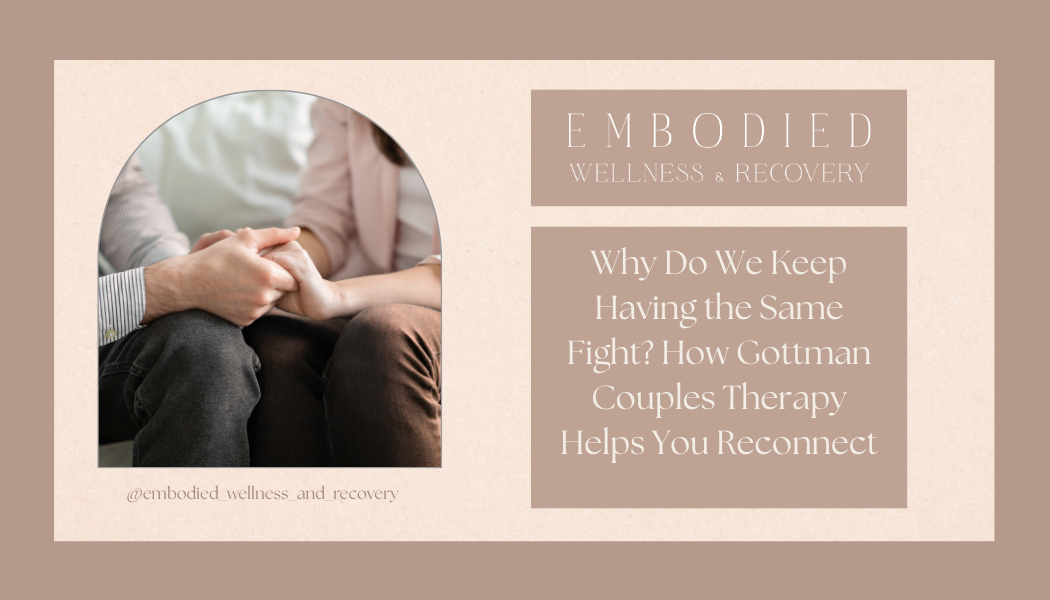
Why Do We Keep Having the Same Fight? How Gottman Couples Therapy Helps You Reconnect
Why Do We Keep Having the Same Fight? How Gottman Couples Therapy Helps You Reconnect
Stuck in the same arguments? Learn how Gottman couples therapy helps improve communication, manage conflict, and rebuild trust and emotional intimacy.
The argument starts with dishes, spending, or another evening spent looking at separate screens. Within minutes, you are defending yourself against accusations you have heard before. You explain harder. Your partner withdraws further. Eventually, someone apologizes or changes the subject. But nothing feels resolved.
Why do we keep having the same fight? Why does my partner shut down when I need reassurance? How can we love each other and still feel so misunderstood?
Recurring relationship conflict can leave couples exhausted and uncertain about their future. Gottman couples therapy offers practical ways to understand the pattern, communicate differently, and rebuild connection.
Why Couples Keep Having the Same Arguments
Repeated arguments often involve an unresolved emotional meaning beneath the immediate problem. A disagreement about household responsibilities may carry the question, “Can I depend on you?” Conflict about sex may involve fears of rejection, pressure, or inadequacy. An argument about money may reflect different needs for security and independence.
Consider this cycle: One partner feels overlooked and protests. The other hears criticism and becomes defensive. The first escalates to get a response. The second withdraws to escape the tension. Each person’s attempt to protect themselves intensifies the other’s distress.
Gottman and Levenson’s (1992) longitudinal research linked patterns of marital interaction and physiology with later relationship outcomes. Their findings helped establish that understanding conflict requires attention to both behavior and bodily responses. These associations do not determine any individual couple’s future. PubMed
What Is Gottman Couples Therapy?
Developed by John and Julie Gottman, the Gottman Method combines relationship assessment with structured interventions addressing friendship, conflict management, and shared meaning. Couples learn to recognize destructive interactions, express needs more clearly, and respond to everyday opportunities for connection. Treatment aims to increase respect, affection, and intimacy while helping partners navigate differences (The Gottman Institute, n.d.-b).
Does Gottman therapy work? Research offers encouraging findings, with limitations. In a small study involving 16 Iranian couples, participants receiving Gottman couple therapy showed improvements in marital adjustment and intimacy compared with a control group. The small sample and specific cultural setting limit generalization (Davoodvandi et al., 2018).
Five Ways Gottman Therapy Helps You Reconnect
1. Recognize the Four Horsemen
The Gottman framework identifies four damaging communication patterns: criticism, contempt, defensiveness, and stonewalling. Its corresponding skills include gentle complaints, appreciation, taking responsibility, and physiological self-soothing (The Gottman Institute, n.d.-a).
What happens when “You never help” becomes “I’m overwhelmed and need help cleaning up tonight”?
The concern remains clear, but the request gives your partner something specific to respond to. Therapy helps couples practice these changes without requiring either person to suppress legitimate frustration.
2. Notice Emotional Flooding Before Escalation
Does your heart race during conflict? Do you lose your words, feel trapped, or feel an urgent need to leave?
Gottman describes overwhelming physiological arousal during conflict as flooding. Learning to recognize it helps couples decide when to pause instead of continuing an increasingly unproductive conversation.
The Gottman approach recommends a self-soothing break of at least 20 minutes. Agreeing on a return time helps distinguish a constructive pause from indefinite withdrawal. Individual settling times vary. A useful starting point: “I want to understand you, and I’m too overwhelmed right now. Let’s take a break and return at 7:30.”
3. Understand the Need Beneath the Complaint
Before responding to an accusation, ask: What matters so much about this issue?
Try asking yourself:
— What am I afraid my partner’s behavior means?
— What do I need them to understand?
— What specific change would help?
“I need more notice when plans change” is easier to address than “You don’t care about me.”
Understanding a partner’s experience does not require agreeing with every interpretation. It creates room for a more useful conversation.
4. Practice Repair After Disconnection
Couples need ways to recover when conversations go poorly. A repair might sound like, “That came out harshly. Let me try again,” or “I understand why that hurt. I want to take responsibility for my part.”
The Gottman Method includes interventions that help couples repair conflict and strengthen their friendship (The Gottman Institute, n.d.-b). A meaningful apology becomes more credible when followed by observable change. Repeated reassurance without follow-through can deepen disappointment.
5. Rebuild Connection Outside Arguments
When did you last feel curious about your partner rather than frustrated with them? The Gottman approach encourages partners to strengthen friendship and respond to bids for connection, such as a question, shared observation, or request for attention.
Connection also has a neurobiological dimension. In an fMRI study of 16 married women anticipating electric shock, holding a spouse’s hand reduced activity in neural systems associated with threat responding (Coan et al., 2006). This laboratory finding supports the importance of supportive relationships, but does not establish that touch resolves conflict or is welcome in every moment.
A Path Toward Greater Trust and Intimacy
At Embodied Wellness and Recovery, our expertise spans trauma, nervous system regulation and repair, relationships, sexuality, and intimacy, We integrate relationship skills with attention to attachment wounds, bodily responses, and the experiences shaping each partner’s reactions.
For couples experiencing coercive control or fear of retaliation, safety and individual assessment take priority over communication exercises. For many couples, progress begins with a manageable change: noticing escalation earlier, making one clearer request, or returning to a conversation with greater care.
You do not have to resolve every difference to build a more connected relationship. You can learn to approach those differences with curiosity, accountability, and mutual respect.
Explore couples therapy at Embodied Wellness and Recovery.
Contact us today to schedule a free 20-minute consultation with our team of somatic practitioners, trauma specialists, and relationship experts and begin your journey toward embodied connection with yourself and others.
📞 Call us at (310) 651-8458
📱 Text us at (310) 210-7934
📩 Email us at admin@embodiedwellnessandrecovery.com
🔗 Visit us at www.embodiedwellnessandrecovery.com
👉 Check us out on Instagram @embodied_wellness_and_recovery
🌍 Explore our offerings at Linktr. ee: https://linktr.ee/laurendummit
References
Coan, J. A., Schaefer, H. S., & Davidson, R. J. (2006). Lending a hand: Social regulation of the neural response to threat. Psychological Science, 17(12), 1032–1039.
Davoodvandi, M., Navabi Nejad, S., & Farzad, V. (2018). Examining the effectiveness of Gottman couple therapy on improving marital adjustment and couples’ intimacy. Iranian Journal of Psychiatry, 13(2), 135–141.
Gottman, J. M., & Levenson, R. W. (1992). Marital processes predictive of later dissolution: Behavior, physiology, and health. Journal of Personality and Social Psychology, 63(2), 221–233.
The Gottman Institute. (n.d.-a). The four horsemen: The antidotes.
The Gottman Institute. (n.d.-b). The Gottman method.
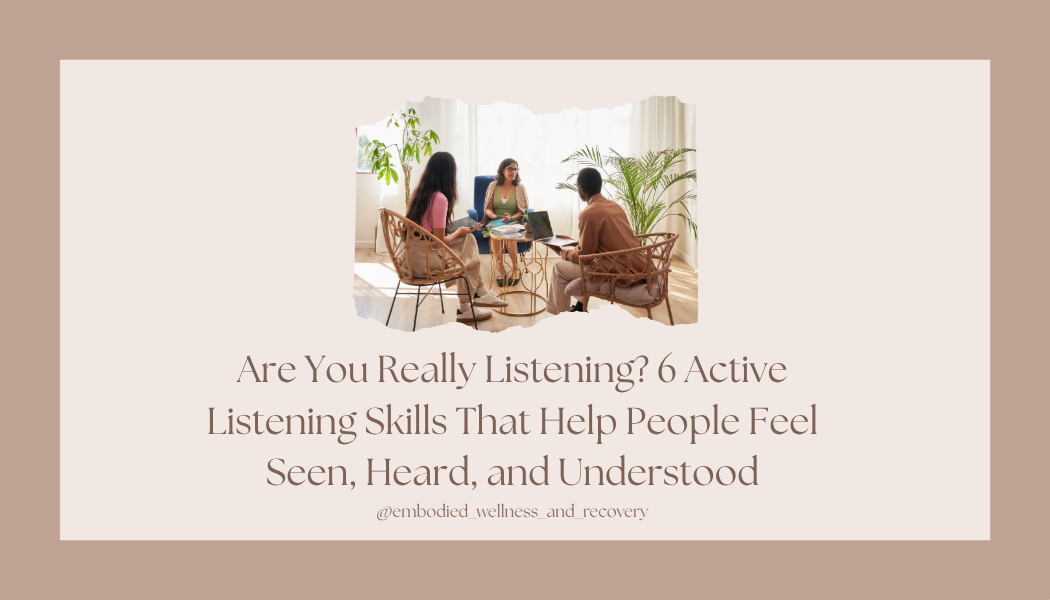
Are You Really Listening? 6 Active Listening Skills That Help People Feel Seen, Heard, and Understood
Are You Really Listening? 6 Active Listening Skills That Help People Feel Seen, Heard, and Understood
Learn 6 active listening skills to improve communication, strengthen relationships, reduce conflict, and help the people you love feel truly seen, heard, and understood.
Have you ever shared something vulnerable with someone, only to walk away feeling strangely more alone? Maybe they offered advice you never asked for. Maybe they immediately explained their side. Perhaps they reassured you that everything would be fine, changed the subject, or told you not to feel the way you do. They may have heard every word you said, but did they actually listen?
Feeling unheard, unseen, or misunderstood can be deeply painful, particularly in our closest relationships. Over time, conversations that repeatedly end in defensiveness, dismissal, interruption, or unsolicited problem-solving can create emotional distance. The good news is that active listening is a skill, and like most relational skills, it strengthens with practice.
What Is Active Listening?
Active listening means giving another person your attention to understand their experience, rather than simply preparing your response. High-quality listening involves attention, comprehension, and positive intention. Research increasingly suggests that these behaviors matter. In two preregistered studies involving 646 participants, verbal validation, follow-up questions, and other high-quality listening behaviors were associated with stronger markers of social connection (West et al., 2025).
Even more compelling, across five experiments involving more than 1,600 participants, high-quality listening reduced feelings of loneliness after people discussed experiences of social rejection (Weinstein et al., 2023). In other words, listening is not merely conversational etiquette. It is one way human beings experience connection.
Why Does Feeling Heard Matter to the Nervous System?
Our brains are constantly evaluating the social environment.
Am I safe here?
Do I matter?
Will this person respond to me?
Can I show them who I really am?
When someone is emotionally attuned to us, their facial expressions, tone of voice, eye contact, posture, timing, and responses provide important interpersonal information. For people with histories of trauma, attachment wounds, betrayal, emotional neglect, or chronically invalidating relationships, being misunderstood may carry even greater emotional weight. A seemingly small interruption or dismissive response can sometimes activate an older expectation: My feelings don't matter here.
Active listening cannot resolve every disagreement, but it can communicate something powerful:
"I am interested in understanding your experience, even when it is different from mine."
Here are six ways to practice it.
1. Listen to Understand, Not to Respond
Many of us listen while simultaneously constructing our defense, explanation, solution, or counterargument. Try noticing when your attention shifts from the speaker's experience to your own response.
Instead of asking yourself, "What am I going to say?" try asking:
"What is this person trying to help me understand?"
You can disagree later. Understanding does not require agreement.
2. Reflect What You Heard
One of the simplest active listening techniques is reflection.
Try:
"It sounds like you felt dismissed when that happened."
"What I'm hearing is that you weren't necessarily asking me to fix it. You wanted me to understand why it hurt."
Reflection gives the speaker an opportunity to say, "Exactly," or equally importantly, "Not quite." The goal isn't to prove you understood correctly. It is to remain curious until you do.
3. Ask Curious Follow-Up Questions
Questions communicate interest when you ask them to understand rather than interrogate. Research has specifically identified relevant follow-up questions as one observable behavior associated with high-quality listening and social connection (West et al., 2025).
Try asking:
"What was the hardest part for you?"
"What did you need from me in that moment?"
"When you say you felt alone, what did that feel like?"
Then allow the answer to change what you thought you understood.
4. Validate Before You Problem-Solve
When someone we love is hurting, the impulse to fix the problem can be strong. But solutions offered too quickly can inadvertently communicate, “Let's make this feeling go away.” Validation communicates something different: "Given what happened, I can understand why you felt that way."
Validation doesn't mean you agree with every interpretation or behavior. It means recognizing that another person's emotional experience has an understandable internal logic. Before asking, "How do we fix this?" consider asking, "Do you want help solving this, or would it feel better for me to just listen right now?"
5. Regulate Yourself While You Listen
Active listening becomes much harder when your own nervous system perceives the conversation as threatening. You may notice an urge to interrupt, defend yourself, withdraw, correct details, raise your voice, or end the conversation.
Before responding, notice your body. Unclench your jaw. Lower your shoulders. Feel your feet against the floor. Lengthen your exhale. Give yourself a few seconds before speaking. This is particularly important during couples conflict. Sometimes the most powerful communication skill is staying emotionally present long enough to hear something difficult without immediately protecting yourself from it.
6. Listen for the Feeling Beneath the Words
People do not always communicate their deepest need directly.
"You're always on your phone" might contain:
I miss you.
"You never tell me anything anymore" might contain:
I don't feel important to you.
"Why didn't you call me?" might contain:
I was scared that I didn't matter.
Instead of responding only to the accusation, listen for the attachment need underneath it.
You might say:
"Are you telling me that when I didn't call, you felt unimportant to me?"
That question can transform the emotional direction of a conversation.
When Both People Are Talking but Nobody Feels Heard
Communication problems are not always caused by a lack of love. Sometimes two people care deeply about each other but have nervous systems that become organized around self-protection rather than connection during conflict. One pursues. The other withdraws. One becomes louder. The other shuts down. One desperately tries to be understood. The other becomes increasingly defensive. Soon, both people are listening for threat rather than listening for meaning. This is where therapy can help.
Learning to Feel Seen, Heard, and Understood
At Embodied Wellness and Recovery, we understand communication as more than choosing the right words. Our work integrates trauma treatment, nervous system regulation, attachment, relationships, sexuality, and intimacy to help individuals and couples understand what happens beneath their communication patterns.
We help clients recognize when past experiences enter present conversations, build greater capacity for emotional regulation, communicate vulnerable needs more directly, and learn to stay connected without abandoning themselves.
Sometimes the question is not simply:
"Are you listening?"
It is:
"Can you stay present with me long enough to understand what I am really trying to say?"
That is where meaningful connection often begins.
Reach out to schedule a complimentary 20-minute consultation with our team of therapists, trauma specialists, somatic practitioners, or relationship experts, and start working towards integrative, embodied healing today.
📞 Call us at (310) 651-8458
📱 Text us at (310) 210-7934
📩 Email us at admin@embodiedwellnessandrecovery.com
🔗 Visit us at www.embodiedwellnessandrecovery.com
👉 Check us out on Instagram @embodied_wellness_and_recovery
🌍 Explore our offerings at Linktr.ee: https://linktr.ee/laurendummit
References
Weinstein, N., Huo, A., Itzchakov, G., & Keltner, D. (2023). Connection heals wounds: Feeling listened to reduces speakers' loneliness following a social rejection disclosure. Personality and Social Psychology Bulletin, 49(8), 1273–1294.
West, T. N., Huston, S., Chandler, K. R., Zhou, J., & Fredrickson, B. L. (2025). High-quality listening behaviors linked to social connection between strangers. Communications Psychology, 3, 165.
Weger, H., Jr., Castle Bell, G., Minei, E. M., & Robinson, M. C. (2014). The relative effectiveness of active listening in initial interactions. International Journal of Listening, 28(1), 13–31.
Why Do I Feel Lonely When I Have Friends? The Hidden Loneliness of High-Functioning People
Why Do I Feel Lonely When I Have Friends? The Hidden Loneliness of High-Functioning People
Why do successful, high-functioning people feel lonely even with friends, family, and full lives? Explore the neuroscience of emotional loneliness, trauma, relationships, and authentic connection.
You have friends. People text you. Your calendar is full. You may have a partner, children, colleagues, clients, neighbors, a thriving career, and people who depend on you. From the outside, your life may look rich with connection.
So why do you still feel lonely?
Perhaps the loneliness hits after everyone leaves. Maybe you notice it lying beside someone you love or sitting at dinner with people who know almost everything about your life, yet somehow do not seem to know you.
Or perhaps loneliness is not even the word you would use. You might call it emptiness. Restlessness. Disconnection. A vague sadness you cannot explain. You might simply think, "Something is missing." This is the hidden loneliness of high-functioning people, and it reveals something important about human connection:
Loneliness is not simply the absence of people. It is the absence of a felt sense of connection.
What Is High-Functioning Loneliness?
"High-functioning loneliness" is not a clinical diagnosis. It is a useful way of describing an experience in which someone appears socially connected and competent while privately experiencing profound emotional disconnection. Loneliness researchers distinguish between objective social isolation and perceived social isolation, or loneliness. You can spend considerable time alone without feeling lonely. Conversely, you can have dozens of relationships and experience significant loneliness.
Research by social neuroscientists John and Stephanie Cacioppo emphasizes that loneliness reflects a perceived discrepancy between the relationships we have and the relationships we need or desire. In other words, the size of your social network does not necessarily predict whether you feel connected (Cacioppo & Cacioppo, 2014).
This explains a paradox many high-functioning adults experience:
You can be needed by many people while feeling deeply known by very few.
Why Do I Feel Lonely Even Though I Have Friends?
Consider your relationships for a moment.
Who calls when they need advice?
Who relies on you when something goes wrong?
Who comes to you because you are competent, calm, funny, helpful, nurturing, productive, or emotionally steady?
Now ask a different question:
Who knows what happens inside you when you are not any of those things?
Who knows when you are scared?
Who sees your uncertainty?
Who knows what you long for?
Who can sit beside you when there is nothing to fix?
Who knows the parts of you that are messy, needy, angry, confused, sexual, grieving, ashamed, playful, tender, or unfinished?
For many high-functioning people, relationships gradually become organized around roles rather than mutual emotional intimacy.
You become the therapist friend, the responsible sibling, the successful professional, the capable mother, the dependable partner, or the person who remembers birthdays, organizes dinner, handles emergencies, listens carefully, solves problems, and rarely needs much in return. These roles can create enormous social value. They can also become surprisingly lonely.
When Being Needed Becomes a Substitute for Being Known
Being needed can feel remarkably similar to being connected, but psychologically, they are not the same. When people depend on us, we receive frequent signals that we matter. There are phone calls, requests, responsibilities, invitations, questions, problems to solve. The nervous system may interpret all of this activity as evidence of belonging.
Yet underneath it can exist an uncomfortable question:
If I stopped being useful, would people still come looking for me?
This question can become especially powerful during midlife. Children become more independent. Careers change. Parents age. Relationships evolve. Hormonal transitions can alter mood, sleep, sexual desire, emotional sensitivity, and one's sense of identity. Suddenly, the roles that once answered the question "Who am I?" may no longer feel sufficient, and beneath the busyness, loneliness becomes easier to hear.
The Neuroscience of Loneliness: Your Brain Measures Connection Differently
The human brain evolved within relationships. For most of human history, belonging was not simply emotionally pleasant. It was protective. Being separated from one's group increased vulnerability, while social bonds increased access to protection, food, caregiving, and reproductive survival. This helps explain why loneliness can feel physically uncomfortable.
Research suggests that perceived social isolation is associated with changes across neural systems involved in attention, threat detection, emotional processing, memory, and social cognition. A systematic review of 41 neurobiological studies found associations between loneliness and regions including the prefrontal cortex, insula, amygdala, hippocampus, and networks involved in attention and social processing (Lam et al., 2021).
One particularly fascinating large-scale neuroimaging study examined approximately 40,000 participants and found differences associated with loneliness concentrated within the brain's default mode network, a system involved in autobiographical memory, imagining the future, understanding other people's perspectives, and internally simulating social experiences (Spreng et al., 2020).
Researchers proposed that greater reliance on these internal processes might partly reflect the brain attempting to compensate for desired social experiences that are missing externally.
In simpler terms:
The lonely brain may spend more time thinking about connection because it is not experiencing enough of the kind of connection it needs.
Your Nervous System May Be Protecting You From the Intimacy You Want
There is another layer to high-functioning loneliness that deserves attention: trauma and attachment. Some people learned early that competence was safer than vulnerability. Perhaps affection was inconsistent. Maybe a parent was emotionally unavailable, overwhelmed, intrusive, critical, addicted, unpredictable, or preoccupied. Perhaps you received praise for achieving but little curiosity about how you felt.
You may have learned:
Do not need too much.
Do not burden people.
Handle it yourself.
Stay useful.
Stay impressive.
Keep everyone happy.
Do not let anyone see how much you care.
These adaptations can become extraordinary strengths. They can help create successful adults, but the nervous system strategy that helped you become independent can later interfere with emotional intimacy. You may crave closeness while automatically protecting yourself from the very vulnerability closeness requires.
The Loneliness of Being "Fine"
High-functioning people are often exceptionally good at appearing fine.
Someone asks, "How are you?"
"Good! Busy."
And the conversation moves on. But imagine answering differently.
"I've actually been feeling strangely disconnected lately."
"I don't think many people really know how I'm doing."
"I'm struggling more than I've been letting people see."
Those sentences create something productivity cannot create: the possibility of being met. Emotional intimacy requires some degree of emotional visibility. If everyone receives the polished version of you, they may genuinely love you while remaining unable to reach you.
That is one of the cruel paradoxes of high-functioning loneliness:
Sometimes we believe people are failing to see us while simultaneously making ourselves extraordinarily difficult to see.
Loneliness in Marriage and Long-Term Relationships
Perhaps one of the most painful forms of loneliness occurs when you are lying beside someone. A relationship can function beautifully on a logistical level while becoming emotionally impoverished. You manage children, pay bills, discuss schedules, attend social events, run a household, have sex occasionally, or perhaps stop having it.
Everything technically works, yet emotional intimacy gradually disappears. Couples may stop asking questions that do not have practical answers.
What are you afraid of lately?
What do you miss about us?
When do you feel closest to me?
What makes you feel desired?
What part of yourself have you lost?
What do you wish I understood without your having to explain it?
For many couples, restoring connection requires more than spending additional time together. It requires rebuilding emotional safety, curiosity, vulnerability, affection, sensuality, and sexual intimacy.
Chronic Loneliness Is More Than an Emotional Problem
Persistent loneliness deserves attention because social connection is closely associated with physical as well as psychological health. The U.S. Surgeon General's advisory on social connection highlighted evidence linking social isolation and poor social relationships with increased risks for premature mortality and cardiovascular disease. Longitudinal research has also demonstrated a reciprocal relationship between loneliness and depressive symptoms, meaning loneliness can contribute to depression while depression can make meaningful connection more difficult (Cacioppo et al., 2010).
This does not mean occasional loneliness is pathological. Loneliness can be understood as information. Just as hunger signals a need for nourishment, loneliness can signal a discrepancy between the connection you currently experience and the connection your nervous system needs.
The question becomes:
What kind of connection am I actually hungry for?
How to Feel Less Lonely When Your Life Is Already Full
For a high-functioning person, the solution is often not adding more people to an already crowded calendar. It may be creating greater depth within fewer relationships. Start by noticing where you perform rather than connect.
Ask yourself:
Where can I be useful but not vulnerable?
Which relationships allow me to receive instead of always give?
Who knows what I am struggling with right now?
When someone offers care, do I let myself receive it?
Do I confuse independence with emotional safety?
Am I waiting for someone to ask the perfect question before I reveal what I need?
When intimacy becomes uncomfortable, do I change the subject, make a joke, become busy, intellectualize, withdraw, or focus on the other person?
Experiment with small doses of greater authenticity. Tell a trusted friend what is actually happening. Ask for something instead of automatically providing it. Allow someone to comfort you without immediately reassuring them that you are fine. Have the conversation with your partner that you keep postponing. Put down the phone when someone you love is talking. Spend time with people who make your body feel more settled, spontaneous, curious, and alive.
Connection is not measured simply by proximity. It is measured by presence, safety, reciprocity, authenticity, and emotional attunement.
You May Not Need More People. You May Need to Be More Fully Present in Your Relationships
There is nothing inherently wrong with being competent, independent, productive, or needed. The goal is not to become less capable. It is to discover whether capability has become armor. The deeper work may involve learning that relationships can hold more of you than the polished version you have learned to present.
At Embodied Wellness and Recovery, we work with individuals and couples navigating trauma, attachment wounds, nervous system dysregulation, emotional disconnection, relationship difficulties, sexuality, intimacy, anxiety, depression, and major life transitions.
Our approach integrates neuroscience-informed psychotherapy with attention to the body and nervous system because connection is not merely something we understand intellectually. It is something we learn to experience physiologically. A person can know intellectually that they are loved while their body remains braced for rejection. They can understand that their partner is safe while struggling to surrender into intimacy. They can have dozens of friends while never allowing themselves to depend on anyone.
The work, then, is not simply becoming more social. It is developing the capacity to be seen, receive care, tolerate vulnerability, communicate needs, remain present during intimacy, and experience connection without having to earn it through usefulness.
Perhaps the question is not:
"Why am I lonely when I have so many people in my life?"
Perhaps it is:
"Where in my life do I feel safe enough to be fully known?"
The answer may reveal far more about loneliness than the number of names in your phone ever could.
Reach out to schedule a complimentary 20-minute consultation withour team of therapists,trauma specialists, somatic practitioners, orrelationship experts and start working towards integrative, embodied healing today.
📞 Call us at (310) 651-8458
📱 Text us at (310) 210-7934
📩 Email us at admin@embodiedwellnessandrecovery.com
🔗 Visit us at www.embodiedwellnessandrecovery.com
👉 Check us out on Instagram @embodied_wellness_and_recovery
🌍 Explore our offerings at Linktr.ee: https://linktr.ee/laurendummit
References
Cacioppo, J. T., & Cacioppo, S. (2014). Social relationships and health: The toxic effects of perceived social isolation. Social and Personality Psychology Compass, 8(2), 58–72.
Cacioppo, J. T., Hawkley, L. C., & Thisted, R. A. (2010). Perceived social isolation makes me sad: Five-year cross-lagged analyses of loneliness and depressive symptomatology in the Chicago Health, Aging, and Social Relations Study. Psychology and Aging, 25(2), 453–463.
Hawkley, L. C., & Cacioppo, J. T. (2010). Loneliness matters: A theoretical and empirical review of consequences and mechanisms. Annals of Behavioral Medicine, 40(2), 218–227.
Lam, J. A., Murray, E. R., Yu, K. E., Ramsey, M., Nguyen, T. T., Mishra, J., Martis, B., Thomas, M. L., & Lee, E. E. (2021). Neurobiology of loneliness: A systematic review. Neuropsychopharmacology, 46, 1873–1887.
Spreng, R. N., Dimas, E., Mwilambwe-Tshilobo, L., Dagher, A., Koellinger, P., Nave, G., Ong, A., Kernbach, J. M., Wiecki, T. V., Ge, T., Li, Y., Holmes, A. J., Yeo, B. T. T., Turner, G. R., Dunbar, R. I. M., & Bzdok, D. (2020). The default network of the human brain is associated with perceived social isolation. Nature Communications, 11, 6393.
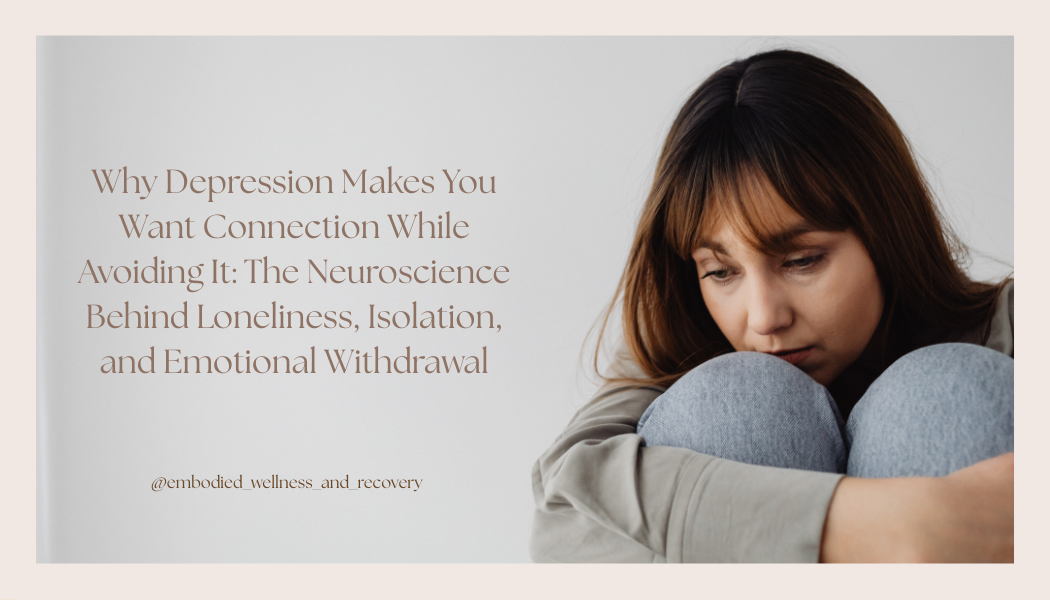
Why Depression Makes You Want Connection While Avoiding It: The Neuroscience Behind Loneliness, Isolation, and Emotional Withdrawal
Why Depression Makes You Want Connection While Avoiding It: The Neuroscience Behind Loneliness, Isolation, and Emotional Withdrawal
Depression often makes people crave connection while simultaneously making it difficult to seek it. Learn how depression affects motivation, loneliness, relationships, and the brain, and discover neuroscience-informed strategies to rebuild meaningful connection and emotional well-being.
Have you ever found yourself longing for connection while ignoring texts, canceling plans, or avoiding phone calls?
Do you desperately miss feeling close to people, yet the thought of socializing feels exhausting?
Have you wondered why you feel lonely, but cannot seem to find the motivation to reach out to someone you love?
Maybe you've caught yourself thinking:
"I don't have the energy."
"I'll just bring everyone down."
"They probably don't want to hear from me."
"I'll respond tomorrow."
Days become weeks. Weeks become months.
What began as a need for a little space quietly transforms into isolation.
One of the cruelest aspects of depression is that it often steals the very thing that helps people recover: meaningful human connection.
Understanding why this happens can replace self-criticism with something far more productive: curiosity.
Depression Does Not Simply Affect Mood
When people think about depression, they often imagine sadness, but depression affects far more than emotions. It changes motivation. It alters attention. It reduces energy. It influences decision-making. It changes how the brain predicts future experiences. From a neuroscience perspective, depression disrupts multiple brain networks involved in reward, emotional regulation, and social connection.
Activities that once felt enjoyable often no longer generate the same anticipation or satisfaction. This phenomenon, known as anhedonia, reduces motivation to pursue experiences that would normally feel rewarding, including spending time with people you care about. In other words, depression doesn't simply make you feel sad. It makes connection feel less possible.
Why Loneliness and Depression Reinforce Each Other
Humans are biologically wired for connection. Supportive relationships help regulate the nervous system, lower stress hormones, increase oxytocin, and provide emotional safety during difficult times. Unfortunately, depression often interrupts this natural process. The more isolated someone becomes, the fewer opportunities the brain has to experience positive social interactions. Without those experiences, depression often deepens.
Researchers have consistently found a bidirectional relationship between loneliness and depression. Loneliness increases the risk of depressive symptoms, while depression increases withdrawal from meaningful relationships.
This creates a painful cycle. Depression decreases motivation. Isolation increases. Loneliness grows. Depression worsens. The problem isn't that someone no longer values relationships. Their brain has temporarily lost access to the motivation needed to pursue them.
The Hidden Beliefs That Keep People Isolated
Depression rarely whispers the truth. Instead, it often tells convincing stories.
"They're too busy."
"They're better off without me."
"I'll be a burden."
"No one would understand."
"I have nothing interesting to say."
These thoughts often feel like facts, yet depression changes how the brain interprets social information. Research suggests that depression increases negative cognitive bias, making people more likely to notice rejection, underestimate acceptance, and assume others are judging them more harshly than they actually are (Fennell, 1997).
As a result, reaching out begins to feel emotionally risky, not because people no longer care, but because depression has convinced the brain they won't.
Trauma Can Make Isolation Feel Safer
For many individuals, depression is not the entire story. Trauma often shapes how the nervous system experiences relationships. If previous relationships involved rejection, criticism, emotional neglect, abuse, betrayal, or unpredictability, the brain may begin associating closeness with danger rather than comfort. The nervous system adapts. Withdrawal becomes protection. Isolation becomes predictable. Connection begins to feel uncertain.
At Embodied Wellness and Recovery, we frequently help clients understand that emotional withdrawal is often less about lacking social skills and more about a nervous system trying to reduce perceived threat.
The Brain Conserves Energy During Depression
Depression affects motivation because the brain shifts into an energy-conserving state.
Tasks that once seemed effortless suddenly require enormous effort.
Replying to a text.
Scheduling dinner.
Returning a phone call.
Getting dressed.
Driving somewhere.
Even enjoyable activities can feel overwhelmingly demanding. This does not reflect laziness. It reflects changes in neural circuits involved in motivation, reward processing, and executive functioning. Understanding this distinction often reduces shame.
Why Relationships Still Matter
Although depression decreases motivation for connection, relationships remain one of the most powerful regulators of emotional health. Emotionally safe relationships help reduce stress responses, improve emotional regulation, and remind the brain that support is available.
One meaningful conversation.
One supportive friend.
One emotionally attuned therapist.
These experiences provide the nervous system with evidence that connection remains possible. Repeated often enough, they begin reshaping the brain's expectations.
Small Steps Matter More Than Big Ones
When depression is severe, telling yourself to "get out more" often feels impossible.
Instead, think smaller.
Could you:
— Send one text instead of planning an evening out?
— Sit beside someone instead of carrying the conversation?
— Meet a friend for coffee instead of attending a large gathering?
— Spend ten minutes outside with someone you trust?
Small moments of connection are still connection. From a neuroscience perspective, repeated experiences of safety gradually strengthen neural pathways associated with reward, trust, and belonging. The brain changes through repetition, not perfection.
Connection Begins With Your Nervous System
Many people assume they need to feel motivated before reaching out. Often, the opposite is true. The nervous system often needs to be connected before motivation returns. This is why trauma-informed therapy emphasizes both top-down and bottom-up healing.
We work with thoughts, emotions, and the body. As nervous system regulation improves, many clients notice something remarkable. Reaching out begins requiring less effort. Social interactions feel less draining. Laughter returns more naturally. The desire for connection slowly reawakens.
How Embodied Wellness and Recovery Can Help
At Embodied Wellness and Recovery, we understand that depression is rarely just about mood. It affects relationships, sexuality, intimacy, self-worth, and the ability to feel emotionally connected. Our clinicians integrate neuroscience-informed psychotherapy with EMDR, somatic therapies, attachment-focused treatment, and evidence-based approaches to address both the psychological and physiological effectsof depression.
Rather than asking why someone is isolating, we ask:
"What has your brain and nervous system learned about connection?"
That question often opens the door to meaningful change.
Connect to Recover
Depression has a remarkable ability to convince people that isolation is safer than connection, yet the very relationships depression encourages us to avoid often become part of what helps our nervous systemsrecover. If connecting feels difficult right now, begin gently.
One message.
One walk.
One conversation.
One therapy appointment.
One small reminder to your brain that connection remains possible. Over time, those moments accumulate, and with each safe relational experience, the brain has another opportunity to update its expectations about belonging, trust, and hope.
Reach out to schedule a complimentary 20-minute consultation with our team of therapists, trauma specialists, somatic practitioners, or relationship experts and start working towards integrative, embodied healing today.
📞 Call us at (310) 651-8458
📱 Text us at (310) 210-7934
📩 Email us at admin@embodiedwellnessandrecovery.com
🔗 Visit us at www.embodiedwellnessandrecovery.com
👉 Check us out on Instagram @embodied_wellness_and_recovery
🌍 Explore our offerings at Linktr.ee: https://linktr.ee/laurendummit
References
Cacioppo, J. T., & Cacioppo, S. (2018). The growing problem of loneliness. The Lancet, 391(10119), 426.
Fennell, M. J. (1997). Low self-esteem: A cognitive perspective. Behavioral and Cognitive Psychotherapy, 25(1), 1-26.
Kupferberg, A., Bicks, L., & Hasler, G. (2016). Social functioning in major depressive disorder. Neuroscience and Biobehavioral Reviews, 69, 313-332.
Porges, S. W. (2011). The polyvagal theory: Neurophysiological foundations of emotions, attachment, communication, and self-regulation. W. W. Norton & Company.
Slavich, G. M., & Irwin, M. R. (2014). From stress to inflammation and major depressive disorder. Psychological Bulletin, 140(3), 774-815.
van der Kolk, B. A. (2014). The body keeps the score: Brain, mind, and body in the healing of trauma. Viking.
Why Parenting Disagreements Can Hurt Your Marriage: The Neuroscience Behind Conflict, Emotional Disconnection, and Stronger Co-Parenting
Why Parenting Disagreements Can Hurt Your Marriage: The Neuroscience Behind Conflict, Emotional Disconnection, and Stronger Co-Parenting
Parenting disagreements can quietly erode trust, intimacy, and marital satisfaction. Learn how different parenting styles affect your relationship, what neuroscience reveals about conflict, and how couples can reconnect through emotional safety and teamwork.
Few experiences transform a relationship as profoundly as becoming parents. Children bring joy, purpose, laughter, and a love unlike anything many couples have ever experienced. They also introduce one of the most common sources of marital conflict: disagreements about parenting.
Should you be stricter?
Should you be more flexible?
Is your child too young for a smartphone?
Should consequences be immediate or natural?
How much independence is appropriate?
How should bedtime, screen time, homework, discipline, or emotional expression be handled?
While these conversations may appear to be about parenting, they often become something much deeper. They become conversations about values, trust, respect, safety, identity, and partnership.
Perhaps you've found yourself wondering:
Why do we argue so much about parenting?
Why does it feel like we're on opposite teams?
Why do I feel criticized every time I parent our child?
Why does my partner undermine me in front of the kids?
Why do I feel more like a co-manager than a spouse?
If these questions feel familiar, you're far from alone. Parenting disagreements are among the most common concerns addressed in couples counseling, particularly during the early years of raising children. Research consistently shows that conflict surrounding parenting can reduce relationship satisfaction and increase stress for both partners and children (Kopystynska et al., 2022).
The encouraging news is that disagreement does not mean your relationship is failing. More often, it reflects two people trying to protect what matters most through different lenses.
Parenting Styles Are Shaped Long Before Parenthood
Many couples assume parenting disagreements begin after children arrive. In reality, they often begin decades earlier. Each partner enters parenthood carrying an invisible blueprint shaped by childhood experiences, attachment relationships, cultural values, family traditions, and previous life experiences.
Perhaps one partner grew up in a home with firm rules and clear expectations. The other may have experienced highly permissive parenting. One may have been criticized frequently. The other may have wished for more structure. Without realizing it, each person often believes their parenting approach feels "normal." When these different blueprints collide, conflict naturally follows.
Why Parenting Conflict Feels So Personal
From a neuroscience perspective, parenting activates some of our deepest emotional and biological systems. Protecting children is closely tied to survival. When a partner questions our parenting decisions, the brain may interpret the disagreement as more than simple feedback.
It may perceive criticism, rejection, failure, or threat. The amygdala, the brain's threat detection center, becomes increasingly active. Stress hormones rise. The nervous system shifts toward protection rather than collaboration. Instead of listening with curiosity, partners often become defensive, critical, or emotionally withdrawn.
The conversation quickly changes from:
"How should we handle this?"
To:
"Why don't you trust me?"
The Hidden Cost of Parenting Disagreements
When unresolved parenting conflict continues over months or years, many couples notice subtle changes in their relationship. They communicate less. Affection decreases. Conversations revolve entirely around logistics. Date nights disappear. Resentment quietly accumulates. Partners begin feeling less like romantic companions and more like coworkers managing a demanding project.
Some describe becoming roommates who happen to share children. These patterns rarely develop because couples stop loving one another. They develop because chronic stress consumes the emotional energy that once nourished the relationship.
Children Benefit When Parents Feel Emotionally Safe
Many parents focus understandably on creating emotional safety for their children. Less attention is often given to emotional safety between the adults. Yet children are remarkably sensitive to the emotional climate of the home. When parents consistently criticize, dismiss, or undermine one another, children often experience increased stress, even if the arguments are never directed at them.
Conversely, when children observe respectful disagreement, collaborative problem-solving, and healthy repair, they learn valuable relationship skills. One of the greatest gifts parents can offer their children is not perfect agreement. It is demonstrating how loving adults navigate differences with respect and compassion.
Trauma Can Shape Parenting Without You Realizing It
Trauma does not simply influence how we respond to danger. It can also shape how we respond to everyday parenting situations. A parent who experienced harsh punishment may avoid discipline altogether. Someone who grew up in an unpredictable home may become highly controlling in an effort to create stability.
A parent who rarely felt emotionally seen may become deeply distressed when their child experiences disappointment. These reactions are understandable. The nervous system often attempts to protect children from experiences we ourselves found painful. Sometimes those protective instincts are incredibly helpful. Other times, they create conflict between partners whose nervous systems respond to different histories. Understanding these patterns often replaces blame with empathy.
Your Child Is Not the Problem
Couples frequently enter therapy believing their child's behavior is the primary issue. Sometimes the greater challenge lies in how stress affects the relationship between the parents. Children naturally test limits, express emotions, seek independence, and make mistakes.
What predicts long-term family resilience is not the absence of parenting challenges. It is the parents' ability to remain emotionally connected as they face those challenges together. When couples shift from "my parenting versus your parenting" to "our shared parenting," conflict often becomes less adversarial and far more collaborative.
From Opponents to Partners
Healthy parenting does not require identical parenting styles. It requires shared values, respect, curiosity, flexibility, and a willingness to understand why your partner responds the way they do.
Instead of asking:
"Why are you parenting like that?"
Consider asking:
"What experience taught you this was the safest way to respond?"
That single question often transforms criticism into understanding.
How Couples Counseling Helps
At Embodied Wellness and Recovery, we understand that parenting disagreements are rarely about discipline alone. They often reflect attachment histories, trauma responses, nervous system activation, communication patterns, and unmet emotional needs.
Using neuroscience-informed, trauma-informed, and attachment-based approaches, we help couples strengthen emotional safety while learning practical strategies for collaborative parenting. Rather than determining which parent is "right," therapy helps partners understand each other's perspectives, regulate conflict more effectively, communicate with greater empathy, and rebuild the sense of teamwork that children thrive upon.
Navigating Differences While Maintaining Connection
Every couple will disagree about parenting at times. The goal is not eliminating differences. The goal is learning how to navigate those differences without sacrificing trust, intimacy, or emotional connection. When partners begin understanding the neuroscience behind parenting conflict, they often discover that they are not standing on opposite sides after all.
They are two loving parents whose brains, histories, and nervous systems are trying to protect the same precious people in different ways. The strongest families are not those without disagreement. They are those in which parents repeatedly choose curiosity over criticism, collaboration over competition, and connection over the need to be right. Those choices strengthen not only the parenting partnership but also the marriage at the heart of the family.
Reach out to schedule a complimentary 20-minute consultation with our team of therapists, trauma specialists, somatic practitioners, or relationship experts and start working towards integrative, embodied healing today.
📞 Call us at (310) 651-8458
📱 Text us at (310) 210-7934
📩 Email us at admin@embodiedwellnessandrecovery.com
🔗 Visit us at www.embodiedwellnessandrecovery.com
👉 Check us out on Instagram @embodied_wellness_and_recovery
🌍 Explore our offerings at Linktr.ee: https://linktr.ee/laurendummit
References
Belsky, J. (1984). The determinants of parenting: A process model. Child Development, 55(1), 83-96.
Cowan, P. A., & Cowan, C. P. (2019). Becoming parents: Supporting couples through the transition to parenthood (2nd ed.). Routledge.
Feinberg, M. E. (2003). The internal structure and ecological context of coparenting: A framework for research and intervention. Parenting: Science and Practice, 3(2), 95-131.
Gottman, J. M., & Silver, N. (2015). The seven principles for making marriage work (Revised ed.). Harmony Books.
Gottman, J. S., & Gottman, J. (2024). Fight right: How successful couples turn conflict into connection. Harmony.
Kopystynska, O., Mueller, J., Bradford, K., Chandler, A. B., Foran, H. M., & Higginbotham, B. J. (2022). The influence of interparental conflict and violence on parenting and parent–child relationships. Personal Relationships, 29(3), 488-523.
Porges, S. W. (2022). Polyvagal theory: A science of safety. Frontiers in Integrative Neuroscience, 16, 871227.
Schore, A. N. (2019). Right brain psychotherapy. W. W. Norton & Company.
Siegel, D. J. (2020). The developing mind: How relationships and the brain interact to shape who we are (3rd ed.). Guilford Press.
van der Kolk, B. A. (2014). The body keeps the score: Brain, mind, and body in the healing of trauma. Viking.
Walsh, F. (2016). Strengthening family resilience (3rd ed.). Guilford Press.
The Science of Great Sex: How Emotional Intimacy, Neuroscience, and Connection Create a More Satisfying Sex Life
The Science of Great Sex: How Emotional Intimacy, Neuroscience, and Connection Create a More Satisfying Sex Life
Discover the science of great sex and why emotionally connected couples often experience more satisfying intimacy. Learn how neuroscience, attachment, communication, and nervous system regulation influence desire, pleasure, and lasting sexual connection.
What makes great sex? Many people assume the answer lies in technique, frequency, physical attraction, or spontaneity. While those factors can certainly contribute, decades of research suggest that the most satisfying sex lives are built on something far deeper: emotional connection.
Couples who describe their sex lives as fulfilling are not necessarily those having sex the most often. Instead, they tend to cultivate trust, emotional safety, friendship, curiosity, and open communication. Neuroscience increasingly supports this idea, revealing that the quality of our emotional bond profoundly shapes how our brains and nervous systems experience desire, arousal, pleasure, and intimacy.
If you've found yourself asking questions like these, you're far from the only one:
— Why does sex feel routine instead of exciting?
— Why has our intimacy faded over time?
— Why do I love my partner but rarely feel desire?
— Why do we struggle to talk about sex?
— Why do I feel emotionally disconnected during intimacy?
Can a relationship regain passion after years together?
Is great sex something some couples simply have naturally?
The encouraging news is that satisfying intimacy is often less about finding the "perfect" partner and more about creating the conditions that allow connection and desire to flourish.
Great Sex Begins Outside the Bedroom
One of the most consistent findings in relationship research is that emotional intimacy strongly predicts sexual satisfaction. Research by psychologists John Gottman and Julie Gottman demonstrates that couples who regularly express appreciation, repair conflict effectively, and maintain friendship tend to report stronger relationships and greater intimacy.
This makes sense from a neuroscience perspective. The brain does not suddenly become intimate when the bedroom door closes. It carries into intimacy the emotional experiences accumulated throughout the day.
Feeling respected.
Feeling emotionally supported.
Feeling appreciated.
Feeling understood.
These seemingly ordinary moments quietly shape sexual connection.
The Brain Is the Most Important Sexual Organ
Although hormones receive much of the attention, the brain is the body's primary sexual organ.
Every intimate experience is filtered through neural networks responsible for:
— Emotional safety
— Memory
— Reward
— Attachment
— Stress regulation
— Pleasure
— Motivation
The brain continuously evaluates an important question:
"Do I feel safe enough to become vulnerable?"
When the answer is yes, desire and pleasure become more accessible. When the answer is no, intimacy often becomes more difficult regardless of attraction or love.
Emotional Safety Fuels Desire
For many couples, emotional safety functions as one of the strongest aphrodisiacs.
Emotional safety develops when partners consistently experience:
— Respect
— Reliability
— Curiosity
— Kindness
— Acceptance
These experiences reduce defensive responses while strengthening trust. According to neuroscientist Stephen W. Porges, our nervous systems constantly evaluate cues of safety through facial expressions, vocal tone, eye contact, and body language. When the nervous system feels secure, it becomes more receptive to affection, touch, and intimacy(Porges, 2022).
Stress and Desire Compete for the Same Resources
One of the most common reasons couples experience declining sexual satisfaction is chronic stress.
Work demands.
Financial concerns.
Health challenges.
Mental overload.
These stressors increase cortisol levels and activate survival systems that prioritize protection over pleasure. From an evolutionary perspective, this makes sense. When the brain perceives ongoing threat or excessive demands, reproduction becomes a lower priority than survival. This is why so many individuals report lower libido during particularly stressful periods of life.
The Importance of Friendship
One of the strongest predictors of long-term relationship satisfaction is friendship. Couples who genuinely enjoy each other's company often experience greater emotional intimacy.
They laugh together.
Share interests.
Express admiration.
Support each other's goals.
These seemingly simple interactions strengthen emotional closeness, which frequently enhances physical intimacy. Great sex often grows from feeling deeply known rather than constantly trying to impress one another.
Communication Creates Better Intimacy
Many couples spend years talking about schedules, finances, parenting, and responsibilities while rarely discussing their intimate relationship.
Healthy sexual communication includes conversations about:
— Desires
— Preferences
— Fantasies
— Emotional needs
— Concerns
— Curiosity
Research consistently shows that couples who communicate openly about sexuality report greater relationship satisfaction and sexual fulfillment. Communication builds trust. Trust creates safety. Safety supports desire.
Responsive Desire Is More Common Than Many Realize
Many people believe desire should always appear spontaneously. However, sex researcher Emily Nagoski explains that many women, and some men, experience responsive desire. Rather than feeling desire before intimacy begins, desire often develops after emotional connection, affectionate touch, or shared closeness. Understanding responsive desire helps many couples replace frustration with compassion. Nothing is "wrong." The pathway simply looks different.
Trauma Can Influence Intimacy
Past experiences do not disappear when relationships begin. Trauma, attachment injuries, emotional neglect, betrayal, or previous painful relationships can all shape how the nervous system experiences intimacy.
Some individuals may notice:
— Difficulty relaxing during sex
— Emotional disconnection
— Anxiety about vulnerability
— Reduced desire
— Difficulty trusting
— Fear of rejection
These responses are not character flaws. They are protective adaptations developed by the nervous system. Trauma-informed therapy can help individuals and couples understand these patterns while developing greater emotional and physiological safety.
Curiosity Keeps Relationships Alive
Long-term couples sometimes assume they already know everything about one another. Healthy relationships remain curious. They ask questions. They share evolving dreams. They explore changing desires. They remain interested. People continue growing throughout life. Great intimacy grows when partners remain interested in discovering who each other is becoming.
Seven Habits of Emotionally Connected Couples
1. They prioritize emotional safety.
2. They repair conflict rather than avoiding it.
3. They communicate openly about intimacy.
4. They nurture friendship outside the bedroom.
5. They understand that desire naturally changes over time.
6. They remain curious instead of making assumptions.
7. They care for their own physical, emotional, and nervous system health.
How Therapy Can Help
At Embodied Wellness and Recovery, we recognize that satisfying intimacy rarely depends upon a single factor. It reflects the interaction between neuroscience, attachment, trauma history, stress, communication, hormones, emotional regulation, and relationship dynamics. Our trauma-informed, neuroscience-based approach helps individuals and couples understand the deeper processes influencing desire, emotional connection, and sexual satisfaction. Rather than focusing solely on symptoms, we help clients strengthen nervous systemregulation, improve communication, deepen emotional intimacy, and cultivaterelationships in which both partners feel safe enough to be fully seen.
Reach out to schedule a complimentary 20-minute consultation with our team of therapists, trauma specialists, somatic practitioners, or relationship experts and start working towards integrative, embodied healing today.
📞 Call us at (310) 651-8458
📱 Text us at (310) 210-7934
📩 Email us at admin@embodiedwellnessandrecovery.com
🔗 Visit us at www.embodiedwellnessandrecovery.com
👉 Check us out on Instagram @embodied_wellness_and_recovery
🌍 Explore our offerings at Linktr.ee: https://linktr.ee/laurendummit
Final Thoughts
Great sex is rarely about perfection.
It is about connection.
It grows through emotional safety, curiosity, friendship, trust, and the willingness to remain present with one another through life's inevitable changes.
The strongest intimate relationships are not built because partners never experience stress, conflict, or changing desires.
They are built because both people continue creating the conditions in which vulnerability, pleasure, and emotional connection can flourish.
When the brain experiences safety, the nervous system becomes more regulated, communication becomes more open, and intimacy often becomes more meaningful.
In many ways, the science of great sex begins long before intimacy itself.
It begins with how two people care for one another every single day.
References
Basson, R. (2001). Using a different model for female sexual response to address women's problematic low sexual desire. Journal of Sex & Marital Therapy, 27(5), 395-403.
Gottman, J. M., & Silver, N. (2015). The seven principles for making marriage work (Revised ed.). Harmony Books.
Gottman, J. S., & Gottman, J. (2024). Fight right: How successful couples turn conflict into connection. Harmony.
Nagoski, E. (2021). Come as you are: Revised and updated. The surprising new science that will transform your sex life. Simon & Schuster.
Muise, A., Impett, E. A., Kogan, A., & Desmarais, S. (2013). Keeping the spark alive: Being motivated to meet a partner's sexual needs sustains sexual and relationship satisfaction. Social Psychological and Personality Science, 4(3), 267-273.
Porges, S. W. (2011). The polyvagal theory: Neurophysiological foundations of emotions, attachment, communication, self-regulation, and health. W. W. Norton & Company.
Porges, S. W. (2022). Polyvagal theory: A science of safety. Frontiers in integrative neuroscience, 16, 871227.
Why We Misunderstand the People We Love: The Neuroscience of Different Communication Styles in Long-Term Relationships
Why We Misunderstand the People We Love: The Neuroscience of Different Communication Styles in Long-Term Relationships
Struggling with different communication styles in your relationship? Discover how neuroscience, attachment, and nervous system regulation influence communication, conflict, emotional intimacy, and lasting relationship satisfaction.
Have you ever walked away from a conversation with your partner thinking:
"That's not what I meant at all."
Or wondered:
"Why does every conversation seem to turn into an argument?"
Perhaps one of you wants to talk immediately while the other needs time to think. One partner values direct honesty, while the other experiences that honesty as criticism. One seeks reassurance through conversation.
The other becomes quiet when emotions intensify. These differences can leave both people feeling hurt, misunderstood, and emotionally alone. Over time, what begins as a difference in communication styles can gradually erode trust, emotional intimacy, and even physical closeness.
The encouraging news is that many relationship struggles are not, in fact, communication problems. They are nervous system and attachment problems expressed through communication. Understanding this distinction can completely change how couples approach conflict, connection, and lasting intimacy.
Do You Feel Like You're Speaking Different Languages?
Consider these questions:
— Do you often leave conversations feeling misunderstood?
— Does your partner think you're criticizing them when you're simply trying to solve a problem?
— Do you avoid difficult conversations because they rarely end well?
— Do small disagreements quickly become emotionally overwhelming?
— Do you feel lonely despite being in a committed relationship?
— Does one of you pursue conversations while the other shuts down?
— Have you started wondering whether you're simply incompatible?
If so, you're not necessarily incompatible. You may simply communicate through different nervous systems.
Communication Is About More Than Words
Many people believe communication is primarily about choosing the right words. In reality, communication is heavily influenced by the brain, nervous system, attachment history, emotional regulation, and previous life experiences.
Research by psychologist John Gottman has consistently demonstrated that relationship success depends less on avoiding conflict and more on how couples repair misunderstandings, regulate emotions, and remain emotionally connected during disagreements (Gottman & Silver, 2015). Healthy communication begins long before anyone speaks. It begins with whether each person's nervous system feels safe enough to listen.
The Neuroscience of Feeling Heard
When we feel emotionally safe, the prefrontal cortex remains engaged.
This area of the brain supports:
— Problem solving
— Empathy
— Perspective taking
— Emotional regulation
— Flexible thinking
When we feel criticized, rejected, or threatened, the brain shifts toward survival. Stress hormones increase. Heart rate rises. The amygdala becomes more active. The ability to listen objectively decreases.
Instead of hearing:
"Can we talk about this?"
The nervous system may hear:
"You're failing."
This explains why couples often argue about completely different conversations. The words may be the same. The nervous system's interpretation is not.
Different Communication Styles Are Often Different Regulation Styles
One of the most common relationship dynamics is the pursuer-withdrawer pattern. One partner feels calmer by talking. Conversation creates connection. Processing emotions aloud reduces anxiety. The other partner becomes overwhelmed during conflict. Silence creates regulation. Time allows emotional intensity to decrease before discussing the issue.
Neither approach is inherently unhealthy. Problems arise when each person assumes their style is the "correct" one.
The pursuer may think:
"If you loved me, you'd talk to me."
The withdrawer may think:
"If you loved me, you'd give me space."
Both partners are often trying to create safety. They're simply using different strategies.
When Communication Styles Trigger Old Wounds
Many communication habits develop long before we meet our partners. Someone raised in a highly critical household may hear constructive feedback as rejection. Someone who experienced emotional neglect may need verbal reassurance to feel connected. Someone who grew up around frequent conflict may instinctively withdraw whenever voices become tense. Someone raised in an unpredictable environment may become highly sensitive to delayed responses or emotional distance.
Attachment theory suggests that early caregiving experiences influence how we seek closeness, respond to conflict, and interpret our partner's behavior. As adults, we often mistake old survival strategies for present relationship realities.
Why Couples Misread Each Other's Intentions
One partner says:
"Can we talk?"
The other hears:
"I'm about to be criticized."
One partner says:
"I need some space."
The other hears:
"I'm being abandoned."
One partner offers solutions. The other wanted empathy. One partner asks questions. The other experiences interrogation. Research in interpersonal neurobiology suggests that our brains constantly interpret not only language but also facial expressions, tone of voice, body posture, and emotional cues (de Gelder et al., 2015). When the nervous system is activated, these signals are more likely to be interpreted negatively. This helps explain why loving couples can repeatedly misunderstand one another despite having good intentions.
Emotional Safety Changes Everything
Emotional safety is one of the strongest predictors of healthy communication. When people believe they can express thoughts, needs, emotions, and disagreements without fear of ridicule, rejection, or punishment, conversations become more collaborative.
They become curious rather than defensive. Open rather than guarded. Compassionate rather than reactive. Emotional safety does not require perfect agreement. It requires trust that the relationship can tolerate disagreement without threatening connection.
Five Ways to Strengthen Communication in Long-Term Relationships
1. Become Curious Before Becoming Correct
Instead of preparing your rebuttal, ask yourself:
"What might my partner be experiencing right now?"
Curiosity reduces defensiveness.
2. Learn Your Partner's Regulation Style
Ask:
— Do they process externally or internally?
— Do they need reassurance or reflection?
— Do they need immediate discussion or time to organize their thoughts?
Understanding differences in regulation often reduces unnecessary conflict.
3. Slow the Conversation Down
When emotions rise, the brain's ability to process information declines. Taking a brief pause can help both nervous systems return to regulation before continuing the discussion.
4. Respond to the Emotion Before the Content
Often, your partner is not asking you to solve the problem immediately. They are asking whether you understand how they feel. Feeling understood frequently decreases emotional intensity.
5. Repair More Than You Defend
According to Gottman's research, successful couples repair misunderstandings quickly (Gottman & Gottman, 2024).
Simple statements such as:
"I can see why that hurt."
"That wasn't my intention."
"Help me understand."
often strengthen connection more effectively than proving who was right.
Communication and Intimacy Are Closely Connected
Emotional intimacy and physical intimacy are deeply intertwined. When communication becomes characterized by criticism, defensiveness, emotional withdrawal, or unresolved conflict, many couples experience declining sexual desire, reduced affection, and increasing emotional distance.
Conversely, when partners consistently feel emotionally safe, respected, and understood, intimacy often becomes more natural and mutually fulfilling. The quality of communication influences far more than conflict resolution. It shapes the emotional climate of the entire relationship.
How Trauma-Informed Therapy Can Help
At Embodied Wellness and Recovery, we understand that communication challenges rarely exist in isolation. They are often connected to attachment wounds, trauma, nervous system dysregulation, perfectionism, emotional neglect, anxiety, sexuality, and relational patterns developed over decades.
Our trauma-informed, neuroscience-based approach helps individuals and couples move beyond simply learning communication techniques. Together, we explore the deeper emotional and physiological processes influencing how partners connect, protect themselves, repair conflict, and cultivate lasting intimacy. As nervous systems become more regulated, communication often becomes less reactive, more flexible, and significantly more compassionate.
Learning the Language of Your Partner’s Nervous System
Healthy relationships are not built because two people communicate in exactly the same way. They are built because two people become increasingly skilled at understanding the meaning beneath each other's communication. When couples learn to recognize that many disagreements are actually nervous system responses rather than character flaws, conflict begins to feel less like a threat and more like an opportunity for deeper understanding.
Sometimes the most important shift is not changing what you say. It is learning to understand what your partner's nervous system is trying to communicate before the words ever arrive.
Reach out to schedule a complimentary 20-minute consultation with our team of therapists, trauma specialists, somatic practitioners, or relationship experts and start working towards integrative, embodied healing today.
📞 Call us at (310) 651-8458
📱 Text us at (310) 210-7934
📩 Email us at admin@embodiedwellnessandrecovery.com
🔗 Visit us at www.embodiedwellnessandrecovery.com
👉 Check us out on Instagram @embodied_wellness_and_recovery
🌍 Explore our offerings at Linktr.ee: https://linktr.ee/laurendummit
References
Coan, J. A., Schaefer, H. S., & Davidson, R. J. (2006). Lending a hand: Social regulation of the neural response to threat. Psychological Science, 17(12), 1032-1039.
De Gelder, B., de Borst, A. W., & Watson, R. (2015). The perception of emotion in body expressions. Wiley Interdisciplinary Reviews: Cognitive Science, 6(2), 149-158.
Gottman, J. S., & Gottman, J. (2024). Fight right: How successful couples turn conflict into connection. Harmony.
Gottman, J. M., & Silver, N. (2015). The seven principles for making marriage work (Revised ed.). Harmony Books.
Johnson, S. M. (2019). Attachment theory in practice: Emotionally focused therapy (EFT) with individuals, couples, and families. Guilford Press.
Porges, S. W. (2011). The polyvagal theory: Neurophysiological foundations of emotions, attachment, communication, and self-regulation. W. W. Norton & Company.