
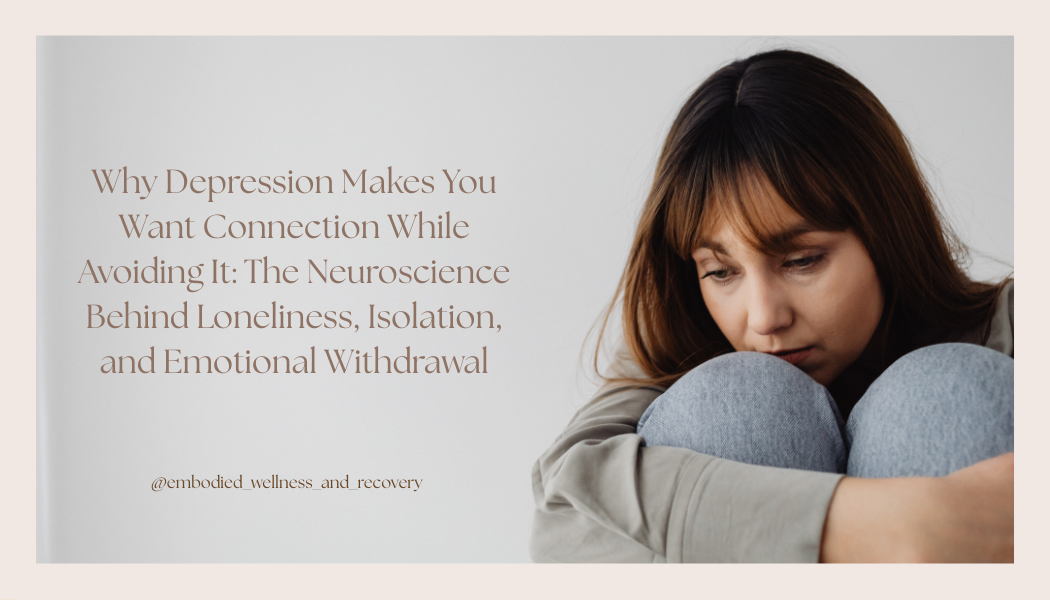
Why Depression Makes You Want Connection While Avoiding It: The Neuroscience Behind Loneliness, Isolation, and Emotional Withdrawal
Why Depression Makes You Want Connection While Avoiding It: The Neuroscience Behind Loneliness, Isolation, and Emotional Withdrawal
Depression often makes people crave connection while simultaneously making it difficult to seek it. Learn how depression affects motivation, loneliness, relationships, and the brain, and discover neuroscience-informed strategies to rebuild meaningful connection and emotional well-being.
Have you ever found yourself longing for connection while ignoring texts, canceling plans, or avoiding phone calls?
Do you desperately miss feeling close to people, yet the thought of socializing feels exhausting?
Have you wondered why you feel lonely, but cannot seem to find the motivation to reach out to someone you love?
Maybe you've caught yourself thinking:
"I don't have the energy."
"I'll just bring everyone down."
"They probably don't want to hear from me."
"I'll respond tomorrow."
Days become weeks. Weeks become months.
What began as a need for a little space quietly transforms into isolation.
One of the cruelest aspects of depression is that it often steals the very thing that helps people recover: meaningful human connection.
Understanding why this happens can replace self-criticism with something far more productive: curiosity.
Depression Does Not Simply Affect Mood
When people think about depression, they often imagine sadness, but depression affects far more than emotions. It changes motivation. It alters attention. It reduces energy. It influences decision-making. It changes how the brain predicts future experiences. From a neuroscience perspective, depression disrupts multiple brain networks involved in reward, emotional regulation, and social connection.
Activities that once felt enjoyable often no longer generate the same anticipation or satisfaction. This phenomenon, known as anhedonia, reduces motivation to pursue experiences that would normally feel rewarding, including spending time with people you care about. In other words, depression doesn't simply make you feel sad. It makes connection feel less possible.
Why Loneliness and Depression Reinforce Each Other
Humans are biologically wired for connection. Supportive relationships help regulate the nervous system, lower stress hormones, increase oxytocin, and provide emotional safety during difficult times. Unfortunately, depression often interrupts this natural process. The more isolated someone becomes, the fewer opportunities the brain has to experience positive social interactions. Without those experiences, depression often deepens.
Researchers have consistently found a bidirectional relationship between loneliness and depression. Loneliness increases the risk of depressive symptoms, while depression increases withdrawal from meaningful relationships.
This creates a painful cycle. Depression decreases motivation. Isolation increases. Loneliness grows. Depression worsens. The problem isn't that someone no longer values relationships. Their brain has temporarily lost access to the motivation needed to pursue them.
The Hidden Beliefs That Keep People Isolated
Depression rarely whispers the truth. Instead, it often tells convincing stories.
"They're too busy."
"They're better off without me."
"I'll be a burden."
"No one would understand."
"I have nothing interesting to say."
These thoughts often feel like facts, yet depression changes how the brain interprets social information. Research suggests that depression increases negative cognitive bias, making people more likely to notice rejection, underestimate acceptance, and assume others are judging them more harshly than they actually are (Fennell, 1997).
As a result, reaching out begins to feel emotionally risky, not because people no longer care, but because depression has convinced the brain they won't.
Trauma Can Make Isolation Feel Safer
For many individuals, depression is not the entire story. Trauma often shapes how the nervous system experiences relationships. If previous relationships involved rejection, criticism, emotional neglect, abuse, betrayal, or unpredictability, the brain may begin associating closeness with danger rather than comfort. The nervous system adapts. Withdrawal becomes protection. Isolation becomes predictable. Connection begins to feel uncertain.
At Embodied Wellness and Recovery, we frequently help clients understand that emotional withdrawal is often less about lacking social skills and more about a nervous system trying to reduce perceived threat.
The Brain Conserves Energy During Depression
Depression affects motivation because the brain shifts into an energy-conserving state.
Tasks that once seemed effortless suddenly require enormous effort.
Replying to a text.
Scheduling dinner.
Returning a phone call.
Getting dressed.
Driving somewhere.
Even enjoyable activities can feel overwhelmingly demanding. This does not reflect laziness. It reflects changes in neural circuits involved in motivation, reward processing, and executive functioning. Understanding this distinction often reduces shame.
Why Relationships Still Matter
Although depression decreases motivation for connection, relationships remain one of the most powerful regulators of emotional health. Emotionally safe relationships help reduce stress responses, improve emotional regulation, and remind the brain that support is available.
One meaningful conversation.
One supportive friend.
One emotionally attuned therapist.
These experiences provide the nervous system with evidence that connection remains possible. Repeated often enough, they begin reshaping the brain's expectations.
Small Steps Matter More Than Big Ones
When depression is severe, telling yourself to "get out more" often feels impossible.
Instead, think smaller.
Could you:
— Send one text instead of planning an evening out?
— Sit beside someone instead of carrying the conversation?
— Meet a friend for coffee instead of attending a large gathering?
— Spend ten minutes outside with someone you trust?
Small moments of connection are still connection. From a neuroscience perspective, repeated experiences of safety gradually strengthen neural pathways associated with reward, trust, and belonging. The brain changes through repetition, not perfection.
Connection Begins With Your Nervous System
Many people assume they need to feel motivated before reaching out. Often, the opposite is true. The nervous system often needs to be connected before motivation returns. This is why trauma-informed therapy emphasizes both top-down and bottom-up healing.
We work with thoughts, emotions, and the body. As nervous system regulation improves, many clients notice something remarkable. Reaching out begins requiring less effort. Social interactions feel less draining. Laughter returns more naturally. The desire for connection slowly reawakens.
How Embodied Wellness and Recovery Can Help
At Embodied Wellness and Recovery, we understand that depression is rarely just about mood. It affects relationships, sexuality, intimacy, self-worth, and the ability to feel emotionally connected. Our clinicians integrate neuroscience-informed psychotherapy with EMDR, somatic therapies, attachment-focused treatment, and evidence-based approaches to address both the psychological and physiological effectsof depression.
Rather than asking why someone is isolating, we ask:
"What has your brain and nervous system learned about connection?"
That question often opens the door to meaningful change.
Connect to Recover
Depression has a remarkable ability to convince people that isolation is safer than connection, yet the very relationships depression encourages us to avoid often become part of what helps our nervous systemsrecover. If connecting feels difficult right now, begin gently.
One message.
One walk.
One conversation.
One therapy appointment.
One small reminder to your brain that connection remains possible. Over time, those moments accumulate, and with each safe relational experience, the brain has another opportunity to update its expectations about belonging, trust, and hope.
Reach out to schedule a complimentary 20-minute consultation with our team of therapists, trauma specialists, somatic practitioners, or relationship experts and start working towards integrative, embodied healing today.
📞 Call us at (310) 651-8458
📱 Text us at (310) 210-7934
📩 Email us at admin@embodiedwellnessandrecovery.com
🔗 Visit us at www.embodiedwellnessandrecovery.com
👉 Check us out on Instagram @embodied_wellness_and_recovery
🌍 Explore our offerings at Linktr.ee: https://linktr.ee/laurendummit
References
Cacioppo, J. T., & Cacioppo, S. (2018). The growing problem of loneliness. The Lancet, 391(10119), 426.
Fennell, M. J. (1997). Low self-esteem: A cognitive perspective. Behavioral and Cognitive Psychotherapy, 25(1), 1-26.
Kupferberg, A., Bicks, L., & Hasler, G. (2016). Social functioning in major depressive disorder. Neuroscience and Biobehavioral Reviews, 69, 313-332.
Porges, S. W. (2011). The polyvagal theory: Neurophysiological foundations of emotions, attachment, communication, and self-regulation. W. W. Norton & Company.
Slavich, G. M., & Irwin, M. R. (2014). From stress to inflammation and major depressive disorder. Psychological Bulletin, 140(3), 774-815.
van der Kolk, B. A. (2014). The body keeps the score: Brain, mind, and body in the healing of trauma. Viking.