
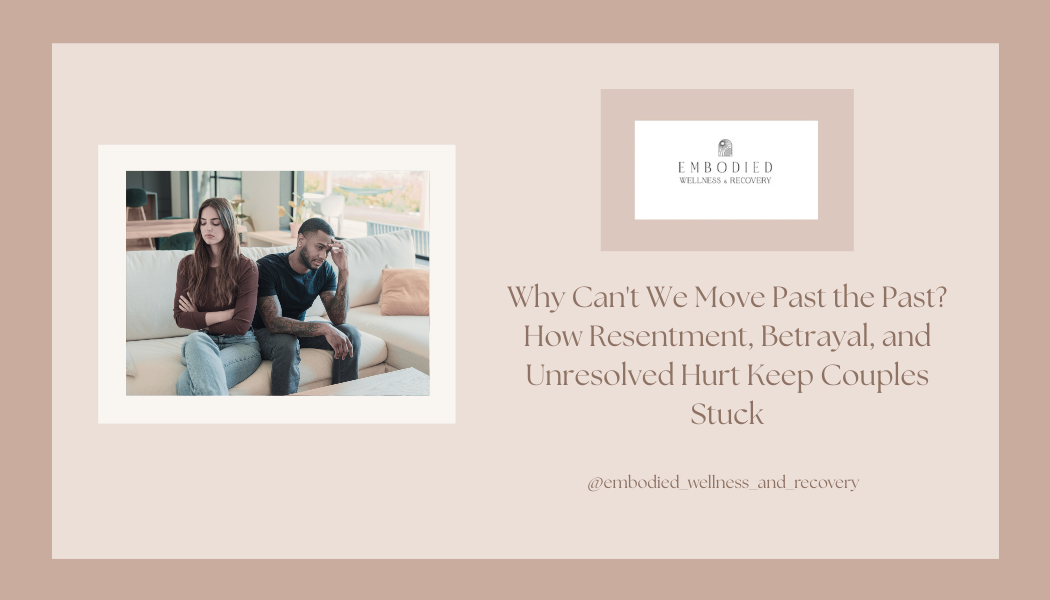
Why Can't We Move Past the Past? How Resentment, Betrayal, and Unresolved Hurt Keep Couples Stuck
Why Can't We Move Past the Past? How Resentment, Betrayal, and Unresolved Hurt Keep Couples Stuck
Why do couples keep fighting about the past? Learn how resentment, betrayal, attachment injuries, and the brain's threat response keep old relationship wounds alive, plus how couples therapy can rebuild trust, intimacy, and emotional safety.
How Did We Get Here?
It starts with something small. Your partner forgets to text. They become defensive during a conversation. They make a comment that lands the wrong way. Suddenly, you are no longer arguing about what happened five minutes ago. You are talking about the affair from three years ago. The lie they told early in your marriage. The night they didn't defend you. The years you felt emotionally neglected. The argument you thought you had already resolved.
One partner says, "Why do you always bring up the past?"
The other thinks, "Because it still hurts."
If this happens in your relationship, the problem may not simply be an inability to forgive or communicate effectively. Your brains and bodies may still be responding to unresolved relational threat. Understanding the neuroscience behind this pattern can help couples stop treating one another as the problem and begin addressing the injury underneath the conflict.
Why Do Couples Keep Fighting About the Past?
Couples often enter therapy sincerely wanting to move forward, yet old injuries, grudges, betrayals, and unresolved arguments repeatedly appear.
Perhaps you have wondered:
— Why can't I forgive my partner even though I want to?
— Why do we keep having the same argument?
— Why can't my spouse let go of the past?
— Why do I still feel angry years after the betrayal?
— Why don't I trust my partner even though they have changed?
— Why does every disagreement become about everything that
has ever happened?
— Can resentment destroy a relationship?
These questions become especially painful when both partners feel they have already discussed the issue repeatedly, but talking about an injury and repairing an injury are not necessarily the same thing.
Your Brain Is Designed to Remember What Hurt You
The human brain is remarkably good at learning from painful experiences. This makes evolutionary sense. If something threatens us once, remembering it may help us avoid being harmed again. Relationship injuries can activate similar protective systems.
Research on attachment suggests that our closest relationships become deeply intertwined with our experience of security. When an attachment figure becomes a source of betrayal, rejection, abandonment, or emotional pain, the nervous system may begin monitoring that relationship for signs of future danger (Mikulincer & Shaver, 2016).
Your rational mind may understand:
"My partner apologized."
But another part of your brain is asking:
"Could this happen again?"
That discrepancy helps explain why someone can consciously forgive a partner while still experiencing anxiety, anger, hypervigilance, or distrust.
Today's Argument May Be Activating Yesterday's Wound
Imagine that your partner arrives home late without calling. In isolation, the situation may be frustrating but manageable. But perhaps your partner previously had an affair. Now the nervous system may interpret the late arrival differently. Your heart races. Your stomach tightens. Your thoughts accelerate.
"Where were they?"
"Are they lying?"
"Is this happening again?"
The body begins responding before the rational brain has fully evaluated the situation. Research on emotional memory suggests that emotionally significant experiences can influence how the brain interprets subsequent cues, particularly when those cues resemble previous threats (LeDoux, 1996). The argument is happening today. The nervous system may be responding to the past.
Why "Just Let It Go" Doesn't Work
Few phrases are more frustrating to someone carrying unresolved relationship pain than:
"You need to let it go."
Letting go sounds like a cognitive decision. Relational repair is more complicated. For the nervous system to update its expectations, it often needs repeated experiences that contradict the old pattern.
If the injury communicated:
"I cannot trust you,"
repair requires experiences of reliability.
If the injury communicated:
"My feelings don't matter,"
repair requires emotional responsiveness.
If the injury communicated:
"You will abandon me when I need you,"
repair requires consistent presence.
Trust is rarely rebuilt through promises alone. It is rebuilt through patterns.
The Hurt Partner May Be Searching for Resolution
When someone repeatedly brings up an old betrayal, the other partner may assume they are trying to punish them. Sometimes they are actually searching for something that still feels missing.
They may be asking:
"Do you understand how deeply this affected me?"
"Do you understand why I am still scared?"
"Can you stay emotionally present when I talk about my pain?"
"Can I trust that you will respond differently now?"
Research on emotionally focused couples therapy suggests that accessing and repairing underlying attachment injuries can help couples create greater emotional security and relationship satisfaction (Johnson et al., 1999). Sometimes the past keeps returning because it has not yet felt fully witnessed.
Meanwhile, the Other Partner May Feel Trapped by Shame
There is another nervous system in the room. The partner who caused the injury may feel increasingly hopeless.
"I apologized."
"I changed."
"Nothing I do is enough."
Eventually, guilt can become shame.
Guilt says:
"I did something that hurt you."
Shame says:
"I am a terrible person."
When shame takes over, people frequently defend, withdraw, minimize, or counterattack. Unfortunately, those protective responses may reinforce the injured partner's belief that their pain still does not matter. And the cycle begins again.
Resentment Can Change the Story of Your Relationship
Unresolved hurt gradually changes how partners interpret one another.
A forgotten errand becomes:
"You never think about me."
A distracted conversation becomes:
"You don't care."
A disagreement becomes:
"This relationship has always been a mistake."
Psychologist John Gottman's research has demonstrated how negative patterns of interpretation, criticism, defensiveness, contempt, and withdrawal can erode relationship satisfaction over time (Gottman & Silver, 2015). Eventually, couples stop responding only to what their partner is doing. They respond to what they believe their partner's behavior means.
The Past Can Follow Couples Into the Bedroom
Unresolved relationship trauma does not remain neatly confined to arguments. It frequently affects sexuality and intimacy. Sex requires vulnerability. When the nervous system remains vigilant, surrendering into pleasure, desire, affection, or erotic connection may become difficult.
A partner may think:
"I love them, but I don't want them touching me."
Or:
"I've forgiven them, but my body hasn't."
This is why rebuilding sexual intimacy after betrayal or chronic conflict often requires more than simply scheduling sex. Emotional and physiological safety frequently need attention first.
How Couples Can Stop Living in the Past
The goal of couples therapy is not to erase history. Nor is it to endlessly revisit every painful event. Effective relationship therapy helps couples understand what the past is doing in the present.
At Embodied Wellness and Recovery, we approach relationship conflict through a trauma-informed, attachment-focused, and nervous system-informed lens.
Treatment may involve helping couples:
— Identify the deeper attachment injury beneath recurring arguments
— Recognize nervous system activation before conflict escalates
— Replace defensiveness with curiosity and accountability
— Process betrayal and unresolved grief
— Develop more effective repair after conflict
— Rebuild trust through consistent behavioral change
— Restore emotional and sexual intimacy
— Create new experiences of safety and connection
When partners begin recognizing the protective nervous system responses underneath their arguments, conflict can become less about determining who is right and more about understanding what each person is protecting.
Moving Forward Does Not Require Forgetting
Perhaps the most useful question is not:
"Why can't we get over this?"
Instead, ask:
"What does our relationship still need in order for this injury to feel resolved?"
Sometimes the answer is accountability. Sometimes it is grief. Sometimes it is changed behavior. Sometimes it is finally feeling understood, and sometimes it is helping the nervous system experience enough consistent safety that the past no longer feels like a prediction of the future. The goal is not forgetting what happened. It is reaching a place where what happened no longer controls what happens next.
At Embodied Wellness and Recovery, we help couples understand how trauma, attachment, nervous system regulation, relationships, sexuality, and intimacy intersect so they can move beyond repetitive conflict toward greater trust, emotional safety, and meaningful connection.
Because moving forward is not about pretending the past did not matter. It is about creating enough repair in the present that the relationship can finally become something new.
Reach out to schedule a complimentary 20-minute consultation with our team of therapists, trauma specialists, somatic practitioners, or relationship experts and start working towards integrative, embodied healing today.
📞 Call us at (310) 651-8458
📱 Text us at (310) 210-7934
📩 Email us at admin@embodiedwellnessandrecovery.com
🔗 Visit us at www.embodiedwellnessandrecovery.com
👉 Check us out on Instagram @embodied_wellness_and_recovery
🌍 Explore our offerings at Linktr.ee: https://linktr.ee/laurendummit
References
1. Gottman, J. M., & Silver, N. (2015). The seven principles for making marriage work: A practical guide from the country's foremost relationship expert. Harmony Books.
2. Johnson, S. M., Hunsley, J., Greenberg, L., & Schindler, D. (1999). Emotionally focused couples therapy: Status and challenges. Clinical Psychology: Science and Practice, 6(1), 67-79.
3. LeDoux, J. E. (1996). The emotional brain: The mysterious underpinnings of emotional life. Simon & Schuster.
4. Mikulincer, M., & Shaver, P. R. (2016). Attachment in adulthood: Structure, dynamics, and change (2nd ed.). Guilford Press.