
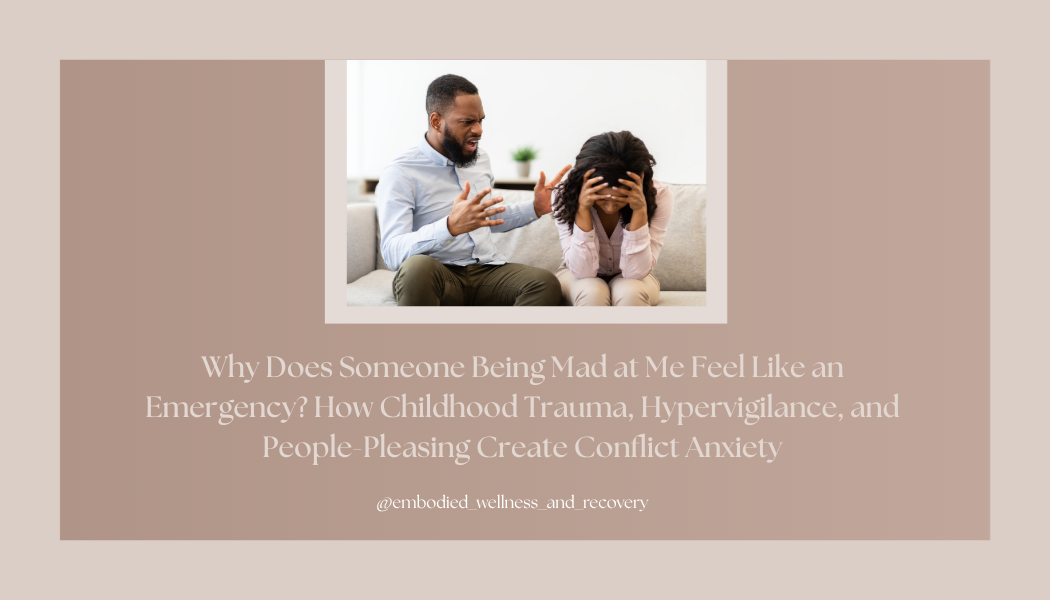
Why Does Someone Being Mad at Me Feel Like an Emergency? How Childhood Trauma, Hypervigilance, and People-Pleasing Create Conflict Anxiety
Why Does Someone Being Mad at Me Feel Like an Emergency? How Childhood Trauma, Hypervigilance, and People-Pleasing Create Conflict Anxiety
Why does someone being mad at you feel terrifying? Learn how childhood trauma, hypervigilance, people-pleasing, attachment anxiety, and the nervous system can turn ordinary conflict into a perceived threat.
Someone's tone changes. Their text seems shorter than usual. Your partner sighs, your friend seems distant, or your boss sounds irritated, and suddenly, your stomach drops.
Are they mad at me?
Within seconds, you may begin replaying the conversation, searching for what you did wrong. Maybe you send another text. You apologize. You explain yourself. You try to make them laugh. You soften the boundary you just set. You cannot seem to relax until you know everything is okay again.
Why does someone being upset with you feel so unbearable? Why does conflict make you anxious even when you know you haven't done anything wrong? Why do you feel compelled to fix someone's feelings immediately? Sometimes, you aren't actually afraid of conflict. You're afraid of what your nervous system learned conflict might cost you.
Why Does Someone Being Mad at Me Make Me So Anxious?
For some children, anger is simply an emotion. A parent can be frustrated and remain loving. A disagreement happens, repair follows, and connection remains intact.
But what if anger in your childhood meant something different?
Perhaps anger was followed by yelling, criticism, humiliation, punishment, withdrawal, the silent treatment, rejection, emotional unpredictability, or even violence. Maybe you had a parent whose mood determined the emotional climate of the entire house. You learned to notice footsteps, facial expressions, doors closing, the way someone put down a glass, or a subtle change in tone.
Your developing nervous system may have learned:
If someone is upset, pay attention. If someone is angry, something bad may happen. If someone is disappointed in me, connection may disappear. I need to fix this. This is how childhood trauma and hypervigilance can eventually become adult conflict anxiety.
When Hypervigilance Follows You Into Relationships
Hypervigilance is the nervous system's tendency to continuously scan the environment for potential threat. Research suggests that childhood emotional maltreatment can be associated with altered processing of emotional facial expressions, including heightened amygdala responsivity to emotional faces.
In childhood, becoming exceptionally skilled at detecting someone's emotional state may be adaptive. If Dad's facial expression tells you whether tonight will be peaceful or frightening, then noticing tiny changes in his mood matters, but the nervous system can continue to use an old survival strategy long after the original environment has changed. Now your partner's sigh may trigger the same internal alarm. A delayed text feels ominous.
Someone saying, “I'm disappointed” feels less like information and more like rejection. You aren't consciously deciding to overreact. Your nervous system may simply be responding to an old equation: Anger = danger.
The Neuroscience of Why Conflict Can Feel Like a Threat
The brain is designed to prioritize threat detection. The amygdala helps identify emotionally salient information, particularly potential danger, while interconnected cortical regions help provide context and determine whether a threat is actually occurring.
When early environments are chronically unpredictable or threatening, these systems can become shaped around detecting danger efficiently. Research on childhood adversity suggests differences in neural processing of emotional and potentially threatening social cues. In adulthood, childhood emotional maltreatment has also been associated with heightened amygdala responses to emotional facial expressions.
This helps explain why your rational mind may know:
“My partner is just frustrated.”
while your body is responding:
“Something is wrong. Fix it now.”
Conflict is not merely cognitive. It is physiological.
Studies of couples have found that attachment insecurity can influence cortisol, autonomic arousal, emotional experience, and physiological recovery during relationship conflict. In other words, relationships happen inside nervous systems.
People-Pleasing Can Be an Attempt to Restore Safety
When conflict feels dangerous, people-pleasing makes perfect sense. You apologize quickly. You agree when you don't agree. You over-explain. You change your boundary. You reassure the other person. You become exceptionally nice. You monitor their face until they smile again.
What is sometimes called the fawn response can be understood as an appeasement strategy: reducing interpersonal threat by becoming agreeable, helpful, accommodating, or emotionally useful.
The underlying message is often:
“If I can make you happy again, I can feel safe again.”
This is why people-pleasing is not always simply about wanting people to like you. Sometimes it is about needing other people to be okay so that your nervous system can be okay.
Signs You May Have Conflict Anxiety
You may recognize yourself if you:
Feel panicked when someone is disappointed in you.
Apologize even when you aren't sure you did anything wrong.
Need to resolve disagreements immediately.
Over-explain your intentions.
Replay conversations for hours afterward.
Struggle to sleep when someone is upset with you.
Change boundaries when another person reacts negatively.
Interpret someone's silence as rejection.
Feel responsible for restoring everyone's mood.
Avoid difficult conversations because you fear losing the relationship.
The painful paradox is that avoiding conflict to preserve relationships can eventually make authentic intimacy harder.
Healthy Relationships Require the Ability to Survive Disagreement
Real intimacy cannot require permanent agreement. Two emotionally healthy people will sometimes misunderstand each other, disappoint each other, irritate each other, want different things, and set boundaries the other person doesn't particularly like.
The goal isn't to eliminate conflict.
It is to teach your nervous system something new:
Someone can be upset with me and still love me. Someone can misunderstand me, and I can still trust myself. Someone can be disappointed, and I don't have to fix their disappointment. A boundary can create discomfort without creating abandonment. Conflict can happen without connection disappearing. This is one of the most important shifts in trauma recovery.
How to Stop Feeling Responsible for Someone Else's Anger
Begin by noticing the moment someone else's emotion becomes an emergency inside your body. Before apologizing, explaining, texting again, changing your boundary, or trying to repair the situation immediately, pause.
Ask yourself:
Is something actually unsafe, or am I uncomfortable because someone is unhappy with me?
Notice what happens physically. Perhaps your chest tightens, your stomach drops, your jaw clenches, or you feel an urgent need to do something. That pause creates space between another person's emotion and your response to it.
Somatic therapy, attachment-focused therapy, EMDR, mindfulness, and other trauma-informed approaches can help people recognize these automatic survival patterns while developing greater capacity to tolerate relational discomfort. Over time, the nervous system can learn that disagreement does not automatically equal danger.
From Hypervigilance to Relational Safety
At Embodied Wellness and Recovery, we understand conflict anxiety through a trauma-informed, attachment-based, and nervous system lens. Our work addresses the deeper patterns beneath people-pleasing, hypervigilance, relationship anxiety, difficulty setting boundaries, trauma, sexuality, and intimacy. Healthy relationships aren't relationships where nobody gets upset. They are relationships in which two people can remain connected to themselves while allowing each other to have their own feelings.
Perhaps the next time someone is disappointed, irritated, or unhappy with you, the question isn't:
“How do I make them okay again?”
It might be:
“Can I stay connected to myself while allowing someone else to be unhappy with me?”
Because sometimes the deepest form of nervous system repair is discovering that someone else's anger can be uncomfortable without becoming an emergency.
Reach out to schedule a complimentary 20-minute consultation with our team of therapists, trauma specialists, somatic practitioners, or relationship experts and start working towards integrative, embodied healing today.
📞 Call us at (310) 651-8458
📱 Text us at (310) 210-7934
📩 Email us at admin@embodiedwellnessandrecovery.com
🔗 Visit us at www.embodiedwellnessandrecovery.com
👉 Check us out on Instagram @embodied_wellness_and_recovery
🌍 Explore our offerings at Linktr.ee: https://linktr.ee/laurendummit
References
Ben-Naim, S., Hirschberger, G., Ein-Dor, T., & Mikulincer, M. (2013). An experimental study of emotion regulation during relationship conflict interactions: The moderating role of attachment orientations. Emotion, 13(3), 506-519.
McCrory, E. J., De Brito, S. A., Kelly, P. A., Bird, G., Sebastian, C. L., Mechelli, A., Samuel, S., & Viding, E. (2013). Amygdala activation in maltreated children during pre-attentive emotional processing. The British Journal of Psychiatry, 202(4), 269-276.
Powers, S. I., Pietromonaco, P. R., Gunlicks, M., & Sayer, A. (2006). Dating couples' attachment styles and patterns of cortisol reactivity and recovery in response to a relationship conflict. Journal of Personality and Social Psychology, 90(4), 613-628.
Taylor, N. C., Seedall, R. B., Robinson, W. D., & Bradford, K. (2018). The systemic interaction of attachment on psychophysiological arousal in couple conflict. Journal of Marital and Family Therapy, 44(1), 46-60.
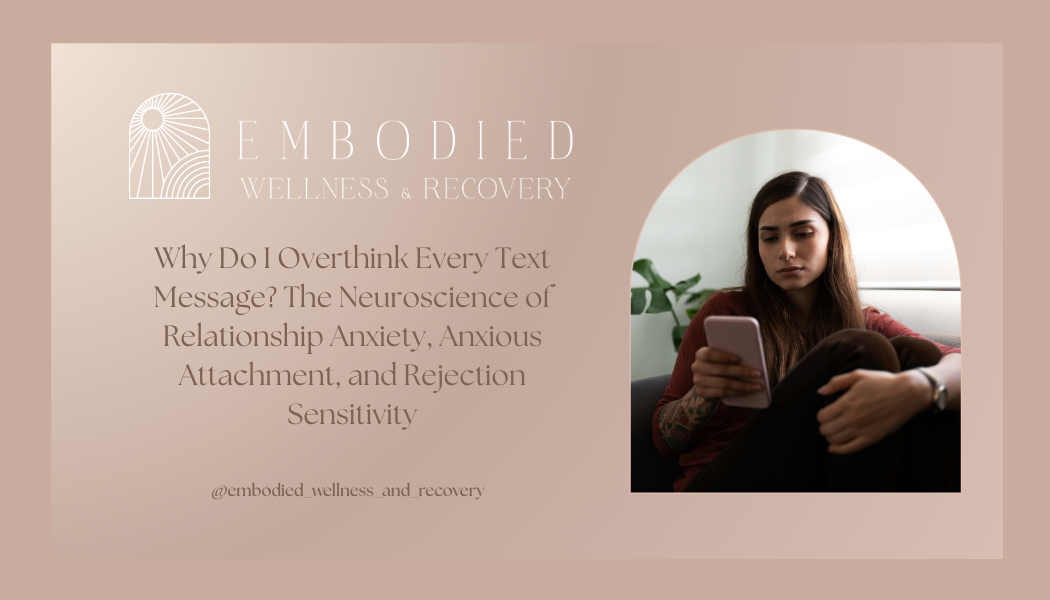
Why Do I Overthink Every Text Message? The Neuroscience of Relationship Anxiety, Anxious Attachment, and Rejection Sensitivity
Why Do I Overthink Every Text Message? The Neuroscience of Relationship Anxiety, Anxious Attachment, and Rejection Sensitivity
Why do you overthink text messages? Learn how relationship anxiety, anxious attachment, rejection sensitivity, trauma, and nervous system dysregulation can make delayed replies and subtle changes in texting feel threatening, plus how to stop overanalyzing every message.
You send the text. Then you read it again…and again. Was it too long? Did you sound too interested? Should you have used an emoji? Maybe the joke didn't land.
Then you notice they haven't responded. Twenty minutes pass. Then an hour. Suddenly, your brain is no longer thinking about a text message. It is trying to solve a relationship.
"Did I do something wrong?"
"Are they upset with me?"
"Are they losing interest?"
"Why are they online but not answering?"
"Should I text again, or will I seem needy?"
If you overthink text messages, the problem may not be that you are overly sensitive. You may be experiencing something much more complex: a nervous system attempting to find certainty in a form of communication filled with ambiguity.
For people with relationship anxiety, anxious attachment, trauma, rejection sensitivity, or histories of inconsistent relationships, texting can become the perfect environment for hypervigilance.
Why Do I Overthink Text Messages So Much?
Texting removes much of the information the human brain normally uses to understand another person. There is no facial expression. No tone of voice. No eye contact. No body language. No immediate opportunity to clarify what someone meant.
Instead, your brain receives:
"Sure."
And now it has to interpret it.
Does "sure" mean yes?
Or does it mean:
"I'm annoyed."
"I'm losing interest."
"Leave me alone."
The brain does not like missing information. Research on predictive processing suggests that our brains continuously use previous experiences to make predictions about what ambiguous information means (Friston, 2010). When your relationship history has taught you that connection can disappear unexpectedly, your brain may fill in missing information with threat.
Anxious Attachment Can Turn Texting Into an Emotional Minefield
Attachment theory helps explain why some people experience texting anxiety more intensely than others. Early relationships help create internal expectations about whether other people will be available, responsive, and emotionally safe. Research on adult attachment has found that people with higher attachment anxiety tend to be particularly sensitive to cues of rejection and abandonment and may engage in hyperactivating strategies when relational security feels threatened (Mikulincer & Shaver, 2016).
That means a delayed text response may not simply register as:
"They're probably busy."
It may activate a deeper fear:
"Something has changed between us."
Your conscious mind may understand that your partner is working. Your attachment system may still be sounding an alarm.
Why Tiny Changes in Texting Feel So Significant
Perhaps your partner normally writes:
"Goodnight ❤️"
Tonight they write:
"Night."
Your stomach drops. Nothing objectively threatening has happened, yet your brain immediately notices the deviation. Humans are remarkably skilled pattern detectors. When someone has experienced inconsistent caregiving, betrayal, abandonment, ghosting, or unpredictable relationships, subtle changes can become especially salient.
The nervous system learns:
Pay attention. Small changes might mean something. Hypervigilance that once helped you anticipate relational danger may now cause you to analyze punctuation, response times, emojis, and word choices as though they contain hidden information about the future of your relationship.
Why Haven't They Texted Me Back?
Few experiences activate texting anxiety more effectively than silence. When there is no information, the anxious brain creates information.
"They haven't responded."
becomes:
"They're avoiding me."
Then:
"They're losing interest."
Then:
"I knew this would happen."
This process resembles what cognitive psychology describes as intolerance of uncertainty, the tendency to experience uncertain situations as particularly distressing. Research has linked intolerance of uncertainty with worry and anxiety across multiple psychological conditions (Carleton, 2016).
Overthinking becomes an attempt to eliminate uncertainty. Unfortunately, thinking harder rarely produces the missing information. It simply generates more possible explanations.
Your Phone Can Become an Attachment Regulation Device
Notice what happens when the message finally arrives. Relief. Your shoulders soften. Your attention returns. Everything suddenly feels okay again. This cycle can gradually teach your brain to use communication from another person to regulate internal distress. No message creates activation. A message creates relief.
Soon you may find yourself checking your phone repeatedly, watching typing bubbles, monitoring read receipts, checking someone's social media activity, rereading previous conversations, sending screenshots to friends, or asking, "What do you think this means?" The phone becomes less of a communication tool and more of a device for monitoring relational safety.
Rejection Sensitivity and ADHD Can Intensify Texting Anxiety
For some people with ADHD, emotional dysregulation and heightened sensitivity to perceived rejection can make ambiguous social interactions particularly difficult. Although the popular term "rejection sensitive dysphoria" is not itself a formal DSM diagnosis, research has documented significant emotional regulation difficulties among many individuals with ADHD (Shaw et al., 2014). A delayed response may therefore trigger a rapid emotional reaction before there is time to evaluate alternative explanations.
You may intellectually know:
"They're probably busy."
while your body feels:
"I'm being rejected."
Both experiences can exist simultaneously.
Trauma Can Teach You That Small Changes Matter
Texting anxiety may also make more sense when viewed through a trauma-informed lens. Perhaps a previous partner suddenly disappeared. Maybe someone cheated, and you discovered subtle changes in their communication beforehand.
Perhaps affection was routinely withdrawn when someone was angry with you. Maybe silence was used as punishment during childhood. Your nervous system learned from experience. Small changes sometimes did predict pain. The problem is that protective learning can become generalized. Your brain may begin responding to harmless ambiguity as though it carries the same meaning as previous relational danger.
Why You Analyze Your Own Messages Too
The anxiety does not end with interpreting other people's texts. You may scrutinize your own. Was I too vulnerable? Did I sound desperate? Should I have waited longer to reply? Did I use too many exclamation points? Should I send another message explaining what I meant? Texting becomes performance rather than communication.
Underneath the editing is often an unconscious belief:
"If I communicate perfectly, I can prevent rejection." But relationships cannot be made completely safe through perfect wording. Trying to eliminate relational risk through carefully constructed messages often increases anxiety rather than reducing it.
When Reassurance Seeking Becomes a Cycle
As anxiety rises, reassurance feels irresistible. You ask friends what the message means. You text again.
You ask your partner:
"Are you mad at me?"
They reassure you. You feel better but only temporarily.
Research on anxiety suggests that reassurance seeking can reduce distress in the short term while maintaining anxiety over time because the brain never learns that uncertainty can be tolerated without external confirmation. The deeper task becomes developing the capacity to remain connected to yourself while connection with someone else temporarily feels uncertain.
How to Stop Overthinking Text Messages
The goal is not to become indifferent. It is to create enough internal security that every ambiguous message does not become an emergency. Start by separating activation from interpretation. Before deciding what a message means, notice what is happening in your body.
Is your chest tight?
Are you holding your breath?
Is your heart racing?
Do you feel compelled to respond immediately?
Your nervous system may need regulation before your brain needs analysis. Next, distinguish facts from stories.
Fact:
"They haven't responded for two hours."
Story:
"They're losing interest."
That distinction sounds simple, but it can profoundly change how you respond to uncertainty. It can also help to delay reassurance seeking, communicaterelationship needs directly, reduce compulsive checking, and explore the attachment experiences underlying the fear.
Nervous System Regulation Changes Relationship Anxiety
Understanding anxious attachment intellectually is valuable.
But attachment anxiety is also embodied.
At Embodied Wellness and Recovery, we help clients explore how trauma, attachment experiences, nervous system dysregulation, and relationship patterns influence emotional connection, sexuality, and intimacy.
Through trauma-informed psychotherapy, somatic approaches, EMDR, attachment-focused work, and relationship therapy, clients can develop greater capacity to recognize activation, tolerate uncertainty, strengthen self-trust, and communicate needs without allowing fear to control the interaction.
The goal is not to convince yourself that everyone will always respond exactly as you hope.
They won't.
It is learning that uncertainty does not have to mean danger.
You Don't Have to Decode Every Message
Perhaps the most important shift happens when you stop asking:
"What does this text mean?"
and begin asking:
"What is happening inside me that makes this uncertainty feel so threatening?"
That question moves you away from endlessly analyzing another person's punctuation and toward understanding your own nervous system.
Because secure connection does not come from finding the perfect text, responding at precisely the right moment, or successfully predicting whether someone might leave.
It grows through self-trust, direct communication, emotional regulation, reciprocal relationships, and repeated experiences of connection that do not require constant monitoring.
A text can simply become a text again.
Not a test of your desirability.
Not evidence of abandonment.
Not a puzzle you have to solve.
Just one small moment inside a relationship that is much larger than what appears on your screen.
Reach out to schedule a complimentary 20-minute consultation withour team of therapists,trauma specialists, somatic practitioners, orrelationship experts and start working towards integrative, embodied healing today.
📞 Call us at (310) 651-8458
📱 Text us at (310) 210-7934
📩 Email us at admin@embodiedwellnessandrecovery.com
🔗 Visit us at www.embodiedwellnessandrecovery.com
👉 Check us out on Instagram @embodied_wellness_and_recovery
🌍 Explore our offerings at Linktr.ee: https://linktr.ee/laurendummit
References
Carleton, R. N. (2016). Into the unknown: A review and synthesis of contemporary models involving uncertainty. Journal of Anxiety Disorders, 39, 30-43.
Friston, K. (2010). The free-energy principle: A unified brain theory? Nature Reviews Neuroscience, 11(2), 127-138.
Mikulincer, M., & Shaver, P. R. (2016). Attachment in adulthood: Structure, dynamics, and change (2nd ed.). Guilford Press.
Shaw, P., Stringaris, A., Nigg, J., & Leibenluft, E. (2014). Emotion dysregulation in attention deficit hyperactivity disorder. American Journal of Psychiatry, 171(3), 276-293.