
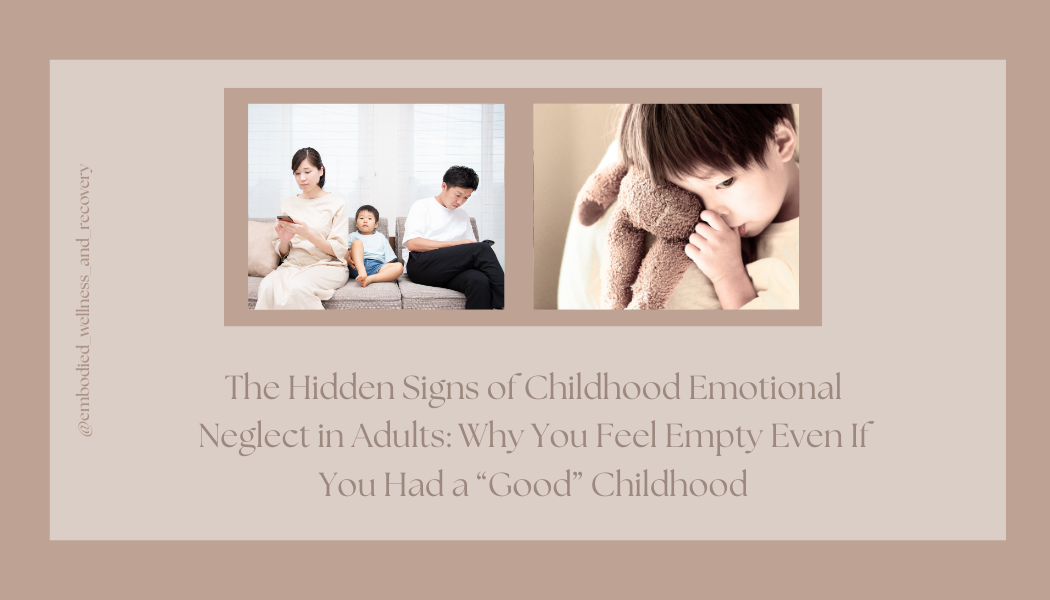
The Hidden Signs of Childhood Emotional Neglect in Adults: Why You Feel Empty Even If You Had a “Good” Childhood
The Hidden Signs of Childhood Emotional Neglect in Adults: Why You Feel Empty Even If You Had a “Good” Childhood
Discover the hidden signs of childhood emotional neglect in adults, including emotional numbness, hyper-independence, people-pleasing, low self-worth, relationship difficulties, and feeling empty despite having a loving childhood.
“My parents loved me.”
“I had everything I needed.”
“Nothing terrible happened to me.”
“So why do I feel like something is missing?”
For many adults struggling with childhood emotional neglect, this contradiction can be profoundly confusing. Perhaps your childhood really was good in many ways. You had food, clothing, birthday parties, vacations, extracurricular activities, and parents who worked hard to provide for you. You may love your parents deeply and know they loved you.
Yet something inside you feels difficult to explain. Maybe you feel emotionally disconnected from yourself. Perhaps you struggle to identify what you need, feel uncomfortable depending on others, or experience a persistent sense of inadequacy despite being accomplished.
Maybe relationships leave you feeling strangely lonely. Or perhaps someone simply asks, “How are you feeling?” and you genuinely don't know. These experiences can sometimes be connected to childhood emotional neglect, a form of relational adversity defined less by what happened to a child than by what was repeatedly missing.
What Is Childhood Emotional Neglect?
Childhood emotional neglect occurs when a child's emotional needs are consistently overlooked, minimized, misunderstood, or insufficiently responded to. This does not necessarily mean a parent was abusive, uncaring, or intentionally neglectful. A parent may have loved their child tremendously while struggling with emotional attunement because of their own upbringing, depression, chronic stress, financial pressure, marital conflict, trauma, cultural expectations, or limited understanding of children's emotional development.
The distinction matters. Emotional neglect is often not about the absence of love. It is about the absence of sufficient emotional responsiveness.
A child needs more than physical safety. Children also develop through experiences such as:
“I can tell someone when I'm scared.”
“My sadness doesn't overwhelm people.”
“My anger doesn't make me unlovable.”
“Someone notices when something is wrong.”
“My feelings contain useful information.”
“I can need someone and still be safe.”
These repeated experiences help shape emotional development, attachment, and nervous system regulation.
Why Childhood Emotional Neglect Can Be So Difficult to Recognize
Physical abuse creates events. Emotional neglect often creates absences. You may not remember the conversation nobody had with you after you were bullied. You may not remember the comforting hug you didn't receive when you were frightened. You may not remember all the times nobody noticed that you were overwhelmed. There is no obvious memory because the wound developed partly through what was missing.
This is why adults sometimes dismiss their own experiences:
“Other people had it much worse.”
“My parents did their best.”
“I wasn't abused.”
“I should be grateful.”
All of these things can be true while another truth also exists:
Some of your emotional needs may not have been adequately met. Research on childhood maltreatment has consistently found that emotional neglect is associated with increased risk for later difficulties, including depression, anxiety, emotional dysregulation, interpersonal problems, and lower psychological well-being (Norman et al., 2012).
Hidden Signs of Childhood Emotional Neglect in Adults
Childhood emotional neglect does not look the same in everyone. In fact, some of its signs are socially rewarded.
1. You Are Extremely Independent
You rarely ask for help. You handle everything yourself. People describe you as capable, strong, responsible, and self-sufficient.
But underneath that independence may be an implicit belief:
“I shouldn't need anyone.”
When emotional support was inconsistent or unavailable during childhood, self-reliance can become a brilliant adaptation. The problem arises when independence becomes the only safe option. Healthy adulthood includes autonomy and the capacity for healthy dependence.
2. You Struggle to Know What You Feel
Someone asks:
“What do you need?”
And your mind goes blank. Perhaps you can analyze everyone else's feelings while struggling to identify your own. This may reflect difficulties with emotional awareness or alexithymia, which involves trouble identifying and describing emotional states.
Children develop emotional literacy partly through caregivers who help name and contextualize their experiences:
“You seem disappointed.”
“That scared you.”
“You really wanted that.”
“You're angry because that felt unfair.”
Without enough of this emotional mirroring, recognizing internal states can remain surprisingly difficult in adulthood.
3. You Feel Guilty for Having Needs
Maybe asking your partner for reassurance feels “needy.” Rest feels lazy. Receiving help makes you uncomfortable. Crying in front of someone feels embarrassing.
You may automatically minimize yourself:
“It's fine.”
“Don't worry about me.”
“I can handle it.”
But having needs is not a character flaw. Needs are part of being human.
4. You Are a People Pleaser
Adults with histories of emotional neglect may become exceptionally attuned to everyone except themselves.
What does my partner need?
Is my friend upset?
Is everyone comfortable?
Did I disappoint someone?
People-pleasing can develop when maintaining connection feels dependent on being easy, helpful, successful, pleasant, or undemanding. Eventually, the nervous system becomes highly skilled at monitoring other people while losing contact with the self.
5. You Feel Lonely Even in Relationships
This can be one of the most painful signs. You may have friends, a spouse, children, coworkers, or a full calendar.
Yet you still feel emotionally alone.
Why?
Because proximity is not the same as emotional intimacy. True intimacy requires allowing another person to know what you feel, want, fear, desire, and need. If emotional vulnerability was never modeled as safe, relationships may remain connected on the surface while feeling strangely distant underneath.
The Neuroscience of Emotional Neglect
Children do not learn emotional regulation entirely on their own. They initially regulate through relationships. A frightened infant is held. A distressed toddler is soothed. An embarrassed child receives reassurance. An overwhelmed teenager has someone who remains present without immediately fixing, criticizing, or dismissing the experience.
These moments of co-regulation help developing neural systems learn how to move through emotional activation and return toward equilibrium. Research on attachment and developmental neuroscience suggests that responsive caregiving plays an important role in developing systems involved in stress regulation, emotional processing, and interpersonal functioning (Schore, 2001).
When co-regulation is insufficient, children adapt. Some suppress emotion. Some become hypervigilant. Some become perfectionistic. Some become caregivers themselves. Some disconnect from bodily sensations. Some learn to need very little. These adaptations may have been highly intelligent responses to the environment in which they developed.
But what protects a child can eventually constrain an adult.
“But My Parents Loved Me”
This may be the most important part. Recognizing childhood emotional neglect does not require deciding your parents were bad people.
Two things can be true simultaneously:
Your parents loved you, and they may not have known how to meet some of your emotional needs. Research on attachment demonstrates that children's emotional development is influenced not simply by whether caregivers love them, but by patterns of responsiveness, availability, sensitivity, and emotional attunement (Mikulincer & Shaver, 2016).
Understanding this distinction allows us to move beyond blame. The goal is not to put your childhood on trial. It is to understand yourself more accurately.
How Childhood Emotional Neglect Affects Adult Relationships and Intimacy
The effects often become particularly visible in romantic relationships. You may desperately want closeness while feeling uncomfortable once someone gets too close. You may struggle to ask for reassurance. Conflict may cause you to shut down. Your partner's disappointment may feel intolerable. Receiving affection may feel more vulnerable than giving it.
Sexual intimacy can also become complicated when being present in the body, communicating desire, expressing preferences, or allowing yourself to receive pleasure requires access to needs you learned to suppress.
You might wonder:
“Why can't I tell my partner what I need?”
“Why do I pull away when someone wants to take care of me?”
“Why does conflict make me want to disappear?”
“Why do I feel responsible for everyone else's feelings?”
“Why do I feel lonely even when someone loves me?”
These are not simply relationship problems. They may reflect relational patterns learned much earlier.
Teaching the Nervous System Something New
At Embodied Wellness and Recovery, we work with adults navigating trauma, attachment wounds, childhood emotional neglect, nervous system dysregulation, relationships, sexuality, and intimacy. Treatment is not simply about understanding childhood intellectually. Insight matters, but the nervous system also needs new experiences.
Therapy can help you practice identifying emotions, recognizing bodily signals, tolerating vulnerability, establishing boundaries, receiving support, communicating needs, and developing relationships in which emotional connection does not require abandoning yourself.
Somatic and trauma-informed approaches can be particularly valuable because many adaptations to emotional neglect exist beneath conscious thought.
The body may still respond according to an old rule:
“Handle it yourself.”
The work becomes gradually discovering:
“I can need someone and remain safe.”
“I can have feelings without apologizing for them.”
“I can disappoint someone without losing myself.”
“I can receive care.”
“My experience matters.”
Maybe Nothing Was “Wrong” With You
If you grew up believing you had a good childhood yet have spent adulthood wondering why you feel empty, emotionally disconnected, inadequate, or inexplicably lonely, perhaps the better question isn't:
“What is wrong with me?”
It might be:
“What did I learn about emotions, needs, vulnerability, and connection?”
Sometimes childhood wounds aren't created solely by what happened. They are also shaped by what a developing nervous system repeatedly needed, but did not receive, and adulthood offers something childhood could not:
The opportunity to become curious about those missing experiences and begin building capacities that were never fully developed, not by rejecting your past, but by learning how to remain connected to yourself in the present.
Reach out to schedule a complimentary 20-minute consultation withour team of therapists,trauma specialists, somatic practitioners, orrelationship experts and start working towards integrative, embodied healing today.
📞 Call us at (310) 651-8458
📱 Text us at (310) 210-7934
📩 Email us at admin@embodiedwellnessandrecovery.com
🔗 Visit us at www.embodiedwellnessandrecovery.com
👉 Check us out on Instagram @embodied_wellness_and_recovery
🌍 Explore our offerings at Linktr.ee: https://linktr.ee/laurendummit
References
Mikulincer, M., & Shaver, P. R. (2016). Attachment in adulthood: Structure, dynamics, and change (2nd ed.). Guilford Press.
Norman, R. E., Byambaa, M., De, R., Butchart, A., Scott, J., & Vos, T. (2012). The long-term health consequences of child physical abuse, emotional abuse, and neglect: A systematic review and meta-analysis. PLOS Medicine, 9(11), e1001349.
Schore, A. N. (2001). Effects of a secure attachment relationship on right brain development, affect regulation, and infant mental health. Infant Mental Health Journal, 22(1-2), 7-66.
Teicher, M. H., & Samson, J. A. (2016). Annual research review: Enduring neurobiological effects of childhood abuse and neglect. Journal of Child Psychology and Psychiatry, 57(3), 241-266.