
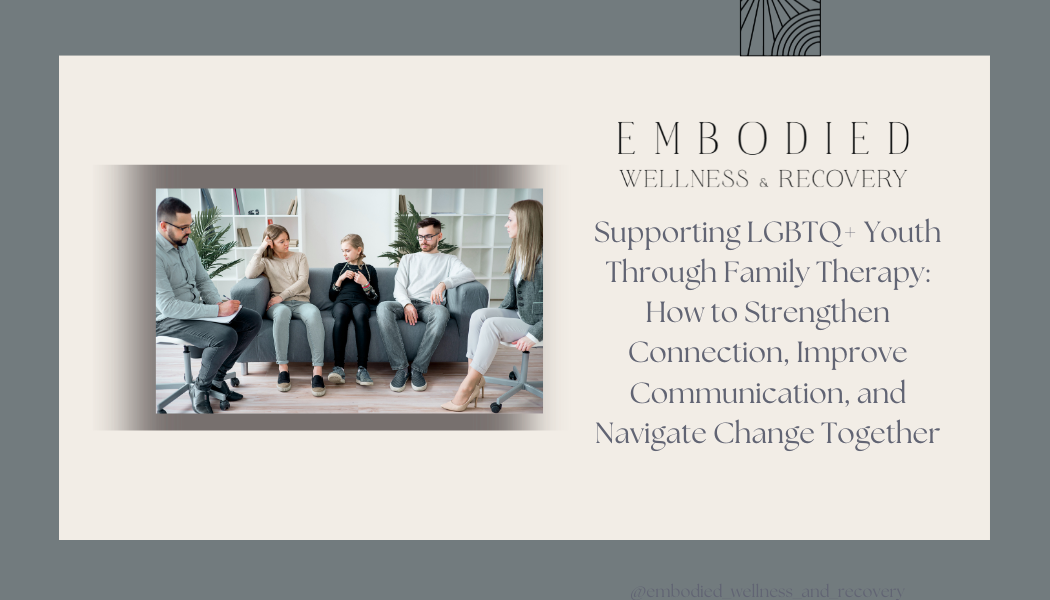
Supporting LGBTQ+ Youth Through Family Therapy: How to Strengthen Connection, Improve Communication, and Navigate Change Together
Supporting LGBTQ+ Youth Through Family Therapy: How to Strengthen Connection, Improve Communication, and Navigate Change Together
Supporting an LGBTQ+ child can bring questions, uncertainty, and emotional challenges for the entire family. Discover how family therapy, attachment science, and neuroscience can strengthen communication, rebuild trust, and preserve connection during times of change.
Learning that your child identifies as LGBTQ+ can bring a wide range of emotions. For many families, the first response is love. Soon after, however, other feelings may begin to surface.
Fear.
Confusion.
Grief over expectations that may be changing.
Worry about your child's future.
Uncertainty about what to say.
Concern that every conversation might make things worse.
Perhaps you have found yourself asking:
— How do I support my child without saying the wrong thing?
— Why do our conversations end in conflict?
— How do I stay connected when we seem to be growing apart?
— What if I accidentally push my child away?
— How can our family move through this together?
These questions are more common than many families realize. While much of the public conversation centers on identity, one of the most significant challenges families face is preserving emotional connection as they navigate change. Family therapy can provide a safe space to strengthen communication, rebuild trust, and help every family member feel heard without losing sight of what matters most: your relationship.
The Challenge Is Often About Connection, Not Love
Many parents deeply love their child while simultaneously feeling overwhelmed by unfamiliar emotions and questions. Likewise, many LGBTQ+ youth long for acceptance while fearing misunderstanding, disappointment, or rejection.
The result can be a painful cycle:
Parents become anxious. Children become guarded. Communication deteriorates. Both sides begin to protect themselves rather than connect with one another. The problem is rarely a lack of love. More often, it is a lack of emotional safety during difficult conversations.
Why Conversations Become So Difficult
From a neuroscience perspective, emotionally charged conversations activate the brain's threat detection system. When people perceive criticism, rejection, shame, or emotional danger, the amygdala becomes more active while the parts of the brain responsible for curiosity, empathy, flexible thinking, and problem-solving become less accessible (Siegel, 2020).
This happens to parents. It happens to children. Suddenly, everyone is reacting rather than listening. One person may withdraw. Another may become defensive. Someone else may attempt to fix, persuade, or avoid the conversation altogether.
Without realizing it, every member of the family is trying to protect themselves. Understanding this changes how we view conflict.
Rather than asking, "Who's right?"
We begin asking:
"What does each person's nervous system need in order to feel safe enough to connect?"
Family Therapy Helps Restore Emotional Safety
Family therapy is not about deciding who is correct. It is about strengthening the relationships that allow difficult conversations to occur with greater understanding and compassion.
Research consistently demonstrates that family acceptance is associated with better mental health outcomes, lower rates of depression, reduced suicide risk, and greater overall well-being among LGBTQ+ youth (Ryan et al., 2010).
Family therapy creates opportunities to:
— Improve communication
— Increase emotional safety
— Repair misunderstandings
— Strengthen attachment
— Reduce conflict
— Foster empathy
— Develop healthier patterns of interaction
The goal is not perfection. The goal is connection.
Understanding Attachment During Times of Change
Attachment theory reminds us that secure relationships are built when people consistently experience safety, responsiveness, and emotional availability. Periods of transition naturally place strain on attachment systems.
Parents may fear:
"Will my child still trust me?"
Children may fear:
"Will my family still accept me?"
These fears often remain unspoken. Instead, they appear as arguments, withdrawal, silence, or emotional distance. Family therapy helps bring these deeper concerns into the open where they can be explored with compassion rather than criticism.
Common Family Experiences
Many families entering therapy describe situations such as:
"We used to talk about everything."
"Now every conversation feels tense."
"I'm afraid of saying the wrong thing."
"My child doesn't tell me anything anymore."
"We're walking on eggshells."
"My spouse and I disagree about how to respond."
These experiences are understandable. They also represent opportunities for growth.
What Neuroscience Teaches About Emotional Safety
The nervous system constantly asks one question:
Am I safe?
When family members experience emotional safety, the brain becomes more capable of:
— Listening
— Reflecting
— Regulating emotions
— Showing empathy
— Solving problems
— Remaining curious
When emotional safety decreases, the nervous system shifts toward self-protection.
People become more likely to:
— Defend
— Criticize
— Withdraw
— Shut down
— Escalate conflict
Family therapy helps slow these interactions long enough for new patterns to develop.
Practical Ways Families Can Strengthen Connection
1. Lead With Curiosity
Replace assumptions with questions.
Instead of:
"Why would you do this?"
Try:
"Help me understand what this experience has been like for you."
Curiosity communicates respect.
2. Listen Before Solving
Many parents immediately search for solutions.
Children often need understanding first.
Feeling heard reduces defensiveness and creates space for meaningful dialogue.
3. Separate Intent From Impact
Families sometimes become stuck because everyone focuses on intentions.
Parents may say:
"I didn't mean to hurt you."
Children may respond:
"But it still hurt."
Both statements can be true. Repair begins when we acknowledge impact without assuming harmful intent.
4. Allow Room for Growth
Parents are learning. Children are learning. Families are learning together. Mistakes will happen. Repair matters more than perfection.
5. Protect the Relationship
Even during disagreement, remind one another:
"We're on the same team."
Shared humanity strengthens attachment.
When Trauma Is Part of the Story
For some families, conversations about identity occur alongside previous experiences of trauma, family conflict, rejection, or emotional wounds. These experiences can heighten sensitivity to misunderstanding and make conversations feel especially intense. Trauma-informed family therapy recognizes that current interactions are often influenced by past experiences. Rather than viewing emotional reactions as character flaws, therapy helps families understand them as nervous system responses that can become more flexible through safety, connection, and repair.
Family Therapy Is About More Than Identity
Although families may initially seek therapy because of LGBTQ+ concerns, many discover that therapy strengthens areas far beyond those conversations.
They develop:
— Better communication
— Greater empathy
— Stronger boundaries
— Healthier conflict resolution
— Increased emotional regulation
— More secure attachment
— Deepertrust
These skills benefit every relationship within the family.
How Embodied Wellness and Recovery Can Help
At Embodied Wellness and Recovery, we believe meaningful healing occurs within the context of safe relationships. Our clinicians specialize in trauma-informed, neuroscience-based care that integrates attachment theory, nervous system regulation, family systems, and evidence-based therapeutic approaches. Whether your family is navigating communication challenges, anxiety, trauma, parenting concerns, or supporting an LGBTQ+ loved one, we create a compassionate environment where every family member has the opportunity to feel seen, heard, and respected.
Our goal is not simply to reduce conflict. It is to help families cultivate deeper trust, stronger emotional bonds, and healthier patterns of connection that endure long after therapy ends.
Creating Safe, Supportive Relationships
Families do not grow stronger because they avoid difficult conversations. They grow stronger because they learn how to have them with honesty, curiosity, compassion, and respect. Supporting an LGBTQ+ child is not about having every answer. It is about creating a relationship where questions can be asked, emotions can be expressed, mistakes can be repaired, and love remains present through every season of change. The most enduring message a family can communicate is this: "Our relationship is strong enough to grow alongside us."
Reach out to schedule a complimentary 20-minute consultation with our team of therapists, trauma specialists, somatic practitioners, or relationship experts and start working towards integrative, embodied healing today.
📞 Call us at (310) 651-8458
📱 Text us at (310) 210-7934
📩 Email us at admin@embodiedwellnessandrecovery.com
🔗 Visit us at www.embodiedwellnessandrecovery.com
👉 Check us out on Instagram @embodied_wellness_and_recovery
🌍 Explore our offerings at Linktr.ee: https://linktr.ee/laurendummit
References
American Psychological Association. (2024). Guidelines for psychological practice with sexual minority persons and gender diverse people.
Diamond, G. M., Diamond, G. S., & Levy, S. (2014). Attachment-based family therapy for depressed adolescents. American Psychological Association.
Porges, S. W. (2021). Polyvagal safety: Attachment, communication, self-regulation. W. W. Norton & Company.
Ryan, C., Russell, S. T., Huebner, D., Diaz, R., & Sanchez, J. (2010). Family acceptance in adolescence and the health of LGBTQ young adults. Journal of Child and Adolescent Psychiatric Nursing, 23(4), 205-213.
Siegel, D. J. (2020). The developing mind: How relationships and the brain interact to shape who we are (3rd ed.). Guilford Press.