
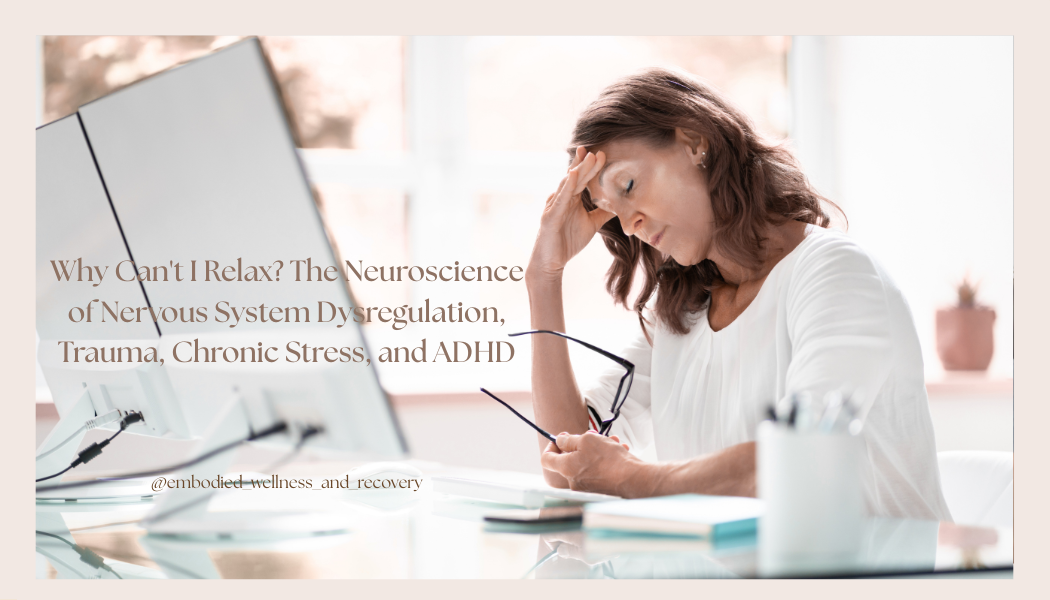
Why Can't I Relax? The Neuroscience of Nervous System Dysregulation, Trauma, Chronic Stress, and ADHD
Why Can't I Relax? The Neuroscience of Nervous System Dysregulation, Trauma, Chronic Stress, and ADHD
Why can't I relax even when life is calm? Discover how trauma, chronic stress, ADHD, and nervous system dysregulation keep your body in survival mode. Learn the neuroscience behind chronic activation and how evidence-based, somatic therapy can help restore emotional balance.
You finally have a free evening. Your to-do list is finished. The house is quiet. No one needs anything from you. Yet instead of feeling peaceful, your mind races. Your shoulders remain tense. You pace the house, scroll your phone, reorganize the pantry, or immediately look for the next task.
If this sounds familiar, you may find yourself asking:
— Why can't I relax?
— Why do I always feel on edge?
— Why does resting make me anxious?
— Why do I feel guilty when I'm not being productive?
— Why can't I stop thinking?
— Why does my body feel tense even when nothing is wrong?
— Is this anxiety, trauma, ADHD, or something else?
For many people, the inability to relax is deeply frustrating. It can also feel confusing. Friends tell you to "just slow down" or "take a vacation," yet your body seems unwilling to cooperate. The truth is that relaxation is not simply a choice. It is a nervous system state. When your brain and body have spent months or years preparing for danger, they often need more than positive thinking to experience genuine calm.
Relaxation Is a Neurobiological Process
Many people assume relaxation is the absence of stress. Neuroscience tells a different story. Relaxation depends on your autonomic nervous system's ability to shift from survival into safety.
Your autonomic nervous system constantly scans both your environment and your body for signs of danger through processes that occur largely outside conscious awareness. This automatic evaluation influences your heart rate, breathing, muscle tension, digestion, emotional state, and ability to connect with others.
When your nervous system perceives safety, it supports:
— Emotional regulation
— Flexible thinking
— Curiosity
— Creativity
— Restful sleep
— Digestion and recovery
When it perceives danger, it prioritizes survival instead.
What Is Nervous System Dysregulation?
Nervous system dysregulation occurs when the brain and body remain stuck in protective survival patterns long after the original threat has passed. Instead of responding flexibly to changing circumstances, the nervous system becomes chronically activated or chronically shut down.
People experiencing chronic activation often describe:
— Feeling constantly "wired"
— Muscle tension
— Difficulty sitting still
— Irritability
— Trouble falling asleep
— Feeling overwhelmed by small stressors
Others fluctuate between feeling intensely activated and emotionally exhausted, creating a cycle that can feel impossible to interrupt.
Why Trauma Makes Relaxation Feel Unsafe
Trauma changes the brain. Research demonstrates that traumatic experiences can increase activity in brain regions responsible for detecting threat while reducing activity in areas involved in executive functioning and emotional regulation (van der Kolk, 2014).
This adaptation is remarkably intelligent. If your nervous system learned that danger could appear unexpectedly, staying alert increased your chances of survival. The challenge is that survival strategies often persist long after they are needed.
Many trauma survivors notice something surprising: Life finally becomes stable, yet their anxiety remains. The body continues preparing for danger because it has not yet learned that the present differs from the past.
Chronic Stress Can Train the Brain to Stay Activated
Trauma is not the only pathway to nervous system dysregulation. Long-term caregiving, demanding careers, financial uncertainty, chronic illness, relationship conflict, discrimination, or years of emotional overload can also recalibrate the stress response.
Research on chronic stress shows prolonged activation of the hypothalamic-pituitary-adrenal axis can contribute to increased cortisol, sleep disturbances, impaired concentration, mood changes, and greater sensitivity to future stressors (McEwen, 2007). In other words, the more time your body spends preparing for emergencies, the more difficult it becomes to recognize when the emergency has ended.
ADHD and the Challenge of Relaxing
Many adults with ADHD describe a similar struggle. Even when they want to relax, their brains continue generating ideas, noticing distractions, shifting attention, and seeking stimulation. This does not mean relaxation is impossible. It means the nervous system may require different supports.
Research suggests ADHD involves differences in attention regulation, executive functioning, and dopamine pathways, which can contribute to restlessness, difficulty transitioning between activities, and challenges with emotional regulation (Barkley, 2015). For individuals with both ADHD and trauma, these patterns can become even more complex.
Why Rest Can Feel Uncomfortable
Have you ever noticed that the moment you stop moving, uncomfortable thoughts or emotions suddenly appear? This experience is incredibly common. Constant productivity sometimes becomes an unconscious strategy for avoiding emotional discomfort.
Others discover they feel guilty whenever they rest. Perhaps you grew up believing your worth depended on achievement. Maybe slowing down was criticized. Perhaps calm was so unfamiliar that your body learned to associate stillness with vulnerability rather than restoration.
The result? Rest begins to feel emotionally unsafe.
The Brain Prefers Familiarity
One of neuroscience's most important discoveries is that the brain constantly predicts what will happen next. It relies heavily on familiar patterns. If busyness, vigilance, or overfunctioning became your baseline, your nervous system may interpret those states as "normal." Calm, on the other hand, may initially feel foreign. This does not mean calm is wrong. It means your brain has not had enough opportunities to learn that safety can also become familiar.
Why Mindset Alone Often Isn't Enough
Many people become discouraged because they understand their anxiety intellectually. They know they are safe. Yet their body does not feel safe.
This disconnect exists because trauma and chronic stress are stored not only as memories but also as physiological patterns involving muscle tension, breathing, heart rate variability, hormonal responses, and implicit memory. Insight is important. So is working directly with the nervous system.
The Science of Nervous System Regulation
The encouraging news is that the nervous system remains remarkably adaptable throughout life. This capacity, known as neuroplasticity, allows the brain to reorganize itself through repeated experiences. Over time, consistent experiences of safety, supportive relationships, body awareness, and emotional regulation can strengthen neural pathways associated with resilience and flexible responding. Rather than forcing yourself to relax, nervous system regulation focuses on gradually expanding your body's ability to experience calm without becoming overwhelmed.
What Actually Helps?
There is no single strategy that works for everyone. Instead, effective treatment often combines multiple approaches that address both the brain and the body.
Research supports interventions such as:
— Trauma-informed psychotherapy
— EMDR
— Mindfulness-based interventions
— Regular movement and exercise
— Breathwork that supports nervous system regulation
— Healthy sleep routines
— Meaningful social connection
The goal is not to eliminate stress altogether. It is to increase your nervous system's flexibility so it can move more easily between activation and restoration.
How Embodied Wellness and Recovery Can Help
At Embodied Wellness and Recovery, we understand that chronic activation is not simply a matter of willpower. It is often the result of a nervous system that adapted brilliantly to overwhelming experiences.
Our clinicians integrate neuroscience, trauma-informed psychotherapy, somatic therapy, EMDR, attachment-based treatment, and relationship-focused interventions to help clients understand the deeper roots of chronic stress, anxiety, emotional dysregulation, intimacy challenges, and trauma.
Whether you are navigating childhood trauma, chronic stress, ADHD, relationship difficulties, or the lingering effects of overwhelming life experiences, treatment is designed to support both cognitive understanding and nervous system repair. Because lasting change happens when the brain, body, and relationships begin working together.
Calm Is a Skill Your Nervous System Can Learn
If relaxing feels impossible, it does not necessarily mean you are doing something wrong. It may mean your nervous system has become exceptionally skilled at protecting you. The same brain that learned to anticipate danger is capable of learning something new.
With repeated experiences of safety, connection, and regulation, your body can begin to recognize that stillness is not the absence of productivity or preparedness. It can become the foundation for clearer thinking, healthier relationships, deeper intimacy, greater resilience, and a life that no longer requires constant vigilance to feel secure.
Reach out to schedule a complimentary 20-minute consultation with our team of therapists, trauma specialists, somatic practitioners, or relationship experts and start working towards integrative, embodied healing today.
📞 Call us at (310) 651-8458
📱 Text us at (310) 210-7934
📩 Email us at admin@embodiedwellnessandrecovery.com
🔗 Visit us at www.embodiedwellnessandrecovery.com
👉 Check us out on Instagram @embodied_wellness_and_recovery
🌍 Explore our offerings at Linktr.ee: https://linktr.ee/laurendummit
References
Barkley, R. A. (2015). Attention deficit hyperactivity disorder: A handbook for diagnosis and treatment (4th ed.). Guilford Press.
McEwen, B. S. (2007). Physiology and neurobiology of stress and adaptation: Central role of the brain. Physiological Reviews, 87(3), 873-904.
Porges, S. W. (2011). The polyvagal theory: Neurophysiological foundations of emotions, attachment, communication, self-regulation. W. W. Norton & Company.
Siegel, D. J. (2020). The developing mind: How relationships and the brain interact to shape who we are (3rd ed.). Guilford Press.
van der Kolk, B. A. (2014). The body keeps the score: Brain, mind, and body in the healing of trauma. Viking.